
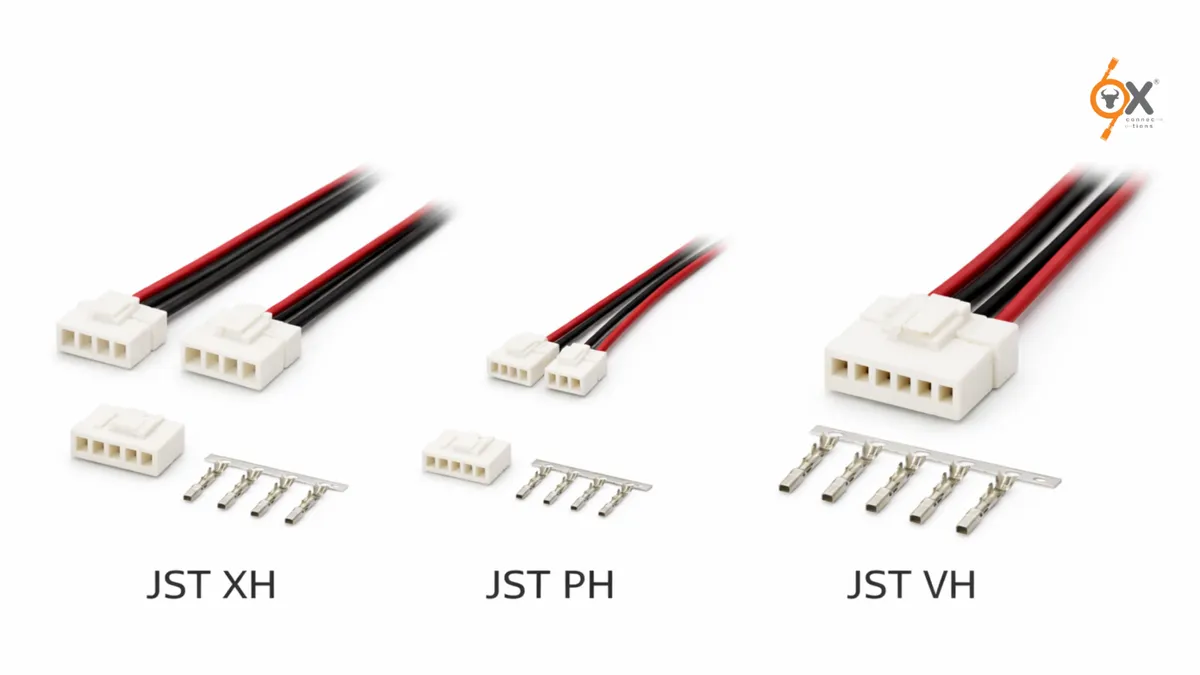
This guide breaks down the JST XH vs JST PH vs JST VH connectors, focusing on real Indian use cases, practical selection tips, and how to avoid costly mistakes.
In India’s rapidly evolving electronics ecosystem – from Mumbai’s dense manufacturing clusters to emerging industrial hubs across the country – choosing the right connector is no longer a minor decision. It directly impacts product reliability, performance, and long-term maintenance.
Among the most widely used options are JST connectors, especially the XH, PH, and VH series. While they may look similar at a glance, their real-world applications differ significantly.
If you’re an engineer, OEM, or procurement lead working with Ox connection solutions in India, understanding these differences isn’t just technical – it’s strategic.
Why JST Connector Selection Matters in India
In markets like Mumbai, Pune, and Noida, electronics are often exposed to heat, humidity, voltage fluctuations, and tight design constraints.
Using the wrong connector can lead to overheating, loose connections, and product failures – something no manufacturer can afford.
That’s why businesses working with Ox connectors in India prioritise not just compatibility, but fit-for-purpose selection.
Understanding the Basics: Not All JST Connectors Are the Same
At a surface level, all three fall under wire-to-board connectors. But their pitch size, current capacity, and use cases vary widely.
If you’re searching for JST connector types and differences, here’s the practical breakdown that actually helps in decision-making.
JST PH Connectors: Compact and Built for Low-Power Systems
The PH series is where miniaturisation meets efficiency.
With a 2.0 mm pitch, PH connectors are designed for tight PCB layouts where space is limited. In India, they’re commonly seen in LED lighting systems, small consumer electronics, and IoT devices.
From a Mumbai manufacturing lens, PH connectors are ideal when your design is compact, power requirements are low, and cost efficiency matters.
However, they typically handle lower current (around 2A), so overloading them can create heating issues—something often overlooked in fast-paced production environments.
For companies sourcing via Ox connection networks, PH connectors are widely used in high-volume, low-power applications.
JST XH Connectors: The Balanced Choice for Everyday Applications
If PH is compact, XH is the middle ground.
With a 2.5 mm pitch, XH connectors offer better current handling (up to ~3A), stronger connections, and easier assembly handling.
In India, especially across Mumbai and Pune manufacturing units, XH connectors are widely used in home appliances, PCB assemblies, and industrial control boards.
When businesses look up JST connector specifications (pitch and current rating), XH often becomes the default reference because it balances size and performance without overengineering.
Ox ensures consistent quality here, which is critical for long-term reliability in Indian conditions.
JST VH Connectors: Built for High Power and Industrial Use
VH connectors are designed for higher load applications.
With a 3.96 mm pitch, they support higher current (up to ~10A) and offer stronger mechanical connections, making them suitable for industrial-grade usage.
In India, VH connectors are commonly used in power supply units, solar installations, industrial machinery, and EV components.
In Mumbai-based industrial setups, where machines run continuously under load, VH connectors help avoid downtime and ensure stable performance.
For high-power applications, VH isn’t optional—it’s essential. Ox-backed VH connectors are particularly valued for their secure locking and durability.
Real Difference: Application Fit Over Appearance
When comparing JST XH vs PH vs VH connectors, the biggest mistake is focusing only on physical size.
The real difference lies in current capacity, application environment, and mechanical strength.
A compact IoT device will not benefit from a VH connector, just as a solar system cannot rely on a PH connector.
Applications in India: Where Each Connector Fits Best
PH connectors are used in compact, cost-sensitive electronics like LED drivers and small devices.
XH connectors dominate general applications like appliances, control boards, and PCB systems.
VH connectors are used in power-heavy sectors such as solar energy, industrial automation, and EV infrastructure.
This is where understanding JST connector types and differences becomes practically useful for Indian manufacturers.
How to Choose the Right JST Connector
Instead of overcomplicating, focus on three things:
Current requirement, available PCB space, and operating environment.
Low current systems work well with PH, moderate applications with XH, and high-load systems require VH connectors.
In fast-paced environments like Mumbai manufacturing, making the right choice quickly is critical—and Ox helps streamline that process.
Why Ox Connectors Make a Difference in India
In India, the challenge is not just availability – it’s consistency.
Ox ensures reliable sourcing, standardised specifications, and compatibility with Indian operating conditions.
Whether it’s a startup building IoT devices or a large-scale manufacturer working on solar systems, Ox connectors help reduce failures, returns, and maintenance issues.
Common Mistakes Indian Manufacturers Make
A few common issues include using PH connectors beyond their capacity, overusing VH connectors unnecessarily, and ignoring pitch compatibility during PCB design.
Understanding JST connector specifications (pitch and current rating) early in the design phase helps avoid these costly mistakes.
Final Thoughts
The discussion around JST XH vs PH vs VH connectors isn’t about which is better – it’s about which is right for your application.
In India, especially in manufacturing hubs like Mumbai, choosing the wrong connector can lead to serious performance issues.
By understanding JST connector types and differences, businesses can build systems that are reliable, efficient, and cost-effective.
With Ox ensuring quality and consistency, connector selection becomes a strategic advantage rather than a technical hurdle.
FAQs
What is the main difference between JST PH, XH, and VH connectors?
The difference lies in pitch size and current capacity, which determines their application.
Which JST connector is best for industrial use in India?
VH connectors are best suited for high-power industrial applications.
Are JST connectors suitable for Indian conditions?
Yes, especially when sourced through reliable providers like Ox, they perform well under Indian environmental conditions.