
In electronics manufacturing, connectors rarely get the spotlight – but they’re often the reason projects slow down. Across industries like solar, EV, home appliances, and medical devices, JST connectors have been the default choice for years. They’re reliable, standardized, and widely accepted.
But today, OEMs in India are facing a different reality – rising costs, long lead times, and rigid supply chains. And that’s exactly where companies like OX are stepping in to change how connectors are sourced and used.
What Are the Types of JST Connectors and Why Are They Under Review?
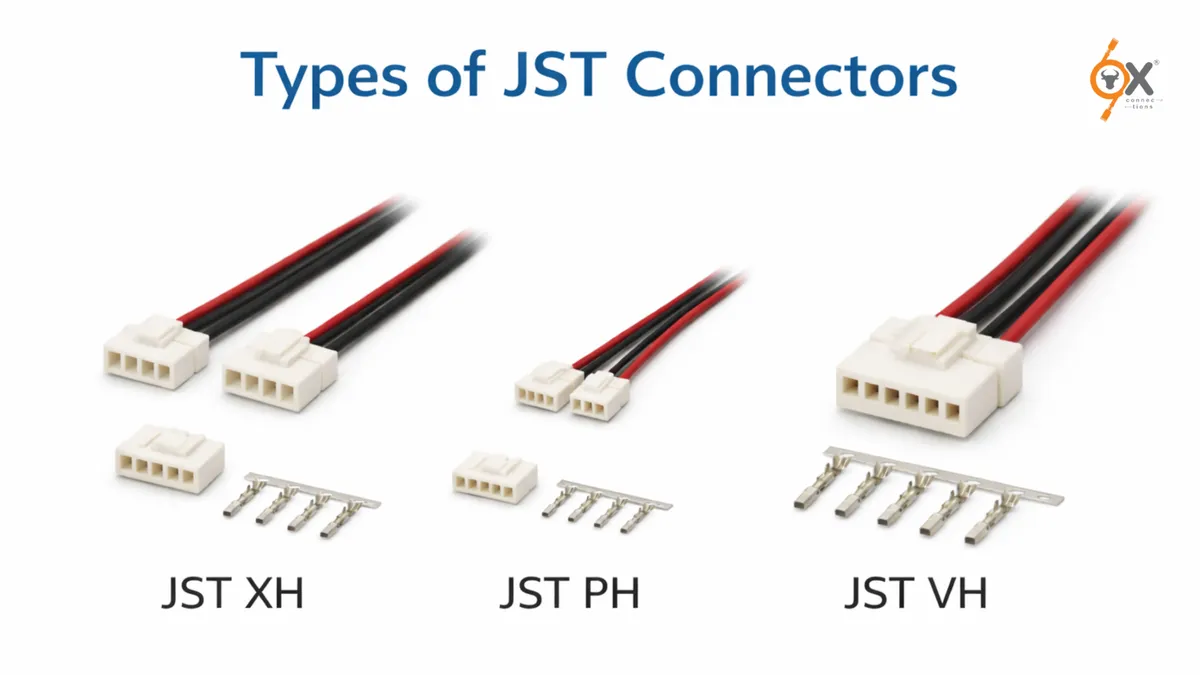
JST connector types include widely used series like XH, PH, and VH, each designed for specific electrical loads and design requirements.
They’ve long been trusted by engineers. But the challenge today isn’t performance – its practicality.
OEMs are increasingly questioning:
- Why does a standard connector come at such a high price?
- Why does it take weeks to procure?
- Why are bulk orders mandatory?
This shift in thinking is what’s driving attention toward OX, which offers the same compatibility without these limitations.
XH Series: Reliable but No Longer the Only Practical Choice
The XH series is one of the most commonly used connectors across applications.
What makes XH popular:
- Balanced pitch size (2.5mm) suitable for multiple designs
- Reliable current handling for general electronics
- Widely accepted across industries
Where challenges begin:
- Pricing becomes expensive at scale
- Lead times can disrupt production schedules
This is where many OEMs are quietly transitioning to OX equivalents. The reason is simple:
- Same fit and performance
- Nearly half the price
- Immediate availability
Without changing the design, they’re improving the economics.
PH Series: Compact, Efficient – But Often Delayed
PH connectors are ideal for compact designs where space is limited.
Why engineers prefer PH:
- Smaller pitch (2.0mm)
- Perfect for tight PCB layouts
- Common in batteries and wearables
The real-world issue:
- Hard to source quickly in large quantities
- Frequent delays in supply
OX addresses this gap directly by ensuring ready stock availability, which allows OEMs to continue production without waiting on imports or distributor timelines.
VH Series: Built for Power, But Comes with Supply Pressure
For high-current applications, VH connectors are essential.
Why VH is widely used:
- Handles higher current loads (up to 10A)
- Suitable for industrial and power-heavy systems
- Common in solar, EVs, and appliances
The operational challenge:
- Long procurement cycles
- High MOQ requirements
With OX VH-compatible connectors, manufacturers are now able to:
- Maintain performance standards
- Reduce procurement delays
- Avoid overstocking inventory
Why JST connector pinout Still Needs Attention
Even when switching to alternatives like OX, understanding the JST connector pinout is critical.
Pinout determines:
- How current flows through the system
- Signal alignment and accuracy
- Overall system safety
Ignoring this can lead to:
- System malfunctions
- Rework and redesign costs
- Production delays
The advantage with OX is that connectors are designed as drop-in compatible, meaning no redesign is needed just better sourcing.
Looking Beyond Datasheets: JST connector specifications in Real Manufacturing
On paper, JST connector specifications focus on:
- Voltage and current ratings
- Pitch size
- Material durability
- Performance standards
But in real manufacturing environments, OEMs look beyond specifications.
They care about:
- Availability when needed
- Cost per unit at scale
- Flexibility in ordering
This is where OX stands out – not by changing the specs, but by removing the friction around them.
The Real Problem Isn’t the Connector – It’s the Supply Chain
Let’s break down what OEMs actually deal with:
High pricing
- JST connectors significantly increase BOM costs
- OX offers nearly 50% cost savings without compromising performance
Long lead times
- Weeks or months of waiting delay production
- OX ensures no lead time with ready stock
High MOQs
- Bulk buying locks working capital
- OX offers flexible ordering for better inventory control
These are not minor inconveniences – they directly impact business efficiency.
Where OX Is Making a Real Difference
Across industries in India, OX is already becoming a preferred choice.
In solar and renewable energy
- Faster sourcing helps meet project deadlines
- Lower costs improve overall margins
electric vehicles
- Reliable supply ensures uninterrupted production
- Consistent quality supports safety requirements
home appliances
- Cost savings at scale improve competitiveness
medical devices
- Certified connectors ensure reliability without delays
JST vs OX: What Actually Matters to OEMs
Instead of focusing on brand names, OEMs are now focusing on outcomes.
With JST:
- You get proven performance
- But higher costs and longer wait times
With OX:
- You get the same compatibility
- At a significantly lower cost
- With immediate availability
- And certified quality (UL, RoHS, CE)
The shift is not about replacing JST—it’s about optimizing operations.
Final Thoughts: From Standard Choice to Smart Choice
JST connectors like XH, PH, and VH have been industry standards for a reason – they work.
But today’s manufacturing environment demands more than just functionality.
It demands:
- Speed
- Cost efficiency
- Flexibility
And that’s where OX fits in naturally.
Because the smartest upgrade isn’t changing your design – it’s improving how you source what’s already working.
Explore Smarter Alternatives
If you’re currently using JST connectors, it may be time to rethink your sourcing strategy.
Look for:
- XH, PH, VH compatible connectors
- Ready stock availability
- Cost-effective solutions
With OXconnection, you don’t just match industry standards – you move ahead of them.