
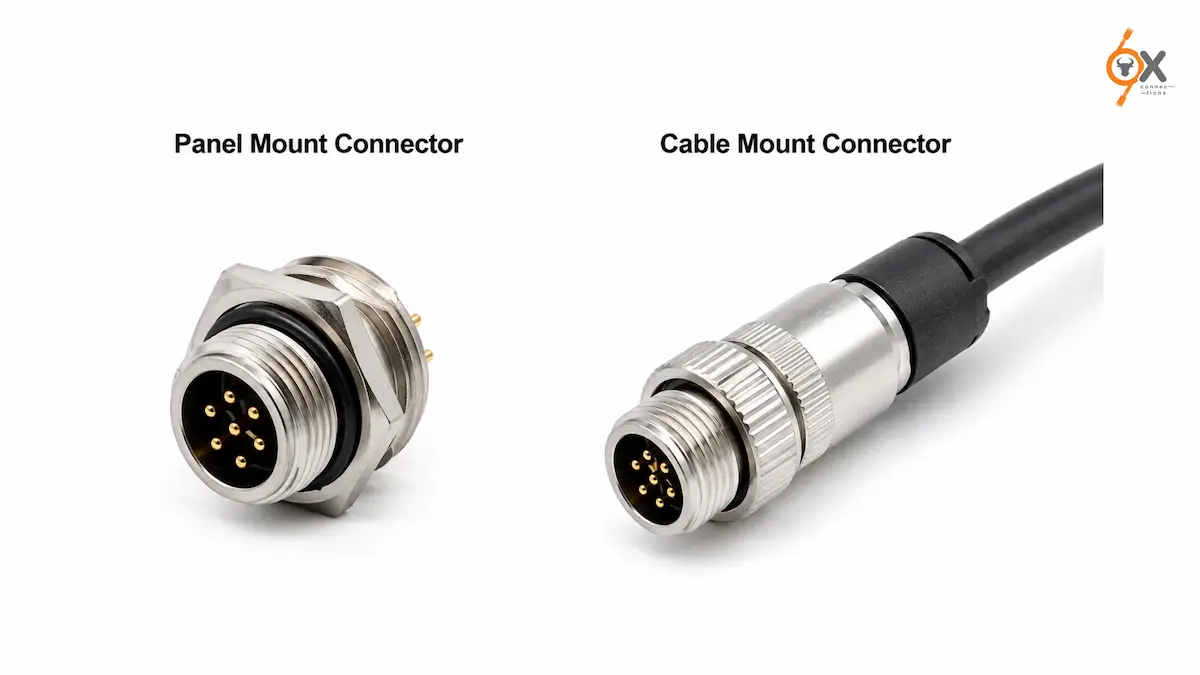
This Panel Mount vs Cable Mount Connectors selection guide explains the key differences, applications, advantages, and design considerations that help engineers choose the most suitable mounting style for their equipment.
When designing industrial equipment, choosing the right connector is about more than electrical connectivity. The connector mounting style directly impacts reliability, maintenance accessibility, assembly efficiency, and long-term product performance. Yet many engineers and procurement teams focus primarily on electrical requirements while overlooking one of the most important design decisions: whether to use a panel mount connector or a cable mount connector.
Both connector styles serve essential roles across industrial automation, renewable energy systems, medical equipment, test and measurement devices, transportation systems, and outdoor installations. However, selecting the wrong mounting configuration can complicate installation, increase maintenance requirements, and create unnecessary challenges during manufacturing and servicing.
For OEMs evaluating SP Series connectors, understanding the differences between panel mount and cable mount configurations is critical to making the right specification decision.
Understanding Panel Mount and Cable Mount Connectors
Before comparing the two options, it is important to understand their basic functions.
A panel mount connector is designed to be permanently installed through a panel, enclosure, housing, or equipment chassis. The connector becomes a fixed interface point, allowing cables to be connected and disconnected externally.
A cable mount connector, on the other hand, is attached directly to a cable assembly. It provides flexibility by enabling connection to a panel-mounted receptacle or another mating connector.
In many industrial systems, both connector types work together as a complete connectivity solution.
For example:
- The machine enclosure may contain a panel mount connector.
- The field cable may use a cable mount connector.
- Both mate together to establish a secure electrical connection.
This combination is commonly found in SP Series circular connector applications.
What Is a Panel Mount Connector?
A panel mount connector is designed to be fixed to an enclosure wall, control panel, equipment housing, or cabinet.
Once installed, it becomes an integrated part of the equipment and serves as the primary connection interface.
Common Applications
Panel mount connectors are frequently used in:
- Industrial control panels
- Automation equipment
- Renewable energy systems
- Medical devices
- Power distribution equipment
- Outdoor monitoring systems
- Communication equipment
Advantages of Panel Mount Connectors
Improved Equipment Organization
Panel mount connectors create a dedicated connection point, making system layouts cleaner and more organized.
Easier Maintenance
Technicians can quickly disconnect external cables without opening equipment enclosures.
Better Environmental Protection
When paired with appropriately rated connectors and enclosures, panel mount installations help maintain environmental sealing requirements.
Enhanced Mechanical Stability
Because the connector is secured to the equipment housing, stress is transferred to the panel rather than directly to internal wiring.
What Is a Cable Mount Connector?
A cable mount connector is attached directly to a cable assembly and is designed for mobility and flexibility.
Unlike panel-mounted solutions, cable mount connectors move with the cable and can be easily routed or replaced when necessary.
Common Applications
Cable mount connectors are widely used in:
- Sensor connections
- Robotics
- Portable equipment
- Field devices
- Testing systems
- Mobile machinery
- Industrial communication networks
Advantages of Cable Mount Connectors
Installation Flexibility
Cable mount connectors can be integrated into custom cable assemblies for unique routing requirements.
Simplified Replacement
If a cable becomes damaged, replacement can often be completed without modifying the equipment enclosure.
Adaptability
Cable mount solutions are suitable for applications where equipment movement or cable mobility is required.
Reduced Design Constraints
Engineers can optimize cable routing without being restricted by enclosure locations.
Panel Mount vs Cable Mount Connectors: Key Differences
1. Installation Method
Panel mount connectors are fixed directly onto equipment panels or housings.
Cable mount connectors are attached directly to cables and remain mobile.
The choice often depends on whether the connection point needs to remain stationary or flexible.
2. Mechanical Strength
Panel mount connectors generally offer superior mechanical stability because mounting hardware absorbs external forces.
Cable mount connectors rely more heavily on strain relief systems to protect the cable and termination points.
For equipment exposed to vibration, repeated mating cycles, or operator interaction, mechanical considerations become particularly important.
3. Maintenance Accessibility
Panel mount connectors typically provide a clearly defined service interface.
Technicians can access the connector externally without opening the equipment enclosure.
Cable mount connectors provide flexibility but may require cable tracing or disassembly depending on system design.
4. Cable Management
Panel mount installations often support cleaner cable management strategies.
Cable mount connectors provide greater routing flexibility but may require additional cable support mechanisms.
5. Environmental Protection
Both configurations can support demanding industrial environments when properly specified.
However, maintaining enclosure integrity often becomes easier when panel mount connectors are integrated into sealed equipment designs.
When Should You Choose a Panel Mount Connector?
Panel mount connectors are often the preferred option when:
The Equipment Requires a Permanent Interface
Machines that connect to external cables regularly benefit from a fixed connection point.
Enclosure Protection Is Important
Industrial equipment operating in challenging environments often relies on sealed panel interfaces.
Frequent Maintenance Is Expected
Panel-mounted interfaces simplify service procedures and reduce downtime.
Professional Appearance Matters
Many OEMs prefer panel mount connectors because they create a cleaner, more organized product design.
When Should You Choose a Cable Mount Connector?
Cable mount connectors are typically preferred when:
Cable Flexibility Is Required
Applications involving moving equipment, sensors, or robotics often require cable-mounted solutions.
Space Constraints Exist
Compact systems may not have sufficient room for panel-mounted interfaces.
Field Installation Flexibility Is Important
Cable-mounted solutions provide greater adaptability during deployment.
Custom Cable Assemblies Are Needed
Many specialized industrial systems require application-specific cable configurations.
SP Series Connectors and Mounting Options
SP Series connectors are commonly available in both panel mount and cable mount configurations, allowing engineers to design complete connectivity systems around specific application requirements.
Popular SP connector families such as SP13, SP17, and SP21 are frequently used in:
- Industrial automation
- Renewable energy systems
- Outdoor equipment
- Medical electronics
- Test and measurement instruments
- Communication systems
- Transportation equipment
The availability of both mounting styles gives OEMs flexibility when developing equipment architectures.
For example:
- Panel mount connectors can serve as the equipment interface.
- Cable mount connectors can be integrated into field wiring assemblies.
This combination helps create reliable and serviceable systems.
Common Selection Mistakes
Selecting Based Only on Connector Size
Connector dimensions are important, but mounting requirements should also influence selection decisions.
Ignoring Maintenance Requirements
A design that works well during manufacturing may become difficult to service later.
Overlooking Cable Routing
Poor cable management can lead to unnecessary strain and reduced connector life.
Focusing Only on Initial Installation
Engineers should evaluate how the connector will perform throughout the equipment lifecycle.
Failing to Standardize Across Product Lines
Using consistent connector platforms can simplify procurement, inventory management, and servicing.
Procurement Considerations for OEMs
Connector selection is not solely an engineering decision.
Procurement teams must also evaluate:
- Supply continuity
- Product availability
- Documentation support
- Certification requirements
- Quality consistency
- Long-term sourcing strategies
Working with suppliers that maintain inventory and support industrial customers can help reduce project delays and procurement challenges.
As product development cycles become increasingly demanding, many OEMs prioritize suppliers capable of supporting both prototype and production requirements while maintaining consistent quality standards.
Conclusion
Choosing between a panel mount vs cable mount connectors depends on the specific requirements of the application. Neither option is universally superior; the correct choice depends on installation requirements, maintenance expectations, environmental conditions, cable routing needs, and equipment architecture.
Panel mount connectors provide a fixed, organized, and service-friendly interface, making them ideal for many industrial and enclosure-based applications. Cable mount connectors offer flexibility, mobility, and adaptability, making them well suited for field wiring, sensor connections, and dynamic equipment.
For many OEM designs, the most effective solution is a combination of both configurations working together within a complete connector system.
OX Connections – Your Partner for SP Series Connector Solutions
OXConnections supplies a comprehensive range of SP Series connectors, including panel mount and cable mount configurations suitable for industrial, renewable energy, medical, automation, and OEM applications. Explore our SP Series connector range to identify the right connectivity solution for your design requirements.
As a stocking distributor, OX Connections supports OEMs with a complete SP Series portfolio, competitive cost structures, consistent top-notch quality, and a proven track record supplying multiple industries. Whether you are developing a new product or optimizing an existing design, our team can help you identify the most suitable connector solution for long-term performance and supply continuity. Contact OX Connections to discuss your application requirements and sourcing needs.