In this guide, we’ll look at how to select the right CPU Connector for Solar Inverter, key considerations for Charge Controller PCB designs, and what procurement teams should evaluate when sourcing connectors for solar products.
Are You Building Solar Inverters in India but Overlooking One of the Most Important PCB Components?
As India’s solar industry continues to expand, manufacturers are investing heavily in better inverter designs, smarter energy management systems, and more efficient electronics. Whether you’re producing solar inverters in Mumbai, assembling charge controllers in Pune, or sourcing components for renewable energy projects across the country, every component on the PCB plays a role in overall system reliability.
Yet one critical component often receives less attention than transformers, controllers, MOSFETs, or power modules – the connector.
A connector may seem like a small part of the overall design, but it serves as the vital link between the wiring harness and the PCB. If that connection is unreliable, difficult to service, or challenging to source consistently, it can create issues throughout the product lifecycle.
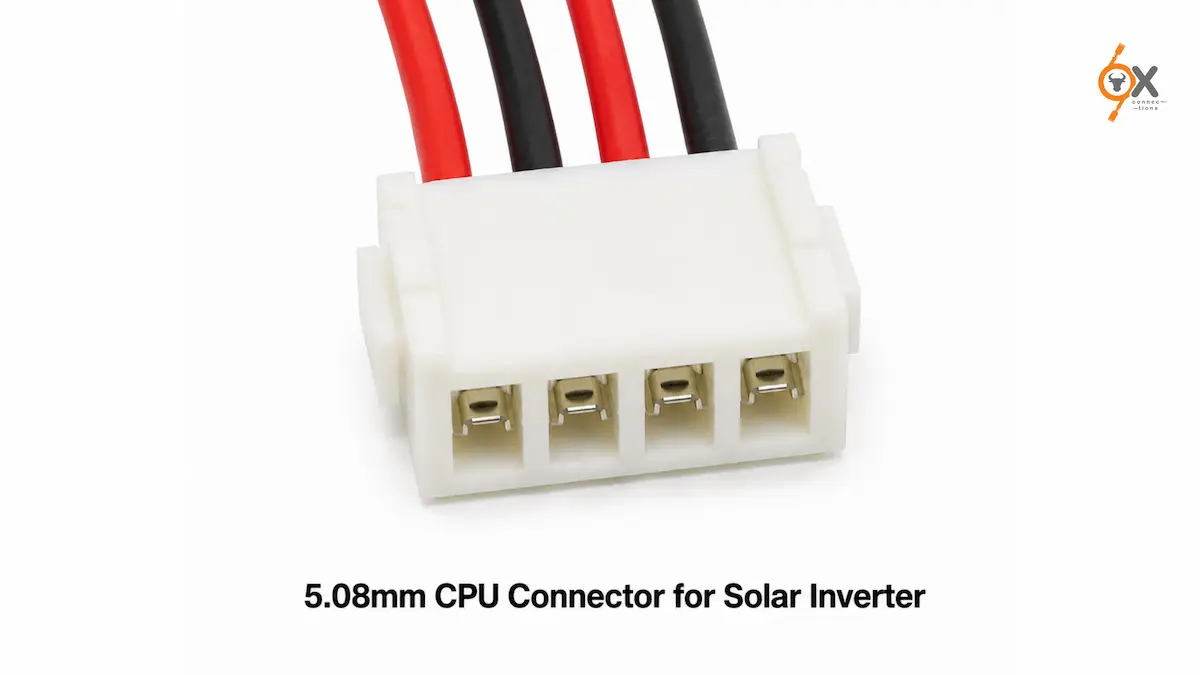
This is why the CPU Connector 5.08mm remains a popular Wire to Board Connector solution for solar electronics. Widely used in inverter boards, controller systems, and power management applications, it offers manufacturers a practical way to create organized, serviceable PCB connections.
Why the Right Solar Inverter Connector Matters
Solar equipment is expected to perform reliably in demanding operating conditions for years. While much of the engineering focus is placed on power conversion efficiency and system performance, connectivity is equally important.
A Solar Inverter Connector provides the interface between external wiring and the electronic control system. It helps ensure that power and signals move reliably between different parts of the equipment while supporting assembly and future maintenance.
In most solar systems, connectors are used across:
- Solar inverter PCBs
- Charge Controller PCB assemblies
- Battery management interfaces
- Monitoring systems
- Communication modules
- Power distribution circuits
Choosing the right Wire to Board Connector helps improve manufacturing efficiency while supporting long-term serviceability.
Understanding the CPU Connector 5.08mm
The CPU Connector 5.08mm is a Wire to Board Connector designed to connect wiring harnesses to PCB-mounted headers through a removable mating system.
The connector assembly generally consists of:
- PCB-mounted header
- Wire housing
- Crimp terminals
- Mating locking mechanism
The wires are crimped into terminals and inserted into the housing. The housing then plugs into the PCB header, creating a secure and removable connection.
This connectorized approach offers advantages over direct wiring because it allows assemblies to be connected, disconnected, serviced, and replaced more efficiently.
For manufacturers producing solar electronics at scale, these benefits can significantly improve production workflows.
Why Wire-to-Board Connectors Are Commonly Used in Solar Electronics
As solar product manufacturing grows across India, OEMs are increasingly looking for solutions that simplify assembly while maintaining product quality.
A Wire to Board Connector helps achieve this by creating a standardized connection system between wiring and PCBs.
Benefits include:
- Faster assembly processes
- Reduced wiring errors
- Easier maintenance
- Simplified servicing
- Better inventory standardization
- Improved production consistency
For manufacturers producing large volumes of solar equipment, these operational advantages often become just as important as technical specifications.
How a Wire-to-Board Connector Supports Charge Controller PCB Design
Every Charge Controller PCB contains multiple connections that manage power flow between solar panels, batteries, and loads.
These boards often require connections for:
- Solar panel inputs
- Battery interfaces
- Output circuits
- Monitoring functions
- Communication systems
Using a Wire to Board Connector allows manufacturers to create organized wiring systems that simplify both assembly and future servicing.
Because the connector system is removable, technicians can disconnect assemblies when performing diagnostics or replacing components without disturbing the entire wiring setup.
This can be particularly valuable in commercial and industrial solar installations where maintenance efficiency matters.
Key Factors When Selecting a Solar Inverter Connector
Choosing the right CPU Connector for Solar Inverter involves more than matching a footprint on a PCB.
Several practical factors should be considered during the design stage.
Application Requirements
The connector should suit the specific requirements of the inverter or controller being designed.
Residential, commercial, and industrial systems may have different connectivity requirements.
Pin Configuration
Different products require different connection layouts.
Selecting the appropriate pin configuration helps ensure compatibility while allowing for future design flexibility.
PCB Layout Considerations
Space on a PCB is always valuable.
Connector placement should support accessibility during assembly while maintaining an organized board layout.
Maintenance Requirements
Solar products are often expected to remain operational for many years.
A removable Wire to Board Connector makes future servicing and replacement significantly easier.
Standardization Opportunities
Many OEMs standardize connector families across multiple product lines.
This reduces inventory complexity and simplifies procurement planning.
Why OEMs Prefer Wire-to-Board Connectors for Manufacturing
Consider a solar inverter manufacturer producing thousands of units each month.
Without a connectorized approach, assembly teams may need to terminate individual wires directly during production.
With a Wire to Board Connector, wiring harnesses can be prepared separately and connected during final assembly.
This creates several advantages:
- Faster production throughput
- Reduced assembly time
- Better consistency
- Fewer wiring mistakes
- Simplified technician training
- Easier quality control
For growing manufacturers, these efficiencies can have a meaningful impact on overall operations.
India’s Growing Solar Manufacturing Ecosystem
India has become one of the world’s fastest-growing renewable energy markets.
Cities such as Mumbai, Pune, Ahmedabad, Chennai, Hyderabad, and Bengaluru have emerged as important hubs for electronics manufacturing and solar equipment production.
As domestic manufacturing expands, companies are paying greater attention to supply chain resilience.
Even a small component shortage can disrupt production schedules and delay customer deliveries.
Because of this, connector sourcing has become an increasingly important consideration for both engineering and procurement teams.
Common Sourcing Challenges for Solar Equipment Manufacturers
Many manufacturers focus heavily on selecting the right connector but spend less time evaluating sourcing risks.
Some common challenges include:
- Long lead times
- Inconsistent stock availability
- High minimum order quantities
- Product quality variations
- Production delays caused by supply shortages
These issues can create significant operational challenges, particularly when production schedules are tight.
This is why sourcing strategy should be considered early in the design process rather than after a product enters production.
What Procurement Teams Should Look For
When sourcing a Solar Inverter Connector or Wire to Board Connector, procurement teams should evaluate several factors.
Inventory Availability
Can the supplier support both current demand and future production growth?
Product Consistency
Will quality remain consistent across multiple orders and production cycles?
Supply Reliability
Can deliveries be maintained without extended delays?
Technical Support
Is support available when selecting connector configurations?
Scalability
Can the supplier support prototype requirements as well as production volumes?
A reliable supplier often becomes a strategic advantage for manufacturers looking to scale efficiently.
Why Standardization Delivers Long-Term Benefits
Many successful OEMs reduce complexity by standardizing connector platforms across multiple products.
Using the same Wire to Board Connector family can help simplify:
- Inventory management
- Procurement planning
- Technician training
- Production scheduling
- Spare parts support
The CPU Connector 5.08mm is frequently selected because it can be used across a wide variety of power electronics applications, including solar products.
This flexibility helps manufacturers streamline operations while reducing sourcing complexity.
Future Trends in Solar PCB Connectivity
As solar systems continue to become smarter and more feature-rich, PCB designs are evolving rapidly.
Manufacturers increasingly prioritize:
- Manufacturing efficiency
- Product reliability
- Serviceability
- Inventory optimization
- Supply chain stability
Connectorized designs continue to support these goals because they simplify production and maintenance while creating more organized electronic assemblies.
For many solar applications, the Wire to Board Connector remains one of the most practical and widely adopted connectivity solutions available.
Conclusion
Selecting the right CPU Connector for Solar Inverter is about more than simply connecting wires to a PCB.
Engineers must consider assembly requirements, maintenance accessibility, product reliability, and long-term sourcing stability. Procurement teams must ensure that the chosen Wire to Board Connector can be sourced consistently without creating supply chain risks.
For many inverter and Charge Controller PCB applications, the CPU Connector 5.08mm continues to be a trusted solution because it supports organized wiring, efficient assembly, and simplified servicing.
About OX Connections
OX Connections supplies connectivity solutions to OEMs, panel builders, electronics manufacturers, and renewable energy companies across India. Our portfolio includes wire-to-board connectors, board-to-board connectors, RF connectors, and industrial interconnect products designed to support reliable manufacturing and long-term supply requirements.
Why Choose OX for Your CPU Connector 5.08mm Requirements?
At OX, we maintain a large ready inventory of CPU Connector 5.08mm solutions, ensuring immediate dispatch for both development and production requirements. We proudly support OEMs and manufacturers across the solar, industrial electronics, power supply, automation, EV, and home appliance industries with best-in-market pricing, consistent top-notch quality, and dependable product availability.
Whether you’re developing a new solar inverter platform, scaling Charge Controller PCB production, or looking for a reliable Wire to Board Connector supplier, we’re here to support you with both sample quantities and bulk orders.
Get in touch with us today to request samples, discuss your application with our team, or receive a quotation for your bulk connector requirements.
Frequently Asked Questions
What is a CPU Connector 5.08mm?
CPU Connector 5.08mm is a Wire to Board Connector used to connect wiring harnesses to PCB-mounted headers in electronic equipment.
Where is a Solar Inverter Connector commonly used?
A Solar Inverter Connector is commonly used in solar inverter PCBs, charge controller boards, battery management systems, monitoring equipment, and power management circuits.
Why are wire-to-board connectors preferred in solar electronics?
A Wire to Board Connector simplifies assembly, improves serviceability, supports organized wiring, and helps manufacturers scale production efficiently.
What should procurement teams consider when sourcing connectors?
Inventory availability, quality consistency, technical support, supplier reliability, and long-term supply capability are all important considerations.
Can the CPU Connector 5.08mm be used in Charge Controller PCB applications?
Yes. The CPU Connector 5.08mm is widely used in Charge Controller PCB designs because it provides a practical and serviceable connection between wiring harnesses and PCB assemblies.