
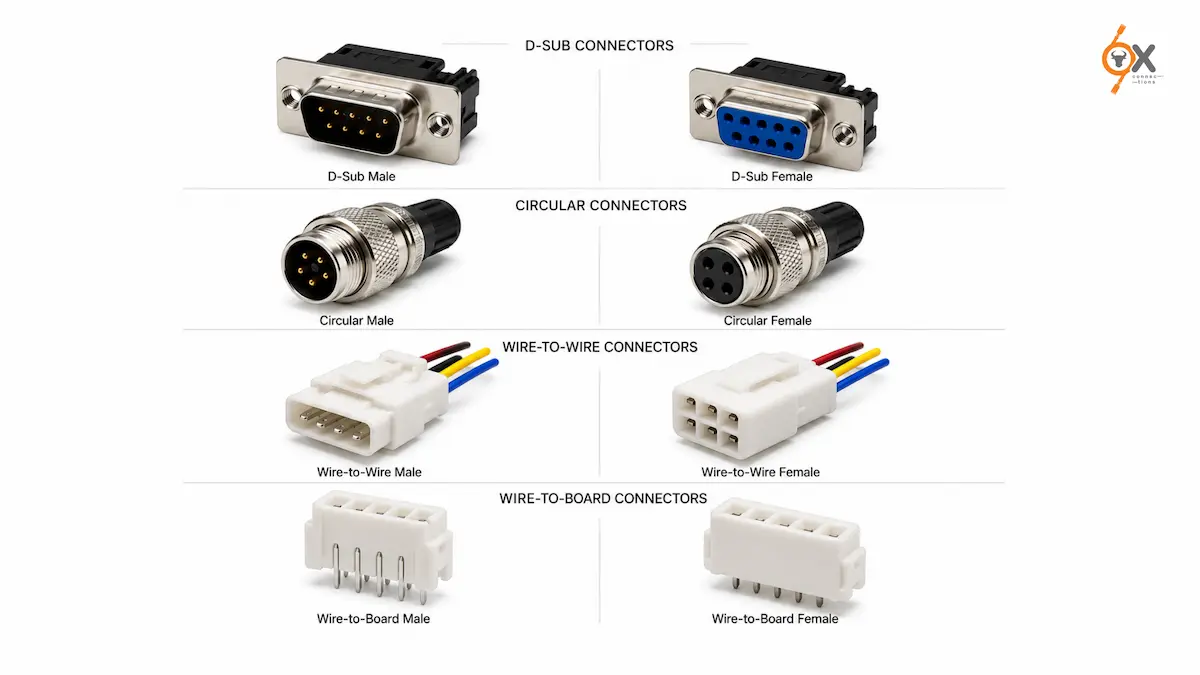
Ever picked up two connectors off a workbench in Bhiwandi and had absolutely no idea which one plugs into the other? You are not alone. It’s one of the most common questions electricians, panel builders, and even experienced procurement teams ask. What actually separates a Male vs Female Connectors? And does it really matter which one you order?
It matters more than people assume. Get the connector gender wrong on a bulk order, and you are looking at delayed installations, mismatched panels, and an awkward call to your supplier asking for an urgent exchange. So let us break this down in plain language, the way it actually plays out on a job site.
What Male vs Female Connectors Actually Mean
The terminology is more literal than technical. A male connector has one or more exposed pins that stick out and carry the electrical contact. A female connector has the corresponding sockets or receptacles that the pins slide into. Think of it the same way as a plug and a wall socket. In industrial and electronic connectors, though, this same pairing repeats across dozens of formats. Wire terminals, D-sub connectors, circular connectors, and multi-pin housings all follow the same logic.
This is also why connector gender is the standard industry term. It has nothing to do with the application or the equipment it goes into. It’s purely about whether that specific connector’s job is to send the pin (male) or receive it (female).
Why Male vs Female Connectors Exist in the First Place
Connector gendering exists for two practical reasons: safety and orientation. Exposed pins on a live line are a shock and short-circuit risk. That’s why wiring convention usually keeps the male end, the one with exposed conductive pins, on the non-powered or downstream side wherever possible. Gendering also prevents incorrect mating. Two connectors of the same type but opposite gender can only join one way, which reduces wiring errors on the factory floor or during on-site panel assembly.
On multi-pin components like D-sub connectors, this becomes even more important. A wrong pairing doesn’t just fail to connect, it can bend or damage pins permanently. That’s an expensive mistake on a production line in Chakan or Taloja, where downtime costs add up fast.
Where Male and Female Connectors Are Typically Used
In most Indian industrial and commercial setups, you’ll find a fairly consistent pattern across sectors. In electrical panels and control cabinets, female connectors are usually fixed to the panel or equipment housing itself, since they’re the more protected, recessed end. This is common practice across manufacturing units in Pune and Chennai, where panel safety compliance is non-negotiable.
On extension cords and portable equipment, male connectors sit on the cable side that plugs into a power source, while the female end connects to the tool or appliance. This convention keeps live pins away from the user’s hands during connection and disconnection.
For data and signal transmission, D-sub and multi-pin connectors follow the same male-female logic. Here, though, the priority shifts from shock protection to signal integrity and preventing bent pins during repeated connect-disconnect cycles — something especially relevant in Bengaluru’s electronics assembly clusters.
In building and infrastructure wiring, Mumbai and Delhi’s high-density commercial buildings add another factor: monsoon-related moisture ingress. That’s why female connectors in outdoor or semi-outdoor panels are frequently paired with additional weatherproof housings.
How to Tell a Male Connector from a Female Connector
If you need to identify connector gender fast, whether you’re sorting inventory in a Kurla warehouse or checking a delivery on-site, a few quick checks help. Start by looking for exposed pins versus recessed holes: visible metal pins mean male, visible sockets or holes mean female. This is the fastest and most reliable check for wire terminals and most circular connectors.
Next, check the housing shape. Many connector families use a shrouded or recessed outer shell on the female side purely to protect the internal sockets. That gives you a visual cue even before you check the pins directly. It also helps to check the datasheet part number, reputable manufacturers append a gender suffix or code precisely so buyers don’t have to guess on reorders, and this is standard practice for D-sub and multi-pin connector lines.
And if you have the mating connector on hand, cross-check against it. Gender becomes obvious immediately once you see which half physically fits into the other.
Common Mistakes to Avoid With Male and Female Connectors
The most frequent error we see is teams ordering connectors based on the equipment name, rather than confirming the actual gender needed. They assume that because a machine “needs a D-sub connector,” any D-sub will do. Always confirm gender against the existing mating half before placing a bulk order.
A second common issue is forcing a mismatched pair together on-site under time pressure. This almost always damages the pins on the male side and can crack the housing on the female side. That leads to a replacement order that costs far more time than the five minutes it takes to double-check the male vs female connector spec upfront.
Gender and Bulk Procurement: What Buyers Should Confirm
For teams sourcing connectors at scale, whether for a new manufacturing line or a facility upgrade, gender confirmation should be a standard line item in the purchase order. It shouldn’t be an afterthought. This matters even more when multiple vendors are involved across a project. Two suppliers can describe the same part differently, and that can produce a batch of connectors that technically meets spec but simply doesn’t mate with what’s already installed.
A useful habit for procurement teams in Mumbai, Pune, or Chennai handling multi-site rollouts: request a sample pair before committing to a bulk order. This matters most for less common formats, like D-sub connectors with non-standard pin counts. It costs almost nothing and removes any ambiguity around connector gender before hundreds of units are on their way to site.
It also helps to standardise terminology internally. Some teams refer to connectors by “plug” and “socket,” others by “male” and “female,” and others still by pin configuration alone. None of these are wrong. But mixing them across purchase requests is where miscommunication tends to creep in — especially during monsoon season, when installation timelines are already tight due to site access issues.
Getting the Pairing Right, Every Time
Connector gender is a small detail with outsized consequences; one wrong pairing can stall an installation, damage equipment, or trigger an unplanned site visit. Whether you’re sourcing wire terminals for a control panel or D-sub connectors for a signal line, take thirty seconds to confirm gender against the existing mating half. It saves far more time down the line. At OxConnections, our team is always happy to help you cross-check gender and pin configuration before you place an order. That way, what reaches your site is exactly what fits.
Frequently Asked Questions
Can a male connector be converted to a female connector, or vice versa?
Not directly, but gender-changer adapters exist for several connector families, including D-sub and circular types. These are useful for temporary fixes, though for permanent installations it is better to source the correct gender outright.
Is the male connector always the one with the exposed live pins?
In most standard wiring conventions, yes, the male end typically carries the exposed pins and stays away from the live power source when possible. However, always verify against the specific product datasheet, since some specialised industrial connectors do not follow this convention strictly.
Why do some connectors list gender differently for the pin versus the housing?
This usually happens with hybrid connectors where the housing and the pin insert are sourced or moulded separately. Always confirm the gender of the actual contact (pin or socket), not just the outer shell, especially when ordering wire terminals in bulk.