
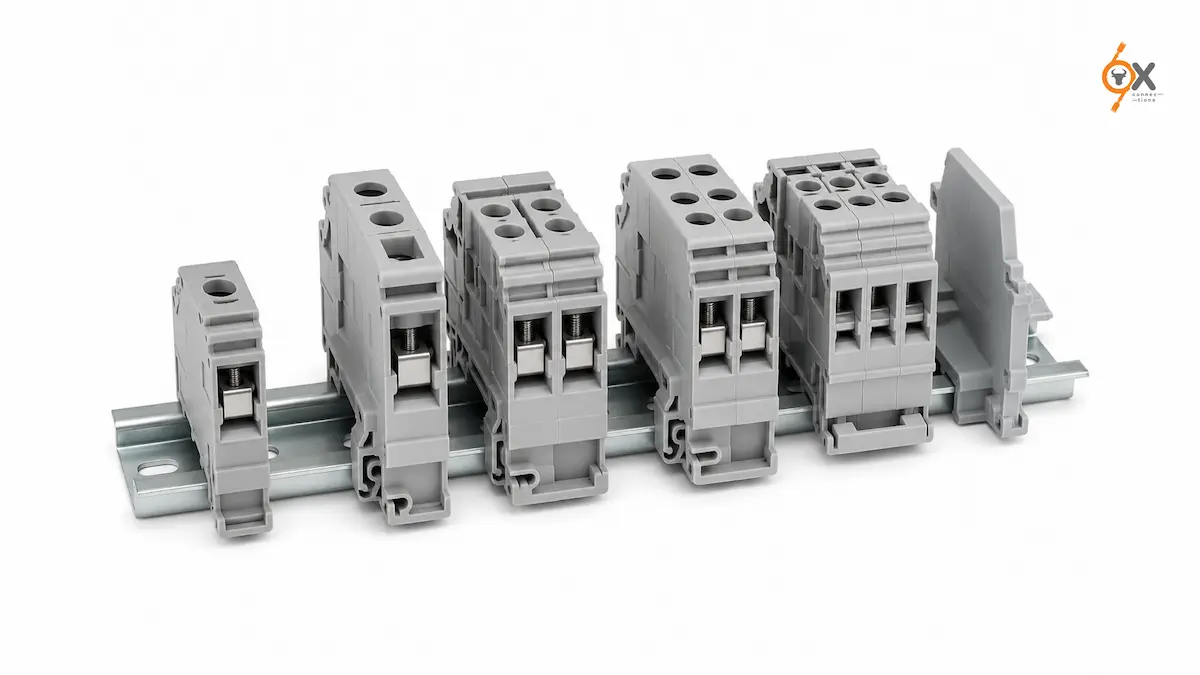
When you compare a terminal block price India quote against a premium brand’s list price, what exactly are you comparing? The part cost is only one line in that decision. Lead time, certification paperwork, and idle production time all belong in the same comparison. Most buyers only price out the first one.
This article won’t hand you a per-part price sheet. Prices move with exchange rates, order volume, and specification. Anyone publishing a fixed number online is guessing or rounding. What we can walk you through is how OX Connections prices its certified equivalents against premium brands. The honest way to get a real number is to send us your BOM.
Terminal Block Price List: What You’re Actually Comparing
A premium brand’s terminal block price list carries costs that have nothing to do with the copper and plastic in the part itself. Global R&D, a worldwide distribution network, decades of brand marketing, and import duties are all baked into that number before it reaches an Indian buyer. None of that is dishonest pricing. It’s simply what a global brand’s cost structure looks like once it lands in India.
A certified equivalent starts from a different cost base. The part is built to the same pitch, footprint, and rating, and tested to back up those claims. But it comes without the layers of global brand overhead added on top. That’s where the savings actually come from, not from cutting corners on the terminal block itself.
Terminal Block Cost Comparison OEM Teams Should Actually Run
A proper terminal block cost comparison OEM teams should run includes lead time. This is the part most price comparisons leave out entirely. Premium brand stock often ships from a European warehouse. Once that shipment clears Indian customs, a delay of a few weeks on a single component can push back an entire panel delivery. A production line waiting on a container is a cost too, even if it never shows up on the purchase order.
OXConnections stocks running items across warehouses in Bangalore, Mumbai, and Delhi specifically to remove that variable. When the part number is available locally, the true cost of ownership includes fewer stockouts and fewer delayed deliveries, not just a lower unit price.
Phoenix vs Equivalent Price: Why the Gap Exists
Buyers often ask us to explain the Phoenix vs equivalent price gap in one sentence. The honest answer is that Phoenix Contact, like WAGO and other premium brands, is pricing in a global engineering standard built for every application. That includes conditions far more demanding than a standard Indian control panel will ever see. An OX equivalent is priced for the application most Indian panels actually run: standard voltage, standard current, indoor installation, with the same certifications and test reports behind it. You’re not paying for the part to also be qualified for conditions your panel will never face.
Where OX Connections Fits: Two Ways to Buy
We offer two tiers, and which one fits depends on what’s driving your decision. The first is our certified 1:1 equivalent range, built to match Phoenix Contact, WAGO, and Degson series on pitch, footprint, and accessory compatibility. It’s priced at a meaningful saving over premium brand landed cost. The second is a competitive pricing tier for buyers whose priority is straightforward cost efficiency on standard specifications, rather than matching a specific brand’s part number. Both tiers carry full certifications and test reports. The difference is precision of match, not quality of certification.
Get an Accurate Number: Request a Quotation Against Your BOM
Any number we quoted here without your actual specification would be a guess dressed up as a fact. That’s not a comparison worth making decisions on. Send us your bill of materials and we’ll quote against it directly. That way you’re comparing a real number against your real requirement, not a published range that may not apply to your order.