
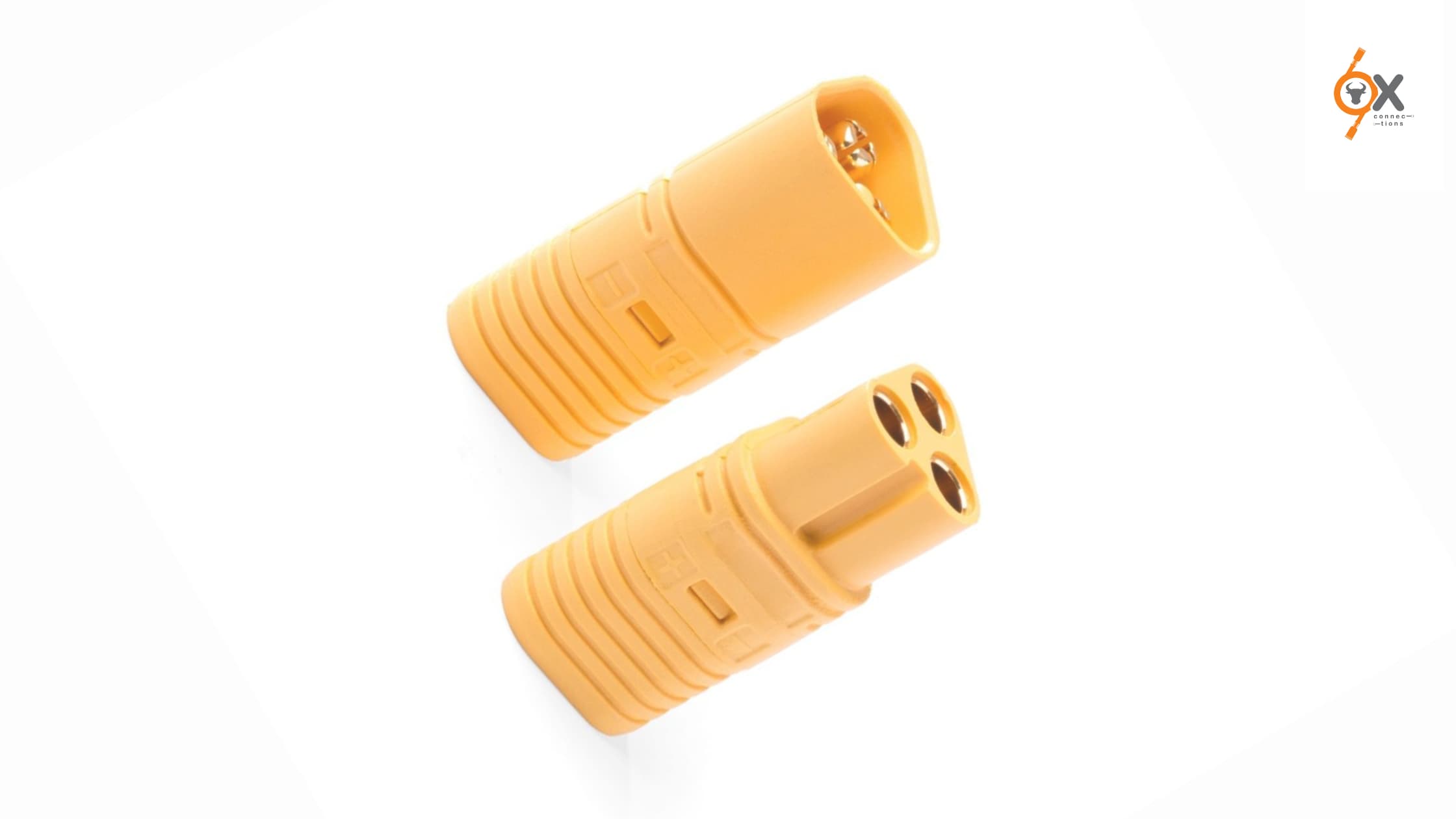
Can a round connector really carry the same current as a flat rectangular one without a bulkier housing? At the 60A mark, this stops being a minor design detail and starts shaping how cleanly a harness routes through a tight enclosure. The MT60 connector is the higher-current step up from MT30, a round bullet-style connector designed for mid-range loads where a cylindrical profile still matters.
What Is an MT60 Connector?
The MT60 connector uses the same round, gold-plated bullet-pin design as MT30, and it scales up to handle roughly 60A of continuous current. The thicker pin diameter is what allows the higher rating while keeping the connector’s cylindrical profile, which is the whole reason teams choose a bullet-style part over a rectangular one in the first place. Two pins sit in a single housing shell, keeping polarity fixed so the connector only mates one way round.
MT60 remains cable mounted and hand-solderable, though the larger pin mass needs a higher-wattage soldering iron than MT30 to get a clean, fully wetted joint.
Where OEMs Actually Use MT60 Connectors
The clearest way to map MT60 connector applications is by combining two factors: mid-range continuous current, and an enclosure or harness routing that favours a round profile over a flat one.
Mid-size battery packs in cylindrical enclosures: e-bike and portable power packs that use round cell formats often route more cleanly with a matching round connector at the pack terminal.
Solar installations with compact junction boxes: a mid-size panel array drawing around 40 to 50A fits within MT60’s rated capacity, and the round profile suits tight gland entries.
Larger RC and drone platforms: builds that have outgrown MT30’s current capacity but still need a round-pin connector for enclosure or weight reasons move up to MT60.
Portable power stations with cylindrical battery modules: mid-capacity units that use round-cell packs often standardise on bullet connectors through the whole power path for consistency.
MT60 vs. MT30 vs. Rectangular 60A Connectors
Choosing between MT60 and MT30 comes down to continuous current, not preference. If your circuit’s sustained draw sits above roughly 30A and below 60A, MT60 is the correct size; running that load through MT30 risks heat build-up at the joint over time. Choosing between MT60 and a rectangular 60A connector like XT60 comes down to physical fit instead. Both carry the same current class, but MT60’s round profile suits cylindrical harness routing, while XT60’s flat housing suits wider, panel-style layouts.
Wire gauge still has to scale with the current, independent of connector shape. At 60A continuous, undersized wire becomes the weak point in the circuit well before either connector style reaches its limit.
Sourcing MT60 Connectors in India
For OEMs across Pune, Bengaluru, Chennai, and the NCR belt, MT60 sits in a narrower stock category than mainstream rectangular connectors, so OEMs need to confirm local availability directly with the supplier rather than assume it from a catalogue listing. Import lead times of 12 to 16 weeks are common for lower-volume connector types, and that window often extends during the monsoon shipping season into Indian ports.
Before finalising an MT60 connector India supplier, confirm genuine local stock versus import-on-demand, consistent pin plating and tolerance across batches, and whether the supplier can support both prototype and full production volumes without a fresh quote cycle each time.
Installation Tips for a Reliable MT60 Connection
The larger pin mass on MT60 needs more heat to reach a good solder flow than MT30 does, so use an iron that suits the thicker contact and pre-tin both the wire and pin before joining them. Rotate the pin slightly while soldering so the fillet forms evenly around its full circumference rather than pooling on one side. Heat-shrink each contact individually before assembling the outer housing, and run a pull test once the joint has cooled, a marginal joint at 60A fails faster than the same fault would on MT30.
Common Mistakes to Avoid with MT60 Connectors
The most frequent error is treating MT30 and MT60 as interchangeable because they look similar and share a housing family. The pin diameters differ enough that MT30 contacts will not seat correctly in an MT60 shell, and forcing a mismatched pair produces a loose, high-resistance joint that runs hot under load. The second common mistake is skipping a fit check against the target enclosure before ordering a full production batch; a round connector that clears one cable gland size may not clear another, so it is worth confirming physical clearance with a sample unit first.
Getting the Right Fit for Your Build
MT60 is the right call when your continuous current sits in the 30 to 60A range and your harness or enclosure genuinely benefits from a round connector profile. Match it to your actual load and physical layout, and source from a supplier that can confirm real stock rather than a listed catalogue entry.
OxConnections stocks bullet-style connectors, including MT60, ready for dispatch from Indian warehouses, so OEMs working with round-profile harnesses don’t have to wait on an overseas shipment. Share your enclosure requirements and volume, and the team can confirm fit and availability directly.
Frequently Asked Questions
What is the current rating of an MT60 connector?
An MT60 connector carries a rating of approximately 60A continuous current. It shares the same round bullet-pin design as MT30, which scales up with a thicker pin to safely carry the higher load.
When should I use MT60 instead of MT30?
Base the choice on continuous current, not the physical size difference alone. If your circuit’s sustained draw regularly exceeds 30A, MT60 gives the necessary headroom; running that load through MT30 risks heat build-up at the connector over time.
Is MT60 easily available in India, or do you need to import it?
MT60 is generally a narrower stock item than mainstream rectangular connectors, so availability varies by supplier. Many work on an import-on-demand basis with lead times of 12 to 16 weeks, making it worth confirming actual stock before committing to a production schedule.