
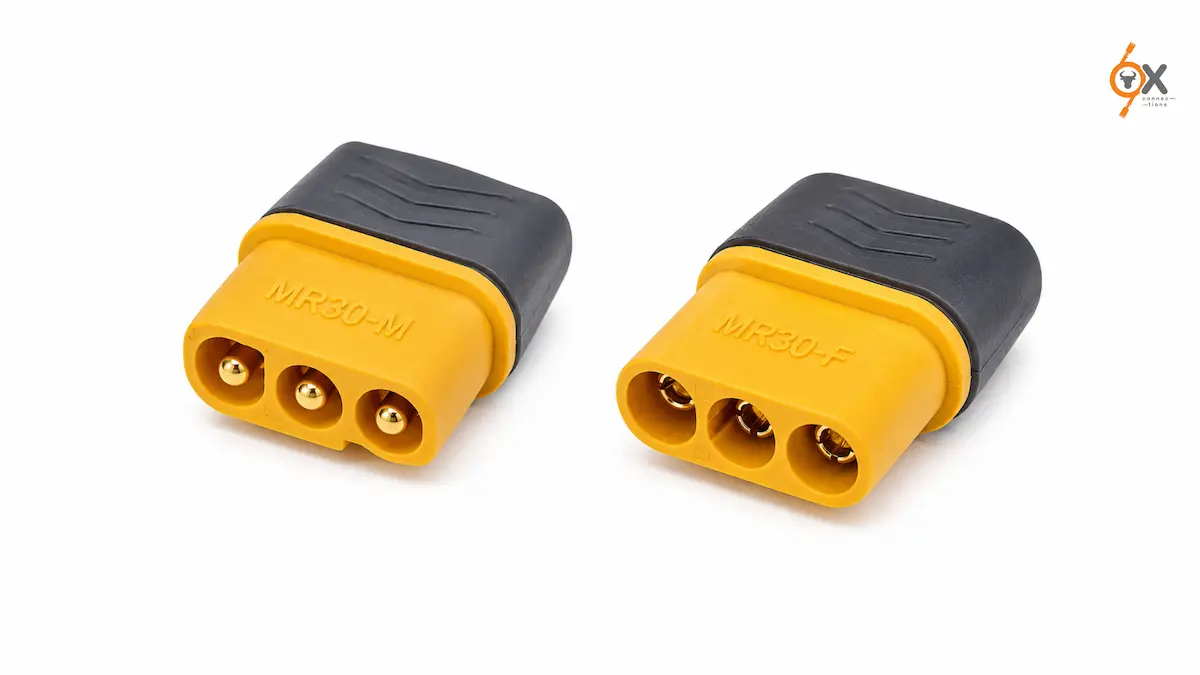
Does every 30A connection need its positive and negative leads locked into one fixed housing? Not always. Some harness layouts route the two poles separately. They may need more spacing or greater flexibility. They may also pass through different points in an enclosure. The MR30 connector suits this type of routing. It uses a round bullet-pin design and carries roughly 30A. Unlike a fixed two-pole shell, installers typically use its pins as individual banana-style contacts.
What Is an MR30 Connector?
The MR30 connector uses a round, gold-plated bullet pin with a matching socket. It falls into a similar current class as other 30A-rated connectors.
However, manufacturers generally supply MR30 pins as separate positive and negative contacts. Installers can therefore route the two leads independently.
This design helps when the two leads need different cable entries. It also works well when the application needs wider physical spacing than a fixed two-pole connector provides.
The round pin profile also suits cylindrical harness routing and cable glands. It offers a practical alternative to flat or bladed contacts in these layouts.
MR30 connectors remain cable mounted and support hand soldering. Suppliers typically provide matching heat-shrink or an outer sleeve to insulate each pin after soldering.
Where Are MR30 Connectors Used?
The main advantage of an MR30 connector appears in applications where independent-pole routing matters alongside the current rating.
Battery Packs With Separated Terminals
Some battery packs place the positive and negative terminals apart from each other. Individual MR30 pins can follow this layout more naturally than a fixed two-pole housing.
Small Drones and RC Electronics
Small drones and RC electronics commonly use round bullet connectors for motor and battery leads. MR30 connectors fit this type of flexible wiring arrangement.
Replacement and Repair Work
MR30 pins can also help during repair work. Technicians can replace a damaged connection without sourcing an entire pre-moulded connector housing.
Solar and Instrumentation Wiring
Low-current solar and instrumentation circuits can use MR30 connectors when the circuit stays within the connector’s rated capacity and the installation requires flexible routing.
MR30 vs. MT30: Which One Should You Choose?
MR30 and MT30 share a round bullet-pin design and sit in roughly the same 30A current class. However, they address different wiring requirements.
The MT30 joins both poles inside one fixed housing. Its housing keeps the polarity fixed and helps prevent reversed connections during assembly. This design suits standard harness builds.
The MR30 uses individual pins. This arrangement gives installers more freedom when they need to route the two leads separately.
That flexibility also requires more care. Installers must check the polarity manually because the individual pins do not provide the same keyed housing protection.
Choose Based on Your Wiring Layout
Choose MR30 when your application needs independent positive and negative routing. And Choose MT30 when you want both poles inside one fixed housing with built-in polarity control.
Wire gauge selection follows the same principle for both connector types. Match the wire to the actual continuous current rather than relying only on the connector’s maximum rating.
Undersized wire can still become the weak point in the circuit, even when the connector has a higher current rating.
Sourcing MR30 Connectors in India
For OEMs and repair workshops in Pune, Bengaluru, Chennai, and the NCR region, individual bullet-pin connectors such as MR30 can have narrower availability than fixed-housing connectors.
For this reason, confirm actual supplier stock before placing an order. Do not rely only on a catalogue listing. Some lower-volume connector types may require imports. Import lead times can reach 12 to 16 weeks in some supply situations. Shipping conditions can also affect delivery schedules.
What Should You Confirm With an Indian Supplier?
Before finalising an MR30 connector India supplier, confirm the following:
- Genuine local stock or import-on-demand supply
- Consistent pin plating between batches
- Matching male and female contacts
- Availability of heat-shrink or protective sleeving
- Required quantity and expected dispatch time
- Connector specifications for your actual application
These checks can help OEMs and repair teams avoid unexpected delays.
How to Install an MR30 Connector Reliably
MR30 pins require individual handling and soldering. Therefore, check and mark the polarity before assembly. The individual-pin design does not provide housing keying to catch a reversed connection later.
Follow These Basic Installation Steps
First, pre-tin the wire before soldering it to the pin. Next, solder the wire securely to the connector. Rotate the pin slightly during soldering so the solder fillet forms evenly around its circumference.
After the joint cools, slide heat-shrink over each pin individually. Make sure the heat-shrink covers the exposed metal and solder joint.
Finally, perform a light pull test on each connection. This simple check can confirm that the solder joint has a solid mechanical bond before you put the connector into service.
Common Mistakes to Avoid
One of the most common mistakes involves treating an MR30 connector like a fixed-housing connector. Always check the polarity before assembly. Individual pins do not provide a keyed shell that prevents reversed connections.
A reversed connection can damage a battery management system or downstream electronics within seconds. Another common mistake involves poor insulation.
Each MR30 pin needs individual insulation because the connector does not use one moulded shell to protect both contacts. Missing or poorly fitted heat-shrink can leave bare metal exposed. That exposed metal can create an accidental electrical contact during handling or operation.
Getting the Right MR30 Connector for Your Build
MR30 works well when your harness needs independent positive and negative routing at around the 30A current class. It can suit separated battery terminals, repair work, and enclosure layouts with limited routing options.
Before selecting the connector, check the actual continuous current. Also select an appropriate wire gauge for the application. Mark the polarity clearly during assembly. Insulate each pin properly after soldering.
Finally, source the connector from a supplier that can confirm actual stock instead of relying only on a catalogue entry.
OxConnections stocks bullet-style connectors, including MR30, for customers looking for independent-pole harness solutions in India. OEMs and repair teams can confirm fit, quantity, and availability directly with the supplier.
Frequently Asked Questions
1. What Is the Current Rating of an MR30 Connector?
An MR30 connector has an approximate 30A continuous current rating. It uses a round bullet-pin design found across the MR and MT connector ranges.
Unlike a joined two-pole housing, MR30 typically uses individual pins. Always check the manufacturer’s specific rating for your chosen connector before using it in a production application.
2. What Is the Difference Between MR30 and MT30?
Both connectors use a similar round bullet-pin design and sit in roughly the same current class.
The main difference involves the housing. MT30 joins both poles inside one fixed housing. This design provides built-in polarity control. MR30 uses individual pins. It offers greater routing flexibility but requires manual polarity checks during assembly.
3. Is MR30 Easily Available in India?
MR30 availability varies between suppliers. Individual bullet-pin connectors can have narrower stock availability than fixed-housing alternatives.
Some suppliers may offer local stock, while others may source the connector through imports. For production or repair work, confirm current stock, quantity, dispatch time, and expected delivery before placing the order.
4. What Should I Check Before Buying an MR30 Connector?
Check the connector’s current rating, pin and socket compatibility, wire size, plating quality, insulation method, and supplier stock.
Also confirm whether the supplier provides matching heat-shrink or sleeving. These details can help ensure that the connector fits your harness and installation requirements.
Final Thoughts
The MR30 connector provides a practical solution when a 30A-class connection needs independent pole routing. Its individual bullet-pin design gives installers more flexibility than a fixed two-pole housing. However, that flexibility also makes polarity checks and proper insulation especially important.
Choose the connector according to your actual current, wire size, routing requirements, and installation environment. Confirm genuine stock with your supplier before committing to a production schedule.
One Reply to “MR30 Connector Guide: Specs, Applications, and Sourcing It in India”
MR60 Connector Guide: Specs, Applications, and Sourcing It in IndiaAugust 24, 2026
[…] choice between MR60 and MR30 comes down to continuous current. If your circuit’s sustained draw sits above roughly 30A, […]
Comments are closed.