
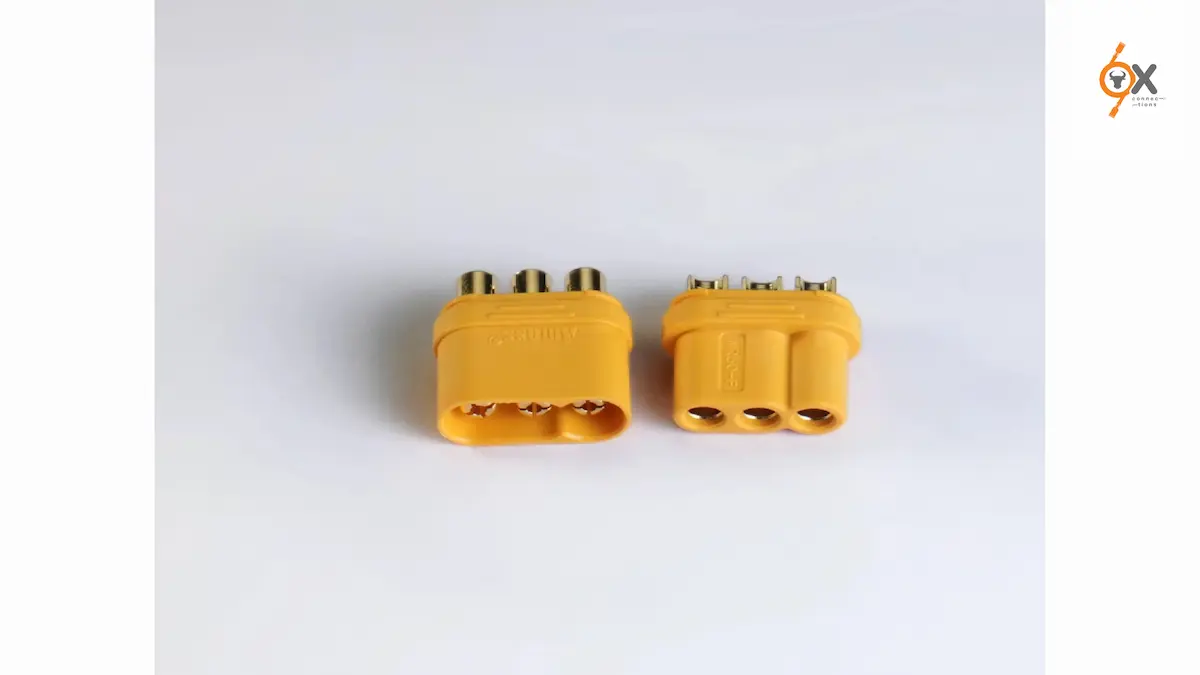
What do you do when a 60A circuit needs its positive and negative leads to travel through two different points in an enclosure? A fixed two-pole housing forces both leads down the same path. That is not always how a real harness is laid out. The MR60 connector solves this at the higher current end. It is a round bullet-pin connector rated for roughly 60A. It is supplied and fitted as individual pins rather than joined into one shell.
What Is an MR60 Connector?
The MR60 connector uses the same round, gold-plated bullet-pin design as MR30. It has a thicker pin to safely carry roughly 60A of continuous current.
Like MR30, the positive and negative pins are generally supplied and soldered separately. They are not moulded into a single fixed housing. This design gives the connector its routing flexibility.
Because polarity is not enforced by a keyed shell, marking each lead clearly during assembly matters more here than with a fixed-housing connector.
This is especially important at 60A, where a reversed connection carries real risk. MR60 remains cable mounted and hand-solderable. However, the larger pin mass needs a higher-wattage soldering iron to get a fully wetted joint.
Where MR60 Connectors Are Actually Used
The clearest way to think about MR60 connector applications is wherever mid-range current and independent-pole routing both matter.
Mid-Size Battery Packs With Separated Terminals
Some battery packs have positive and negative terminals that sit apart physically. Individual MR60 pins can route more naturally in this layout. They avoid forcing both leads through a single fixed connector.
Solar Installations With Split Cable Entries
Mid-size arrays drawing 40 to 50A may route through separate gland points on an enclosure. These installations can use individual bullet pins rather than a joined housing.
Larger RC and Drone Platforms
Some builds outgrow MR30’s current capacity. However, they may still need independent-pole routing for enclosure or motor-mount reasons. These applications can move up to MR60.
Repair and Retrofit Work
MR60 pins are supplied individually. This makes them useful for replacing a damaged high-current joint. The repair does not require sourcing a matching pre-moulded housing.
MR60 vs. MR30 vs. MT60: Choosing the Right Connector
The choice between MR60 and MR30 comes down to continuous current. If your circuit’s sustained draw sits above roughly 30A, MR60 gives the necessary headroom.
Running that load through MR30 risks heat build-up at the joint over time. The choice between MR60 and MT60 comes down to routing instead.
Both share the same 60A current class and round pin design. However, MT60 locks both poles into one housing with built-in polarity keying. MR60 uses individual pins. This suits layouts where the two leads genuinely need to travel separately.
Wire Gauge and Current
Wire gauge still has to scale with current, regardless of housing style. At 60A continuous, undersized wire becomes the weak point in the circuit. It can reach its limit well before either connector style does.
Sourcing MR60 Connectors in India
For OEMs and repair workshops across Pune, Bengaluru, Chennai, and the NCR belt, individual high-current bullet pins like MR60 are typically a narrower stock item than fixed-housing types. Confirming real availability with a supplier therefore matters more than trusting a catalogue listing.
Import lead times of 12 to 16 weeks are common on lower-volume connector types. That window can stretch further during the monsoon shipping season into Indian ports.
What to Confirm From an MR60 Supplier
Before finalising an MR60 connector India supplier, confirm genuine local stock versus import-on-demand. Also confirm consistent pin plating and tolerance across batches.
Check whether matching heat-shrink or sleeving ships along with the pins. These checks can help avoid unexpected sourcing issues during production or repair work.
Installation Tips for a Reliable MR60 Connection
Mark polarity clearly before starting. There is no housing keying to catch a reversed connection later. This matters more at 60A than at lower current.
Use a soldering iron rated for the larger pin mass. Pre-tin both the wire and pin before soldering. Rotate the pin slightly while soldering so the fillet forms evenly around its circumference.
Slide heat-shrink over each pin individually before final assembly. Run a pull test once the joint has cooled. This confirms that the joint can handle sustained load without working loose.
Common Mistakes to Avoid with MR60 Connectors
The most frequent error is skipping the polarity check that individually handled pins require. Some installers assume the connector will prevent a reversed connection the way a fixed housing does.
MR60 does not provide that protection through a keyed housing. At 60A, a reversed or loose joint heats up faster. It can also fail more visibly than the same fault on a lower-current connector.
Avoid Under-Insulating the Joint
The second common mistake is under-insulating the joint. Each pin receives separate sleeving. A single moulded shell does not protect both contacts.
A rushed heat-shrink step can therefore leave exposed metal. A fixed-housing connector would normally protect these areas through its moulded shell.
Getting the Right Fit for Your Build
MR60 is the right choice when your harness needs independent-pole routing at a genuine 60A load. This may result from pack layout, enclosure constraints, or repair work.
Match it to your actual current draw. Mark polarity carefully during assembly. Also source it from a supplier that can confirm real stock rather than a listed catalogue entry.
OxConnections stocks bullet-style connectors, including MR60, ready for dispatch from Indian warehouses. OEMs and repair teams working with independent-pole, high-current harnesses are therefore not left waiting on an overseas shipment.
Share your routing requirements and volume. The team can confirm fit and availability directly.
Frequently Asked Questions
1. What Is the Current Rating of an MR60 Connector?
An MR60 connector is rated for approximately 60A continuous current. It uses the same round bullet-pin design as MR30. The pin is scaled up with a thicker profile to safely carry the higher load.
2. When Should I Use MR60 Instead of MR30 or MT60?
Choose MR60 over MR30 when continuous current regularly exceeds 30A. Choose MR60 over MT60 when your harness needs the two poles to route independently rather than through one fixed housing.
3. Is MR60 Easily Available in India, or Does It Need to Be Imported?
MR60 is generally a narrower stock item than fixed-housing connectors. Availability therefore varies by supplier.
Many suppliers work on an import-on-demand basis. Lead times of 12 to 16 weeks can apply. For this reason, confirm actual stock before committing to a production or repair schedule.