
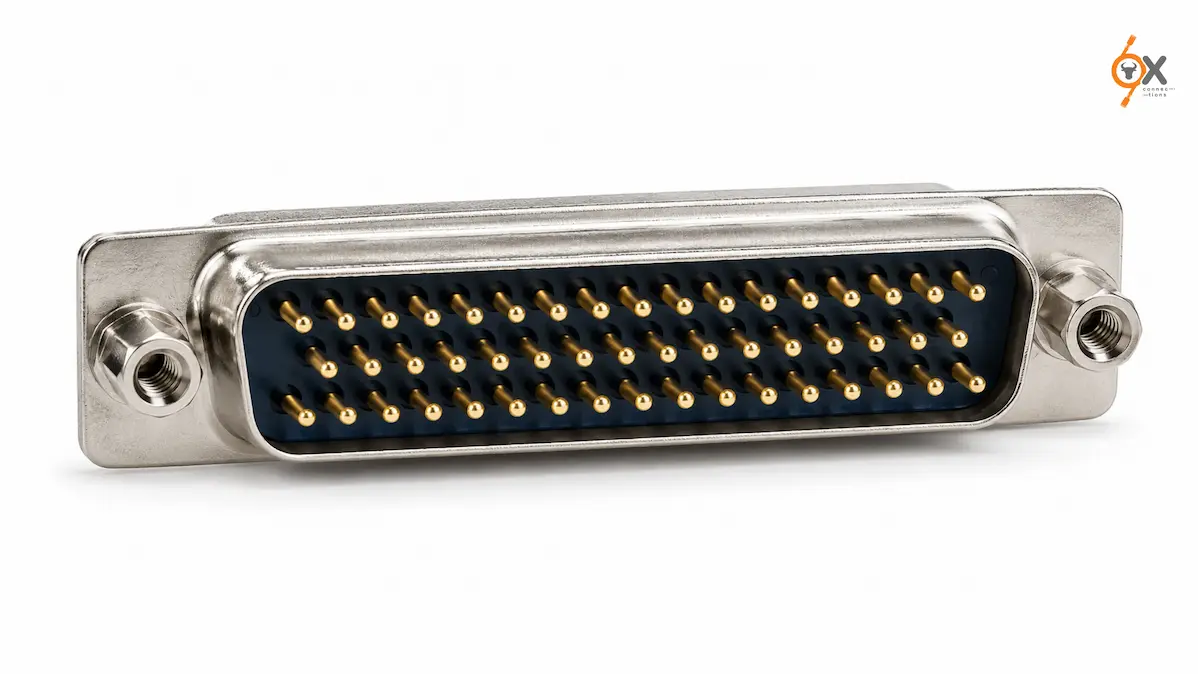
Some equipment needs more than a handful of signal lines but doesn’t demand the largest connector on the shelf. The 50-Pin D-Sub Connector sits comfortably in that middle ground. It carries a real signal load while staying manageable to wire, mount, and service.
A Round Number With Real Purpose
Fifty pins is a natural stopping point in the D-Sub family. It sits above the high-density 44-pin size and below the larger 62 and 78-pin options. Designers reach for this count when a project needs a clean, round number of signal paths. Ribbon cable interfaces and legacy computing hardware both used this pin count for exactly that reason. Some of that older hardware is still in service today, which keeps demand for this connector steady even decades later.
Where 50 Pins Shows Up on the Factory Floor
Industrial control panels use this connector to bundle a large group of digital inputs and outputs. Data acquisition systems rely on it to bring many measurement channels into one interface. Legacy SCSI-style equipment still runs on this pin count in some older facilities. Communication racks with dense wiring needs also turn to this size when a smaller connector can’t carry the full signal load.
D-Sub Connector Applications That Fit This Signal Load
D-Sub Connector Applications built around 50 pins usually involve equipment with a genuinely large signal count. Automation systems use it to consolidate wiring from multiple sensors and actuators into one connector. Test and measurement racks rely on it to bring dozens of channels back to a central recorder. Instrumentation panels in process industries also choose this size when the signal count outgrows a 37-pin connector. It’s a natural step up without jumping to the largest options available.
Mounting Choices for Every Production Volume
Ox Connections offers the 50-pin D-Sub across solder-type, crimp, IDC, and PCB-mounting versions. A solder-type connector suits hand-built cable assemblies made in small batches. A crimp version suits volume production, keeping termination quality consistent across every unit. IDC versions save considerable time on ribbon cable jobs. PCB-mount versions, in straight or right-angle orientation, solder directly onto a board for a clean internal layout.
Why This Connector Needs a Confident Grip
Fifty conductors add real weight to a cable bundle. That weight pulls on the connector at every bend and flex point. A secure locking mechanism keeps the shell seated tightly despite that pull. Threaded jack screws resist vibration from nearby machinery too. A loose connection at this pin count can affect a large portion of a system’s wiring at once. That’s why proper locking hardware matters more here than on smaller sizes.
Sourcing a D-Sub Connector India Large Builds Can Count On
D-Sub Connector India buyers working on data-heavy or multi-subsystem projects need a supplier who treats this size as standard stock. Ox Connections carries the 50-pin version alongside 9, 15, 25, 26, 37, 44, 62, 78, and 104 pin configurations. Over 5,000 products sit in stock. Quick dispatch across India keeps larger installations on schedule.
Planning Around the Cable Bundle
Fifty conductors terminating into one connector create a substantial cable bundle. Panel layouts need clearance for the connector body and a proper bend radius. Skipping this planning step often means a cramped installation once the hardware actually arrives. Labelling every conductor at termination also saves considerable time during future troubleshooting on a connector carrying this many signals. A wiring diagram stored with the equipment itself helps whoever services the panel years down the line.
Final Word
The 50-Pin D-Sub Connector suits projects with a genuinely large signal count that still don’t need the biggest connector available. Match mounting style and locking hardware to the actual installation. Plan panel space and cable routing early, since retrofitting clearance later almost always costs more. Ox Connections offers D-Sub connectors across the full 9 to 104 pin range. Choices include solder, crimp, IDC, power, waterproof, and Centronics variants. Over 5,000 products stay in stock, with quick dispatch across India.
Quick Answers
What kind of systems need a 50-pin D-Sub connector?
Systems with a large signal count, such as industrial automation panels, data acquisition setups, and dense instrumentation racks.
How does this connector compare to smaller D-Sub sizes?
It carries far more signal capacity. It also demands more care during installation, since a loose connection affects more wiring at once.
Should I plan for extra panel space?
Yes. Fifty conductors create a thick cable bundle, so reserve clearance and a proper bend radius during the layout stage.
Leave A Comment