
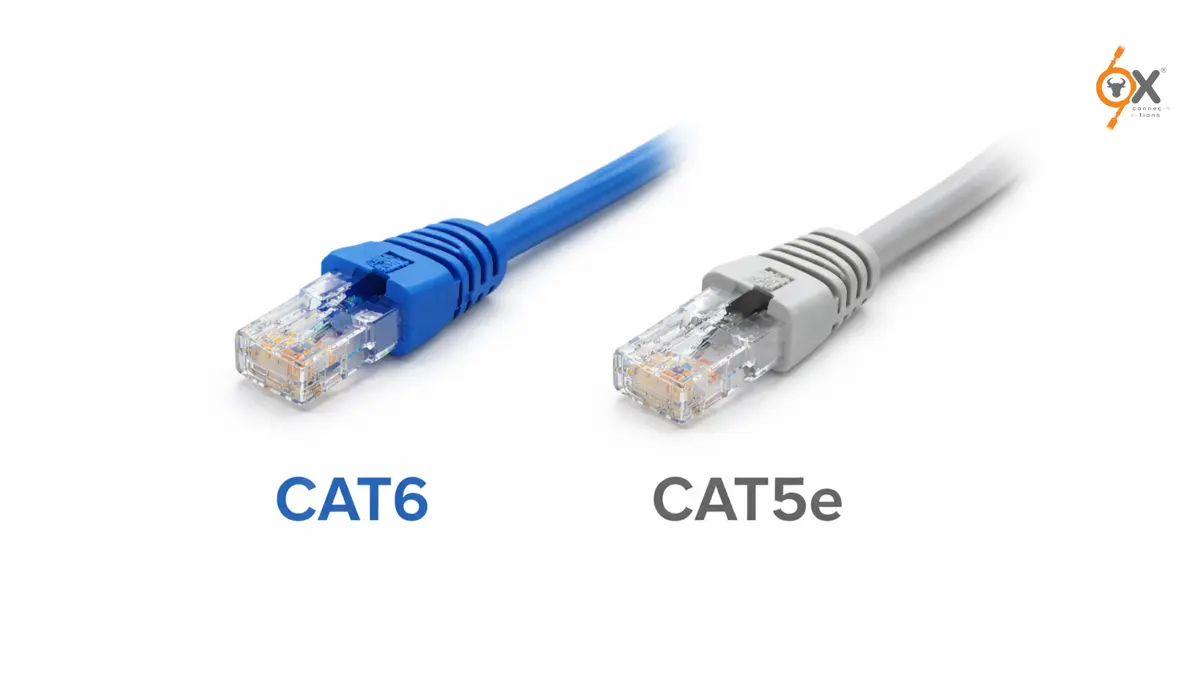
When setting up a reliable industrial network, one question often comes up first – should you choose CAT6 vs CAT5e Ethernet cable?
For factories, solar plants, OEM manufacturing units, control panels, automation systems, and office networks, the right LAN cable directly affects speed, performance, and long-term reliability. Many buyers in India, especially across Mumbai, Pune, Ahmedabad, and Bengaluru industrial hubs, often compare CAT5e and CAT6 before placing bulk orders.
While both are widely used, the better choice depends on your speed requirements, environment, and future scalability.
In this guide, we’ll break down the real difference between CAT5e and CAT6 and help you decide which one works best for industrial networking.
Understanding Ethernet Cables in Industrial Applications
Ethernet cables are used to connect devices such as routers, switches, PLC systems, servers, computers, printers, CCTV systems, and industrial automation panels.
In manufacturing and industrial environments, network stability is not just about internet speed – it affects:
- Machine communication
- Data transfer between systems
- ERP and automation performance
- Security systems
- Remote monitoring
- Industrial IoT operations
That’s why choosing the right industrial Ethernet cable matters.
The most common options are CAT5e Ethernet cable and CAT6 Ethernet cable.
What is CAT5e?
CAT5e stands for Category 5 enhanced.
It is the improved version of CAT5 and is designed to reduce crosstalk and improve signal performance.
CAT5e Specifications:
- Supports up to 1 Gbps speed
- Bandwidth up to 100 MHz
- Effective for distances up to 100 meters
- Commonly used in offices and standard LAN setups
- Cost-effective for basic networking needs
CAT5e is still widely used in small businesses and moderate industrial applications where ultra-high speed is not required.
What is CAT6?
CAT6 stands for Category 6 cable and is the upgraded version of CAT5e.
It offers better speed, stronger shielding, and improved performance in high-interference environments.
CAT6 Specifications:
- Supports up to 10 Gbps speed (for shorter distances)
- Bandwidth up to 250 MHz
- Better resistance to electromagnetic interference
- Improved performance for industrial environments
- Better long-term investment for growing businesses
This makes CAT6 ideal for factories, automation-heavy industries, and future-ready networking systems.
CAT5e vs CAT6 Cable: Key Differences
| Feature | CAT5e | CAT6 |
| Maximum Speed | 1 Gbps | 10 Gbps |
| Bandwidth | 100 MHz | 250 MHz |
| Crosstalk Protection | Moderate | Higher |
| EMI Resistance | Standard | Better |
| Cost | Lower | Slightly Higher |
| Industrial Suitability | Basic to Moderate | High |
This is why most OEMs and industrial buyers now prefer CAT6 Ethernet cable for modern infrastructure projects.
Which Ethernet Cable is Better for Industrial Networking?
The answer depends on your use case.
Choose CAT5e if:
- Your network is basic
- You need standard office connectivity
- Budget is the primary concern
- No high-speed automation systems are involved
Choose CAT6 if:
- You run industrial automation systems
- Your setup includes PLCs, SCADA, IoT, or CCTV networks
- You want long-term reliability
- Your business is scaling
- You want better performance in noisy electrical environments
For most industrial buyers today, CAT6 is the smarter investment.
Why Industrial Buyers in Mumbai Prefer CAT6
In industrial areas across Mumbai, Navi Mumbai, Thane, Vasai, and Bhiwandi, businesses are moving toward faster and more reliable infrastructure.
Reasons include:
- Increased factory automation
- Smart manufacturing systems
- Data-heavy operations
- Renewable energy projects
- EV manufacturing setups
- Medical equipment production
These industries require dependable communication systems where downtime can be expensive.
That is why CAT6 Ethernet cable demand is growing rapidly.
The Connector Side Matters Too
A high-performance cable also needs reliable connectors.
Many industrial failures happen not because of the cable – but because of poor connector quality.
For stable LAN networking, choosing the right RJ45 connectors, modular plugs, and industrial-grade components is equally important.
At OX Connections, businesses across India source reliable connector solutions for industrial networking, including:
- RJ45 connectors
- Modular plugs
- Industrial terminal blocks
- Wire-to-board connectors
- JST equivalent connectors
- TE equivalent connector solutions
Many OEMs choose OX because imported brands often come with:
- High prices
- Long lead times
- High MOQ requirements
OX offers equivalent connector solutions with:
- Competitive pricing
- Faster availability
- No long waiting periods
- UL, RoHS, and CE compliant products
- Strong support for OEM industries
This helps businesses maintain quality without overpaying.
You can explore more connector solutions at OX Connections.
Cost vs Value: Is CAT6 Worth It?
Many buyers hesitate because CAT6 costs slightly more than CAT5e.
But in industrial environments, downtime costs far more than cable upgrades.
If your network supports production systems, security infrastructure, or plant operations, CAT6 is usually worth the extra investment.
It offers:
- Better speed
- Lower maintenance risk
- Improved future compatibility
- Stronger network reliability
The upfront cost is small compared to long-term operational savings.
Final Verdict
If you are comparing CAT5e vs CAT6 cable, the decision should not be based only on price.
It should be based on performance, future growth, and operational reliability.
For standard office setups, CAT5e may still work well.
But for industrial networking, automation systems, and OEM infrastructure, CAT6 Ethernet cable is the better choice.
It delivers stronger performance, better protection, and long-term efficiency – making it the preferred option for serious industrial operations.
FAQs
1. Is CAT6 faster than CAT5e?
Yes. CAT6 supports up to 10 Gbps for shorter distances, while CAT5e typically supports up to 1 Gbps.
2. Can I use CAT5e for industrial networking?
Yes, but only for basic networking needs. For automation systems and high-performance industrial setups, CAT6 is usually the better option.
3. Why is CAT6 better for factories?
CAT6 offers better shielding, reduced interference, and stronger performance in electrically noisy environments – making it ideal for factories and industrial plants.