
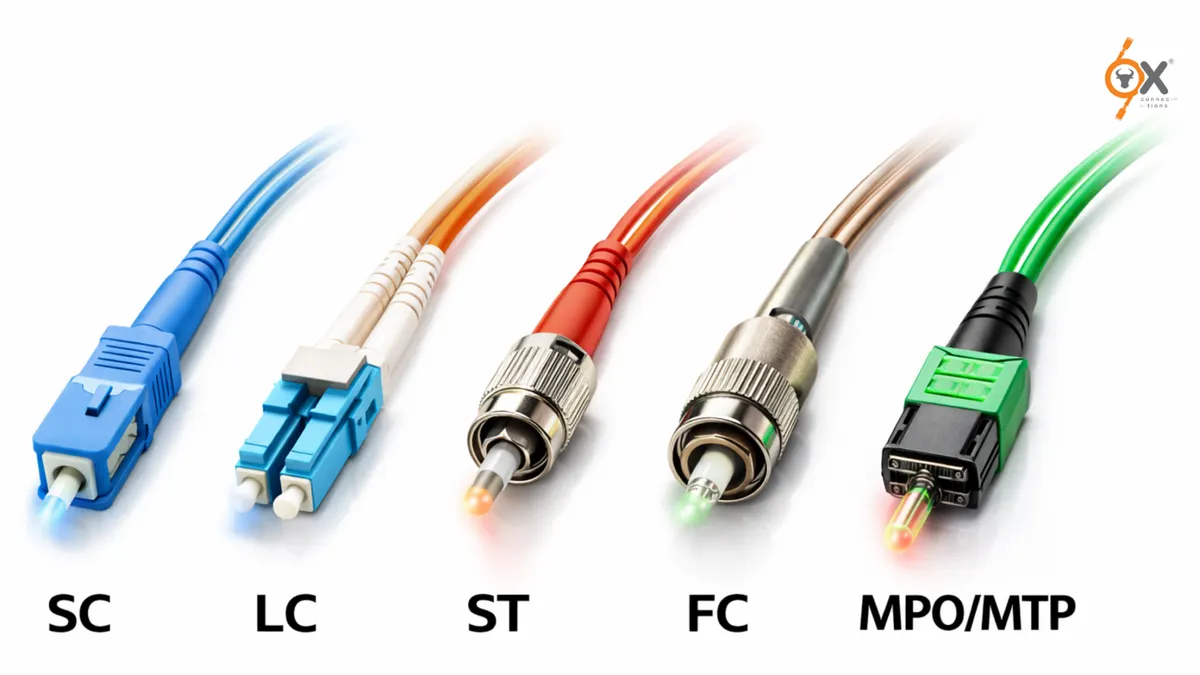
This guide explains the most common types of fiber optic connector, their features, advantages, and how to select the right fiber optic cable connectors for your specific application.
Fiber optic technology has become the backbone of modern communication systems, enabling high-speed data transmission across telecom networks, industrial automation systems, data centers, and enterprise infrastructure. At the center of these systems are connectors that ensure precise alignment and uninterrupted signal flow. Understanding different fiber optic connector types, their structure, and their applications is essential for building reliable and efficient networks.
What Are Fiber Optic Connector?
Fiber optic connectors are specialized mechanical devices used to join fiber optic cables to other cables, equipment, or network devices such as switches, routers, and patch panels. Their primary function is to align the fiber cores precisely so that light signals can pass through with minimal loss or reflection.
Each connector contains a ferrule, typically made from ceramic or metal, that holds the fiber in perfect alignment. Even microscopic misalignment can cause signal loss, which is why connector precision is critical. These connectors also allow easy installation, maintenance, and replacement of fiber optic systems without affecting overall network performance.
Reliable fiber optic cable connectors ensure stable communication, reduced signal attenuation, and long-term network reliability.
Why Are Fiber Optic Connectors Important?
Fiber optic connectors play a vital role in ensuring the efficiency and functionality of modern communication systems. Without proper connectors, it would be impossible to create modular, scalable, and serviceable fiber networks.
Key benefits include:
- Secure and precise fiber alignment
- Minimal signal loss and reflection
- Easy installation and maintenance
- High-speed and high-bandwidth support
- Reliable long-distance communication
Fiber optic systems offer significantly faster speeds and higher bandwidth compared to traditional copper cables. This makes choosing the correct fiber optic connector types essential for achieving optimal performance.
Most Common types of fiber optic connectors
Different connectors are designed to meet various network requirements. Each connector offers unique advantages depending on the application, density, and environmental conditions.
1. LC Connector (Lucent Connector)
The LC connector is one of the most widely used connectors in modern high-density networking environments.
Key features:
- Small form factor
- 25 mm ferrule
- Push-pull locking mechanism
- High precision alignment
The compact design allows more connections in limited space, making LC connectors ideal for data centers and enterprise networks.
Common applications:
- Data centers
- Telecom equipment
- Network switches and routers
LC connectors are among the most popular fiber optic connector types due to their efficiency and space-saving design.
2. SC Connector (Subscriber Connector)
SC connectors are known for their reliability and ease of installation.
Key features:
- 5 mm ferrule
- Push-pull snap-in mechanism
- Durable square design
- Reliable and stable connection
SC connectors are widely used in telecommunications and broadband applications because of their simple installation and strong performance.
Common applications:
- Fiber-to-home (FTTH) networks
- Telecom infrastructure
- Passive optical networks
They remain one of the most dependable fiber optic cable connectors used in telecom deployments.
3. ST Connector (Straight Tip Connector)
ST connectors were among the earliest connectors used in fiber optic networks and are still found in legacy systems.
Key features:
- Bayonet twist-lock mechanism
- 5 mm ferrule
- Secure connection
The twist-and-lock design ensures stability, especially in industrial environments.
Common applications:
- Industrial networks
- Legacy network systems
- Campus infrastructure
Although newer connectors have replaced them in many applications, they remain relevant among certain types of fiber optic connectors.
4. FC Connector (Ferrule Core Connector)
FC connectors use a threaded locking system, making them highly reliable in environments with vibration or movement.
Key features:
- Screw-type locking mechanism
- Excellent alignment stability
- Durable and vibration resistant
These connectors provide strong and secure connections, ideal for critical systems.
Common applications:
- Industrial automation
- Military and aerospace systems
- Precision measurement equipment
FC connectors are preferred fiber optic connector types where connection stability is essential.
5. MPO Connector (Multi-Fiber Push-On Connector)
MPO connectors are designed for high-density and high-speed applications.
Key features:
- Supports multiple fibers in one connector
- Compact and efficient design
- High bandwidth capability
They are widely used in modern high-speed networks.
Common applications:
- Data centers
- Cloud computing infrastructure
- High-performance networks
MPO connectors are increasingly used fiber optic cable connectors for next-generation networking.
6. MT-RJ Connector (Mechanical Transfer Registered Jack)
MT-RJ connectors combine two fibers into a single connector and are used in specific applications.
Key features:
- Duplex fiber support
- Compact design
- Easy installation
Although less common today, they remain part of legacy and specialized systems.
Single-Mode vs Multimode Connector Compatibility
When selecting fiber optic connector types, compatibility with fiber type is essential.
Single-Mode Fiber Connectors
Single-mode fiber connectors support long-distance transmission and high-speed communication. They use smaller core diameters and provide minimal signal loss.
Common uses include:
- Telecom backbone networks
- Long-distance communication
- Internet infrastructure
Multimode Fiber Connectors
Multimode connectors are designed for shorter distances and are commonly used in enterprise and data center environments.
Common uses include:
- Local area networks (LAN)
- Data centers
- Commercial buildings
Choosing compatible fiber optic cable connectors ensures optimal performance and reliability.
Factors to Consider When Choosing types of fiber optic connectors
Selecting the right connector requires careful evaluation of technical and environmental factors.
1. Application Environment
Different environments require different connector designs.
For example:
- Data centers require high-density connectors like LC and MPO
- Industrial environments require durable connectors like FC
- Telecom networks require reliable connectors like SC
2. Installation Density
High-density installations benefit from smaller connectors that save space and improve efficiency.
LC and MPO connectors are ideal for compact installations.
3. Stability Requirements
In environments with vibration or movement, threaded connectors such as FC provide better stability.
This ensures uninterrupted signal transmission.
4. Bandwidth Requirements
High-speed networks require connectors capable of handling large data volumes efficiently.
Modern fiber optic connector types like MPO are designed for high-bandwidth applications.
Advantages of Modern fiber optic cable connectors
Modern connectors offer several important advantages:
High Speed
Fiber connectors support extremely fast data transmission speeds, essential for modern communication systems.
Low Signal Loss
Precision alignment ensures minimal insertion loss and high signal quality.
Reliability
Durable connector designs ensure consistent performance over long periods.
Scalability
Modern connectors support scalable network infrastructure, allowing future expansion.
Role of Connectors in Modern Network Infrastructure
Fiber connectors play a critical role in enabling scalable and maintainable network systems. They allow easy installation, quick upgrades, and efficient troubleshooting.
Adapters and connectors allow seamless integration between different network components, ensuring compatibility and flexibility.
High-quality fiber optic cable connectors ensure consistent network performance and reduced downtime.
Conclusion
Understanding fiber optic connector types is essential for designing efficient, reliable, and scalable fiber optic networks. Each connector type—LC, SC, ST, FC, MPO, and MT-RJ—offers unique advantages depending on the application, environment, and performance requirements. Choosing the correct types of fiber optic connectors ensures optimal signal transmission, reduced loss, and long-term network stability.
Equally important is selecting high-quality fiber optic cable connectors from a trusted and experienced connectivity solutions provider. Precision engineering, durable construction, and reliable performance directly impact network efficiency and operational reliability.
Ox Connections is a trusted provider of advanced fiber connectivity solutions designed to meet the demands of modern telecom, industrial, and enterprise infrastructure. Their fiber optic connectors are engineered with precision to ensure secure alignment, low insertion loss, and long-term durability. Built to meet stringent quality standards, Ox Connections products deliver consistent performance in critical environments such as industrial automation, control panels, telecom networks, and high-speed communication systems.
With a strong commitment to engineering excellence, reliability, and innovation, Ox Connections offers dependable connectivity solutions that support efficient network deployment and long-term scalability. Choosing Ox Connections ensures your fiber optic network remains robust, efficient, and ready to support the growing demands of modern digital infrastructure.