
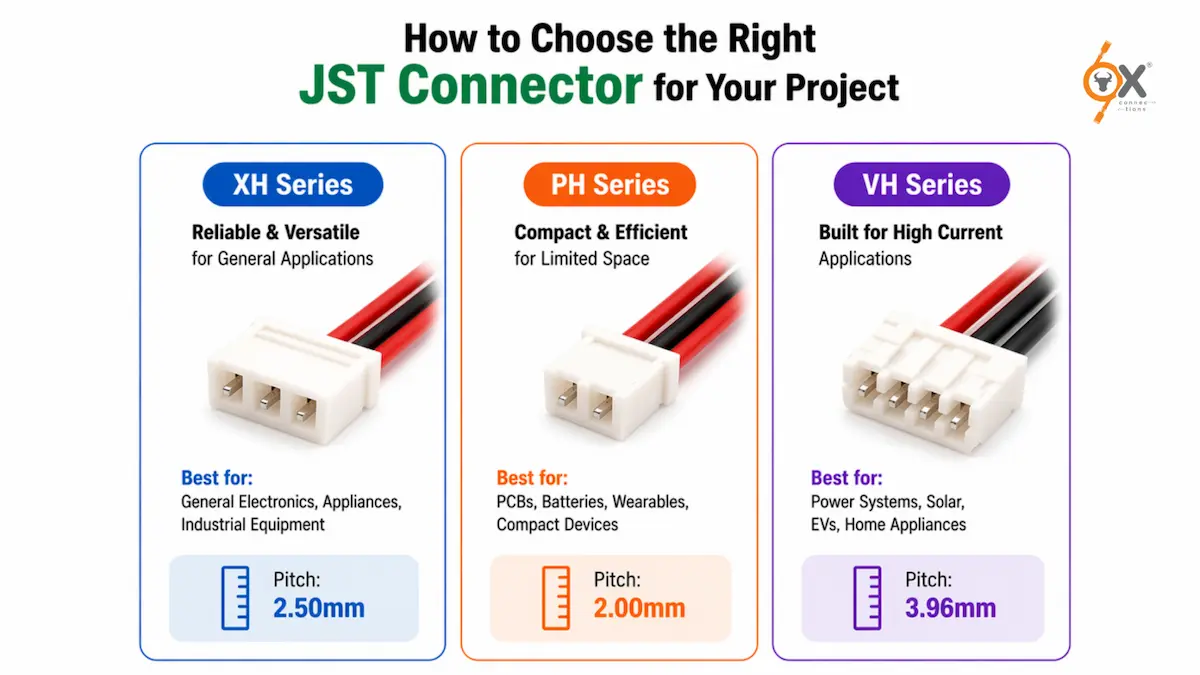
This guide simplifies the process and helps you understand how to choose JST connector solutions that align with your project requirements, especially within the Indian manufacturing landscape.
In India’s rapidly evolving electronics and manufacturing ecosystem – especially in hubs like Mumbai, Pune, and Ahmedabad – choosing the right connector is no longer a small technical decision. It directly impacts product reliability, production timelines, and overall cost efficiency.
Among the most widely used options, JST connectors have become an industry standard across applications from consumer electronics to EV systems. But with multiple series like XH, VH, PH, and HY available, selecting the right one can quickly become confusing.
Understanding the Basics of JST Connectors
Before diving into selection, it’s important to understand what makes JST connectors so widely used.
JST (Japan Solderless Terminal) connectors are compact, reliable, and designed for secure electrical connections in PCB-based systems. They are known for:
- Consistent performance
- Compact form factors
- Ease of assembly
- Wide range of configurations
However, not all JST connectors are the same. Each series is designed for specific use cases, which is why understanding JST connector types is the first step toward making the right decision.
Why Choosing the Right Connector Matters in India
In markets like Mumbai, where OEMs operate under tight deadlines and cost pressures, connector selection goes beyond just technical compatibility.
Here’s why it matters:
- Supply Chain Efficiency: Long lead times can delay entire production cycles
- Cost Sensitivity: Even small component cost differences scale significantly in bulk manufacturing
- Application Reliability: Incorrect connector choice can lead to failures in the field
- Compliance Needs: Certifications like UL, RoHS, and CE are increasingly essential for exports
This makes a well-informed JST connector selection guide critical for engineers and procurement teams alike.
Key Factors to Consider When Choosing a JST Connector
1. Pitch Size
Pitch refers to the distance between pins in the connector.
- Smaller pitch (e.g., 2.0mm – PH series) → compact applications
- Larger pitch (e.g., 3.96mm – VH series) → higher power applications
In space-constrained devices like home appliances or compact PCBs, smaller pitch connectors are preferred. For industrial or power-heavy applications, larger pitch connectors offer better performance.
2. Current & Voltage Requirements
Each connector series is designed to handle a specific range of current and voltage.
- Low-power electronics → PH or XH
- Medium-power applications → XH
- High-power systems → VH
For example, solar inverters or EV subsystems in India require connectors that can handle higher loads consistently – making VH-type connectors more suitable.
3. Application Environment
Mumbai’s coastal climate brings humidity and temperature variations into play.
Consider:
- Heat resistance
- Vibration tolerance
- Moisture exposure
Industrial applications, especially in renewable energy or outdoor installations, demand connectors that maintain performance under stress.
4. Wire Compatibility
Not all connectors support all wire gauges.
- Thin wires → PH series
- Medium wires → XH
- Thick wires → VH
Incorrect pairing can lead to loose connections or overheating both of which are costly mistakes in production environments.
5. Mounting Type
You’ll need to decide between:
- Wire-to-board
- Board-to-board
- Wire-to-wire
Most Indian OEMs working in appliances and electronics prefer wire-to-board configurations for ease of assembly and maintenance.
Overview of Common JST Connector Series
Understanding JST connector types helps you narrow down your options quickly.
The JST PH Series
- Pitch: 2.0mm
- Application: Compact devices, consumer electronics
- Strength: Space-saving design
The JST XH Series
- Pitch: 2.5mm
- Application: General-purpose electronics
- Strength: Balance between size and performance
JST VH Series
- Pitch: 3.96mm
- Application: High-power systems (industrial, solar)
- Strength: High current capacity
JST HY Series
- Application: Cost-effective alternatives in certain designs
- Strength: Functional flexibility
Each of these serves a different purpose, and selecting the wrong one can lead to inefficiencies or redesign costs.
The Reality of JST Connectors in the Indian Market
While JST connectors are widely trusted, many Indian manufacturers face practical challenges:
- High pricing compared to local budgets
- Long lead times affecting production schedules
- High minimum order quantities (MOQs)
- Limited flexibility for small or mid-sized OEMs
This becomes especially critical for startups and growing manufacturers in Mumbai who need agility in both sourcing and scaling.
A Practical Shift in Sourcing Strategy
Many OEMs in India are now exploring alternatives that offer:
- Equivalent performance
- Faster availability
- Lower cost structures
For instance, suppliers like OX provide compatible connector solutions that address these gaps effectively.
Without overcomplicating procurement, such alternatives offer:
- Comparable quality to traditional JST connectors
- Nearly half the cost in many cases
- No lead time delays
- Certifications like UL, RoHS, and CE
- Supply support across industries like solar, EV, medical, and home appliances
For Mumbai-based manufacturers dealing with tight production timelines, this flexibility can be a major advantage.
Matching Connector Choice to Industry Use Cases
1. Solar & Renewable Energy
High current handling is critical. VH-type connectors or equivalents are typically preferred.
2. Home Appliances
Compact and cost-effective connectors like PH and XH are commonly used.
3. Electric Vehicles (EV)
Durability, vibration resistance, and current capacity are key – requiring robust connector choices.
4. Medical Equipment
Precision and reliability are non-negotiable. Connector consistency matters more than cost alone.
Common Mistakes to Avoid
Even experienced engineers can overlook critical details. Here are some common pitfalls:
- Choosing based only on price
- Ignoring current rating specifications
- Overlooking environmental conditions
- Not considering supply chain delays
- Selecting incorrect pitch or wire compatibility
A structured JST connector selection guide helps avoid these mistakes and ensures long-term efficiency.
Final Thoughts
Choosing the right connector is not just a technical decision- it is a strategic one, especially in a competitive manufacturing landscape like India.
By understanding how to choose JST connector options based on pitch, current, application, and sourcing realities, you can:
- Improve product reliability
- Reduce production delays
- Optimize costs
- Scale operations more efficiently
Whether you’re an OEM in Mumbai or a growing manufacturer elsewhere in India, making informed connector choices can significantly impact your bottom line.
And in a market where flexibility, speed, and cost matter more than ever, combining technical understanding with smart sourcing is the real advantage.