
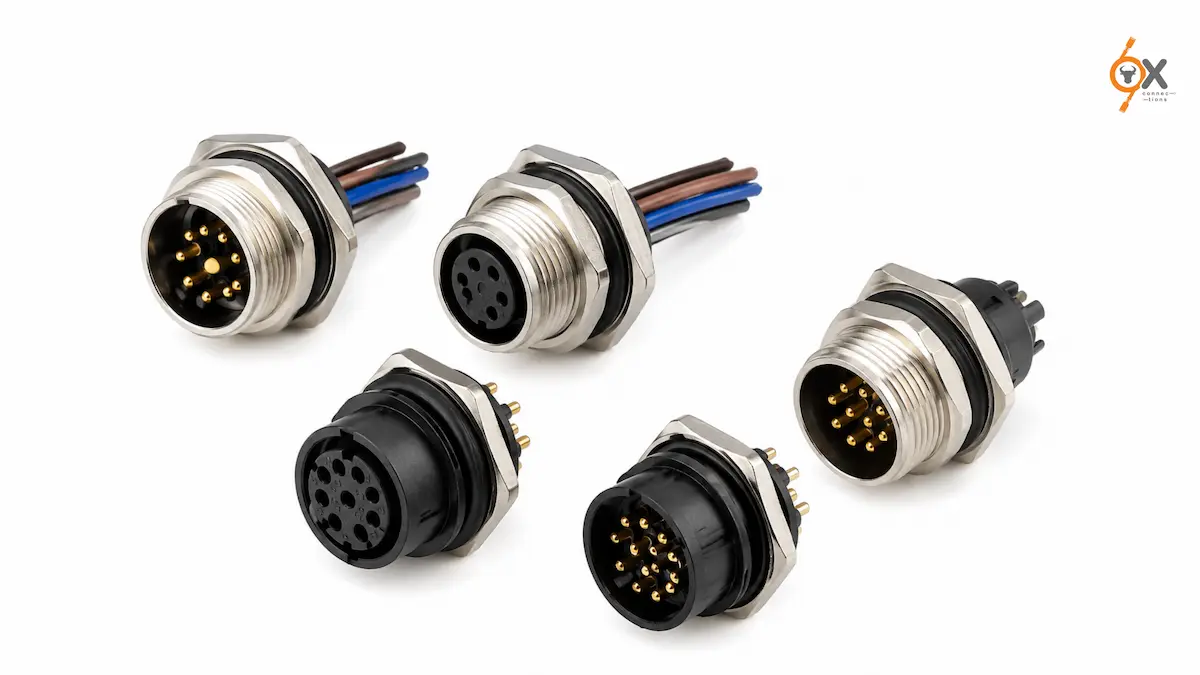
When electrical connections need to pass cleanly and securely through an enclosure, the connector itself is only part of the solution. The way that connector is mounted to the panel can have a direct impact on installation, accessibility, wiring organisation and the overall reliability of the connection. This is where panel mounting sockets become an important part of connector selection.
Designed for applications where connectivity needs to be integrated directly into an enclosure or panel, panel mount sockets provide a structured interface between internal wiring and external connections. For equipment manufacturers, control-panel builders and OEMs, choosing the right panel-mounted connection can help simplify assembly while keeping the finished system organised.
OX Connections offers an M-Series range designed for applications requiring dependable, enclosure-ready connectivity.
What Are Panel Mounting Sockets?
A panel mounting socket is a connector designed to be secured directly onto an equipment panel, enclosure or housing. Instead of allowing the connector to remain loose within an assembly, panel mounting provides a defined connection point that can be accessed from the outside.
This arrangement is particularly useful in equipment where cables need to be connected or disconnected without opening the entire enclosure.
Depending on the application, panel-mounted connectors can be used in control equipment, industrial machinery, automation systems, instrumentation and other electrical assemblies where structured cable access is required.
The key advantage is simple: the connection becomes part of the enclosure rather than simply sitting inside it.
Why Panel Mounting Matters in Enclosure Design
Electrical enclosures are designed to protect components while keeping wiring organised and accessible. A connector that is not properly integrated into the enclosure can make installation and servicing unnecessarily difficult.
Panel mounting helps create a defined interface for incoming and outgoing connections.
Some of the key considerations include:
- Secure installation: The connector has a fixed position on the panel rather than remaining free inside the enclosure.
- Better accessibility: External connections can be accessed from a defined location.
- Cleaner wiring: Internal wiring can be routed systematically from the mounted connector to other components.
- Simplified servicing: Connections can be easier to identify and access during maintenance.
- Enclosure integration: The connector becomes part of the overall mechanical and electrical design.
For OEMs and equipment manufacturers, these considerations become especially important when designing repeatable assemblies.
Understanding the M-Series Approach
The M-Series from OX Connections is positioned for applications where connector installation and enclosure integration are important considerations.
Rather than treating connectivity as an isolated component, panel mounting allows designers to consider the connector as part of the complete equipment architecture.
This is particularly relevant when an enclosure has designated cable entry points or when external connections need to follow a consistent layout across multiple units.
For production environments, a repeatable connector mounting arrangement can also contribute to more consistent assembly practices.
Where Can Panel Mounting Sockets Be Used?
Panel-mounted connectivity can be relevant across several types of electrical and electronic equipment.
Industrial Equipment
Machinery and industrial equipment often require external connections for power, control or signal-related wiring. A fixed panel connection provides a defined interface between the equipment and its external wiring.
Control Panels
Control cabinets and electrical panels can benefit from clearly positioned connectors that allow field wiring to connect with internal circuits without creating unnecessary cable clutter.
Automation Systems
Automation equipment frequently combines multiple electrical connections within a compact enclosure. Panel-mounted interfaces can help create a structured connection point for these systems.
OEM Equipment
For OEMs producing equipment in volume, connector placement and mounting can become an important part of the overall enclosure design. Standardising the connection interface can help maintain consistency across assemblies.
Factors to Consider When Selecting a Panel Mount Connector
Selecting a panel mounting socket should not be based on the connector alone. The application and enclosure design need to be considered together.
1. Panel Compatibility
The connector must be suitable for the panel or enclosure in which it will be installed. Mechanical dimensions, mounting arrangement and available space should be reviewed during the design stage.
2. Connection Requirements
The electrical requirements of the application should be established before selecting a connector. This includes understanding the type of connection, number of contacts and the intended operating environment.
3. Cable Routing
The position of the mounted socket should allow practical cable routing both inside and outside the enclosure. Poor positioning can create unnecessary bends or strain during installation.
4. Accessibility
If a connection will need to be disconnected during servicing, the location of the panel socket becomes particularly important. A clearly accessible connection point can make maintenance more straightforward.
5. Overall Enclosure Design
The connector should work with the complete enclosure rather than being considered independently. Clearance, mounting position and surrounding components all need to be accounted for.
Panel Mounting Sockets vs. Loose Internal Connections
A loose connector inside an enclosure may work for certain designs, but it can make external connections less structured.
Panel mounting creates a fixed interface.
For equipment that is regularly installed, serviced or connected to external systems, this distinction can be significant. A mounted socket provides a defined location for the connection, while internal wiring can remain organised behind the panel.
This approach is particularly useful when manufacturers need consistency across multiple equipment builds.
Designing for Reliable Connectivity
Connector selection is only one part of creating a dependable electrical assembly. Mechanical integration, wiring practices, panel design and application requirements all play a role.
A panel mounting socket should therefore be evaluated according to the complete system in which it will operate.
For OEMs, this means considering the connector during the enclosure-design stage rather than treating it as a last-minute component choice.
When the connector, panel and cable routing are designed together, the resulting assembly can be easier to build, inspect and service.
Why Consider OX Connections for Panel-Mounted Applications?
OX Connections supplies connector solutions for OEM and industrial applications where component compatibility, availability and practical integration matter.
Its M-Series range provides an option for applications requiring panel mounting sockets and enclosure-ready connectivity.
For manufacturers evaluating connector alternatives, the focus should remain on matching the connector to the required electrical, mechanical and environmental conditions of the application.
Final Takeaway
Panel mounting sockets provide more than a convenient connection point. They help establish a defined interface between an enclosure and the external electrical system.
For control panels, industrial equipment, automation systems and OEM assemblies, the right panel-mounted connector can contribute to cleaner installation, better accessibility and more organised equipment design.
The M-Series from OX Connections is worth considering when your application requires a structured, enclosure-ready connectivity solution.
As a stocking distributor, OXConnections supports OEMs and manufacturers with connector solutions designed around practical sourcing and application requirements.