
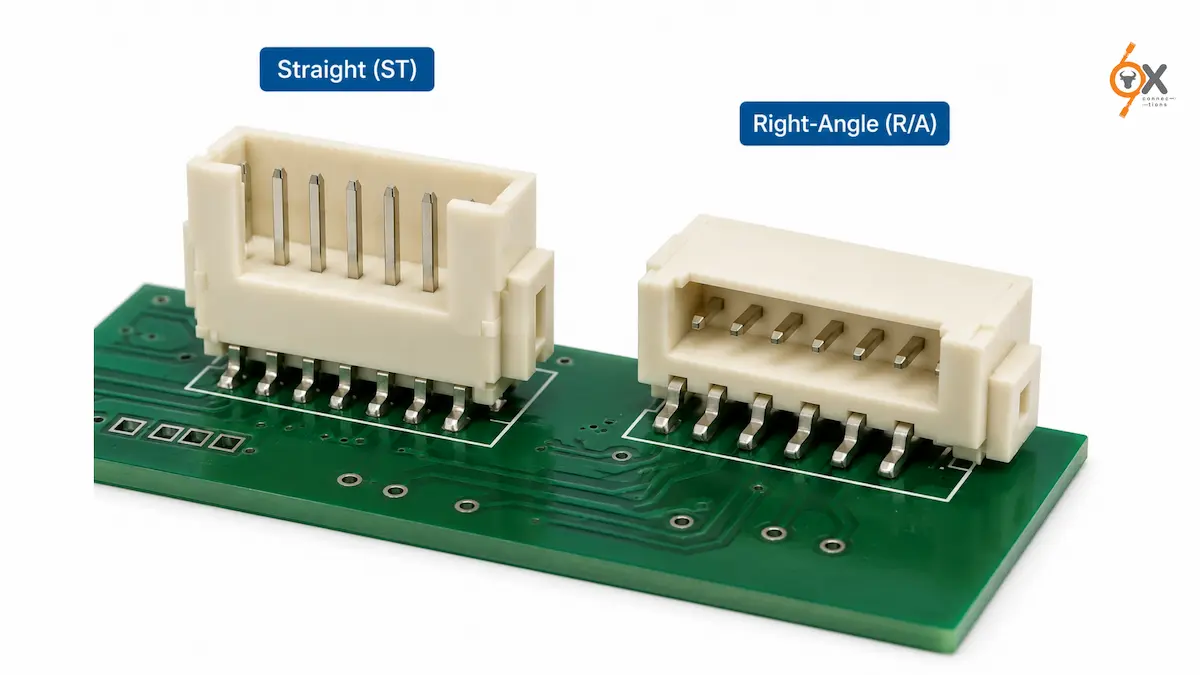
In PCB-based electrical assemblies, PCB Mounting Connectors are more than a matter of appearance. The way a connector sits on a printed circuit board can influence cable routing, available space, enclosure design and the overall layout of the assembly.
Two commonly considered configurations are Straight (ST) Connectors and Right-Angle (R/A) Connectors.
Both are designed for PCB mounting, but their physical orientation makes them suitable for different design requirements. Understanding the difference can help OEMs and electronic equipment manufacturers select a connector configuration that fits their PCB and enclosure architecture.
OX Connections offers connector solutions for applications where practical PCB integration and reliable connectivity are key considerations.
What Are PCB Mounting Connectors?
PCB Mounting Connectors are connectors designed to be installed directly onto a printed circuit board. They establish an electrical connection between the PCB and another component, cable or mating connector.
Unlike connectors that are mounted separately from the board and connected through additional wiring, PCB-mounted connectors become part of the board-level assembly.
This makes connector orientation an important design consideration.
The two basic configurations discussed here are:
- Straight (ST) Connectors
- Right-Angle (R/A) Connectors
The primary difference is the direction in which the mating connection extends from the PCB.
What Are Straight PCB Connectors?
Straight Connectors, commonly referred to as ST connectors, maintain a straight connection path from the PCB.
The mating interface follows the same general direction as the connector’s mounting orientation. This configuration can be particularly useful when the available space and cable-entry direction align naturally with the board layout.
Advantages of Straight Connectors
A straight configuration can offer:
- A straightforward connection path
- Simple PCB layout considerations
- Convenient access where vertical or direct mating is preferred
- Flexibility for assemblies with sufficient clearance around the PCB
Straight connectors can be a practical choice when the enclosure provides enough space above or around the PCB for the mating connection.
What Are Right-Angle PCB Connectors?
Right-Angle Connectors, or R/A connectors, change the direction of the mating connection relative to the PCB.
Instead of extending directly from the board, the connection is positioned at approximately 90 degrees to the mounting direction.
This configuration can be particularly useful where vertical clearance is limited or where cables need to travel horizontally along the PCB or enclosure.
Advantages of Right-Angle Connectors
A Right-Angle Connector can help with:
- Managing cable direction
- Reducing the amount of vertical space required
- Routing connections toward the side of an enclosure
- Working within compact PCB layouts
- Integrating the connector with specific enclosure geometries
For compact electronic equipment, connector orientation can make a meaningful difference to the overall mechanical design.
Straight vs Right-Angle: What’s the Difference?
The key difference between ST and R/A Connectors is their orientation and the resulting direction of the mating connection.
| Feature | Straight (ST) | Right-Angle (R/A) |
| Connection direction | Straight from PCB | At an angle to PCB |
| Cable routing | Direct/vertical depending on design | Sideways/horizontal routing can be convenient |
| Vertical clearance | May require more space | Can help where vertical space is restricted |
| PCB application | Suitable for open layouts | Useful for compact or constrained layouts |
| Enclosure integration | Depends on available clearance | Can suit side-entry configurations |
Neither configuration is universally better. The right choice depends on the PCB layout, enclosure dimensions, cable direction and overall assembly requirements.
When Should You Choose a Straight Connector?
A Straight PCB Connector may be appropriate when:
- There is adequate clearance above the PCB.
- The mating connector naturally approaches the board in a straight direction.
- Cable routing does not require a change in direction.
- The enclosure design accommodates the connector height.
- The PCB layout prioritises direct connector access.
Straight configurations can keep the connection path simple and may be easier to accommodate in assemblies where space is not heavily restricted.
When Should You Choose a Right-Angle Connector?
A Right-Angle PCB Connector can be considered when:
- Vertical space inside the enclosure is limited.
- Cables need to exit toward the side of the PCB.
- The enclosure requires a side-entry connection.
- PCB and enclosure dimensions demand a more compact arrangement.
- Cable routing needs to avoid components or structures positioned above the board.
In these applications, the right-angle orientation can provide greater flexibility in how the connection is positioned within the overall assembly.
How Connector Orientation Affects PCB Design
Connector selection should ideally happen alongside PCB and enclosure design rather than after the board layout has been finalised.
The orientation of the connector can influence:
- Component placement
- Board-edge clearance
- Cable routing
- Enclosure dimensions
- Accessibility during assembly
- Accessibility during maintenance
For example, selecting a straight connector where the enclosure has limited vertical clearance could create mechanical constraints. Similarly, choosing a right-angle connector where direct vertical access is required may not be the most suitable approach.
The connector’s physical orientation should therefore be considered as part of the complete system design.
Consider Cable Routing Before Selecting the Connector
Cable routing is one of the most practical considerations when comparing ST and R/A Connectors.
A straight connector may work well when cables can approach or leave the PCB directly. A right-angle connector, meanwhile, can redirect the connection path and may make routing more practical in compact assemblies.
Designers should consider the complete cable path rather than looking only at the connector footprint.
This includes the available space around the connector, the position of nearby components and how the finished PCB will sit inside its enclosure.
Choosing the Right Configuration for Your Application
The decision between Straight and Right-Angle PCB Connectors should ultimately be based on application requirements rather than connector orientation alone.
Before selecting a configuration, OEMs and design engineers should review:
- PCB layout and available board space
- Enclosure dimensions
- Required cable direction
- Clearance around the mating interface
- Accessibility for installation and maintenance
- Overall mechanical arrangement
- Electrical requirements of the application
Taking these factors into account early can help avoid unnecessary redesigns later in the development process.
PCB Mounting Connectors for OEM Applications
For OEMs, connector selection needs to balance electrical requirements with mechanical integration and manufacturing considerations.
A connector may meet the required electrical requirements but still be unsuitable if its orientation creates problems with the enclosure or cable routing.
This is why PCB Mounting Connectors should be evaluated as part of the complete product architecture.
OX Connections supports OEM and industrial applications with connector solutions intended for practical integration into electronic assemblies.
Final Takeaway
There is no universal winner between Straight (ST) and Right-Angle (R/A) Connectors.
Straight connectors can be suitable when a direct connection path and sufficient clearance are available. Right-angle connectors can offer greater flexibility when cable routing, enclosure dimensions or vertical space present constraints.
The best choice depends on the PCB layout, enclosure design, cable direction and requirements of the finished equipment.
For manufacturers evaluating PCB Mounting Connectors, understanding the difference between ST and R/A configurations is an important step toward selecting a connector that fits both the electrical and mechanical design of the application.
OXConnections provides connector solutions for OEMs and manufacturers looking for practical PCB connectivity options and reliable component sourcing.