
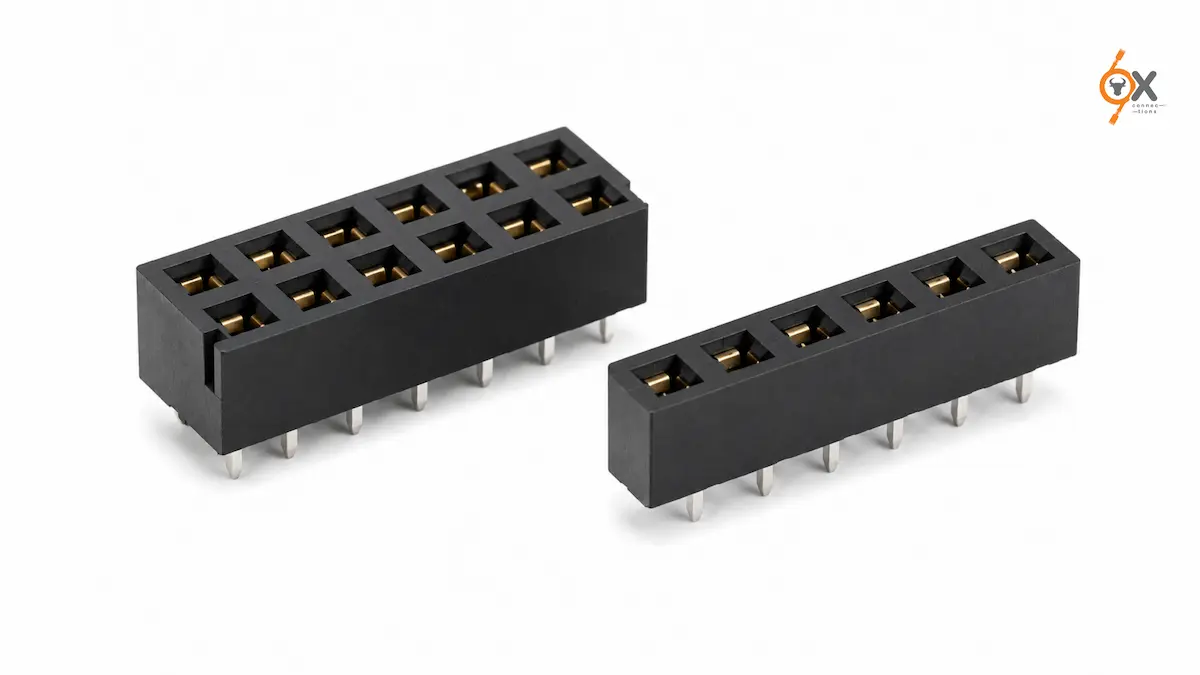
This guide explores what defines a PCB socket equivalent, the factors to consider before selecting one, and how to ensure compatibility without compromising performance.
Printed Circuit Boards (PCBs) form the backbone of almost every electronic device – from industrial automation systems and medical equipment to consumer electronics and automotive applications. While components like ICs and capacitors often receive the spotlight, PCB socket connectors play an equally critical role in ensuring reliable electrical connections between the PCB and external components.
For design engineers and procurement teams, finding a PCB socket equivalent is a common requirement. Components may become obsolete, have long lead times, or exceed budget constraints. However, replacing a PCB socket isn’t as simple as choosing one with the same appearance. A compatible replacement must meet electrical, mechanical, and environmental requirements to ensure long-term system reliability.
What Is a PCB Socket Connector?
A PCB socket connector is designed to establish a removable electrical connection between a printed circuit board and another component such as a plug, cable assembly, daughterboard, or electronic module. Unlike soldered joints, sockets allow easy installation, replacement, testing, and maintenance.
These connectors are widely used in:
- Industrial control panels
- Consumer electronics
- Medical devices
- Automotive electronics
- Telecommunications equipment
- Power supplies
- Renewable energy systems
Depending on the application, PCB sockets are available in various pitches, current ratings, pin configurations, mounting styles, and locking mechanisms.
Why Do Engineers Search for a PCB Socket Equivalent?
There are several reasons why manufacturers and procurement teams look for compatible PCB socket replacements.
1. Long Lead Times
Global supply chain disruptions often result in extended delivery schedules for branded connectors. A compatible equivalent helps manufacturers keep production moving without redesigning the PCB.
2. Cost Optimisation
Electronic assemblies often contain dozens of connectors. Selecting a technically compatible equivalent can significantly reduce overall production costs while maintaining performance.
3. Product Obsolescence
Connector manufacturers occasionally discontinue certain product lines. Finding an equivalent becomes essential for supporting legacy equipment and ongoing production.
4. Multi-Sourcing Strategy
Many OEMs avoid relying on a single supplier. Using compatible equivalents creates sourcing flexibility and reduces procurement risks.
What Makes a Good PCB Socket Equivalent?
Not every connector that looks similar will perform the same. Before selecting an equivalent, engineers should evaluate several technical parameters.
Pitch
The connector pitch refers to the centre-to-centre distance between adjacent contacts.
Even a small difference in pitch can make the connector incompatible with the PCB layout. Common pitches include:
- 27 mm
- 00 mm
- 54 mm
- 50 mm
- 08 mm
The replacement connector must exactly match the PCB footprint.
Number of Positions
The equivalent should offer the same number of contact positions or pins.
Using fewer pins may prevent installation, while additional unused positions can create mechanical interference depending on the enclosure design.
Current Rating
Every connector is designed to carry a specified amount of current safely.
Choosing an equivalent with a lower current rating may result in:
- Excessive heating
- Voltage drop
- Contact degradation
- Premature connector failure
Always ensure the replacement meets or exceeds the original current specification.
Voltage Rating
Industrial applications often operate at higher voltages than consumer electronics.
A suitable equivalent should match the required insulation characteristics and voltage rating specified by the original connector.
Mounting Style
PCB socket connectors are available in different mounting options:
- Through-hole
- Surface Mount Technology (SMT)
- Vertical mounting
- Right-angle mounting
The mounting style must remain identical to ensure compatibility with the PCB design.
Contact Material and Plating
Connector performance depends heavily on contact materials and surface finishes.
Common plating options include:
- Tin plating
- Gold plating
- Nickel underplating
Gold-plated contacts generally provide superior corrosion resistance and improved signal integrity in demanding environments.
Housing Material
The housing should be manufactured using high-quality engineering thermoplastics such as PA66 or equivalent flame-retardant materials that meet recognised safety standards.
Durable housing materials improve:
- Mechanical strength
- Heat resistance
- Long-term reliability
- Dimensional stability
Locking Mechanism
Some PCB sockets include locking latches or retention systems to prevent accidental disconnection.
When selecting an equivalent, ensure the locking mechanism matches the mating connector.
Common Applications of PCB Socket Connectors
PCB socket connectors are used across numerous industries because they simplify assembly, servicing, and component replacement.
Typical applications include:
Industrial Automation
Used in PLCs, motor drives, HMIs, sensors, and control cabinets where reliable electrical connections are essential.
Medical Equipment
Medical devices require secure, high-quality connectors that maintain consistent electrical performance over repeated use.
Consumer Electronics
Televisions, audio systems, home appliances, and smart devices frequently use PCB socket connectors for modular assembly.
Automotive Electronics
Modern vehicles contain multiple electronic control units where durable PCB connectors help withstand vibration and varying temperatures.
Renewable Energy
Solar inverters, battery management systems, and energy storage equipment rely on dependable PCB connectors for stable electrical connections.
Common Mistakes When Selecting PCB Socket Equivalents
Although many connectors appear interchangeable, overlooking technical details can lead to expensive failures.
Some common mistakes include:
Choosing Based Only on Dimensions
External dimensions alone do not guarantee compatibility.
Always verify electrical ratings, contact configuration, and mechanical tolerances.
Ignoring Environmental Conditions
Applications exposed to:
- Dust
- Moisture
- Chemicals
- High temperatures
- Continuous vibration
require connectors designed for those operating conditions.
Selecting Lower-Quality Materials
Low-cost connectors manufactured using inferior plastics or contact materials may initially function correctly but often experience reduced lifespan under continuous operation.
Why Certifications Matter
Reliable PCB socket connectors should comply with recognised industry standards wherever applicable.
These certifications typically indicate that the connector has undergone testing for safety, material quality, and performance.
Common certifications include:
- UL Recognition
- RoHS Compliance
- CE Compliance
Using certified connectors helps manufacturers maintain product quality while meeting customer and regulatory expectations.
Choosing a Reliable PCB Connector Manufacturer
Finding the right PCB socket equivalent involves more than matching dimensions.
A dependable connector supplier should offer:
- Consistent product quality
- Wide inventory availability
- Multiple pin configurations
- Technical support
- Short lead times
- Reliable documentation
- Quality certifications
Working with an experienced supplier also simplifies future procurement by ensuring continuity across production cycles.
Conclusion
Finding the right PCB socket equivalent is a balance of electrical compatibility, mechanical precision, and long-term reliability. While supply chain challenges and cost pressures make alternatives increasingly attractive, selecting an equivalent should never involve compromises in quality or performance.
By carefully evaluating parameters such as pitch, current rating, voltage capacity, mounting style, contact plating, housing material, and certifications, engineers can confidently identify compatible PCB socket connectors that meet application requirements while supporting uninterrupted production.
At OXConnections, we supply a comprehensive range of high-quality PCB socket connectors and equivalent connectivity solutions for industrial automation, consumer electronics, medical devices, renewable energy, automotive, and OEM applications. Our products are designed to meet stringent quality standards while offering dependable availability, competitive pricing, and minimal lead times – helping manufacturers source reliable connector solutions without compromising on performance.