
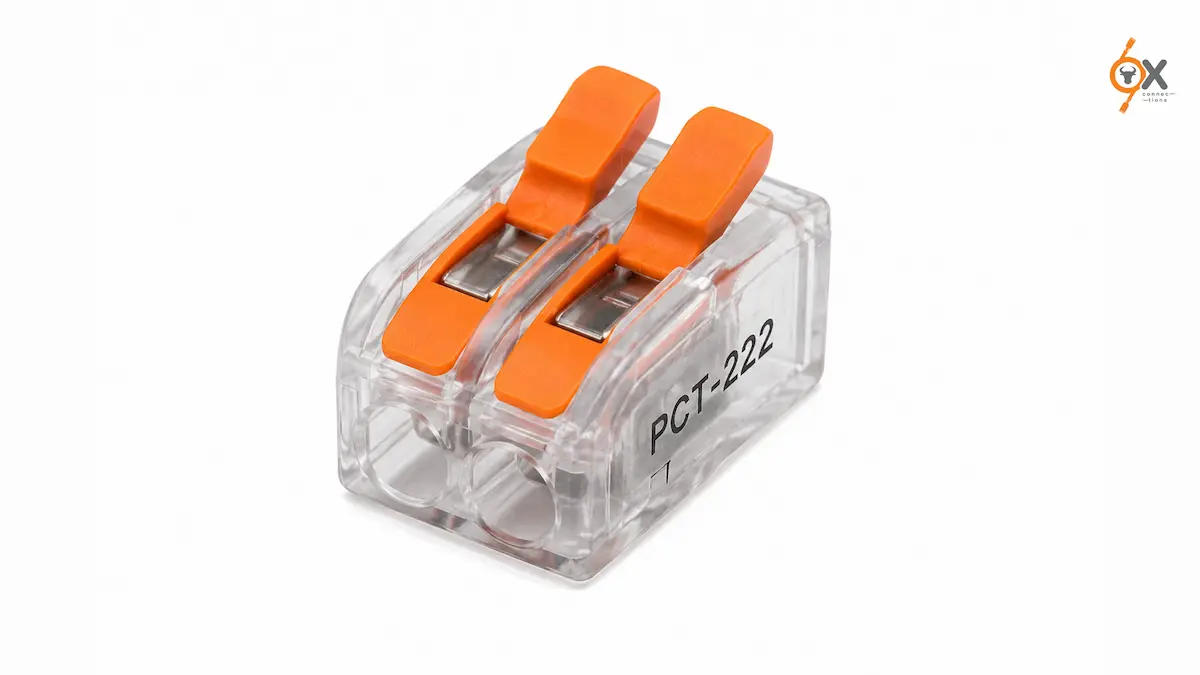
This guide explains the PCT-222 connector, its connection mechanism, key features, and factors to consider before selecting it for an application.
Electrical installations often require multiple wire connections in a limited space. Panel builders and OEMs need connectors that simplify installation without compromising connection integrity.
The PCT-222 connector belongs to the PCT Series of releasable connectors from OX Connections. The series uses a spring-loaded lever mechanism to secure conductors without tools. OX lists PCT-222 through PCT-225 in this series, with configurations from 2-pin to 5-pin. The connectors support both solid and stranded conductors within the specified wire range.
For electrical installers, panel builders, and OEMs, the right connector can improve wiring efficiency. It can also make future circuit changes and maintenance easier.
What Is the PCT-222 Wire Connector?
The PCT-222 is a releasable wire connector designed for electrical wire joining applications.
It uses a spring-loaded lever mechanism. The installer lifts the lever, inserts the stripped conductor, and pushes the lever down. The spring mechanism then holds the conductor in place. OX describes the connection as gas-tight and resistant to vibration and pull-out.
The PCT Series also uses a transparent housing. This allows installers to visually check wire insertion during installation.
The design provides a practical alternative to connection methods that require separate tools for tightening or crimping.
How the PCT-222 Electrical Wire Connector Works
The PCT-222 uses a lever-operated spring connection.
The process is straightforward:
- Lift the lever to open the spring clamp.
- Prepare the wire according to the manufacturer’s instructions.
- Insert the stripped conductor into the connection point.
- Push the lever down.
- Check that the conductor sits correctly inside the connector.
OX explains that the spring mechanism maintains contact pressure on the conductor. This helps create a consistent electrical connection.
The transparent housing adds another practical benefit. Installers can visually verify the wire’s position rather than relying only on the feel of the connection.
Why Use a Releasable Wire Connector?
Not every electrical connection needs a permanent termination.
Some installations require future changes, troubleshooting, or equipment replacement. In these cases, a releasable wire connector can make service work more convenient.
The PCT Series allows users to release the connection through its lever mechanism. This supports applications where installers may need to modify or inspect wiring later.
The design can also reduce installation time. Technicians do not need a screwdriver or crimping tool to operate the lever mechanism. For high-volume assembly work, these small time savings can become significant across multiple units.
PCT-222 Push-In Wire Connector Design
The PCT Series falls within the category of push-in wire connector and reusable spring connection solutions listed by OX Connections.
The spring-loaded mechanism provides the connection force. The lever controls the opening and closing of the contact.
This approach differs from conventional screw terminals. A screw terminal requires the installer to tighten a screw around the conductor. The PCT design uses the spring mechanism instead.
Each connection method has its own applications. Engineers should select the option that matches the circuit, conductor, installation environment, and maintenance requirements.
Key PCT-222 Wire Connector Features
The PCT-222 forms part of a wider PCT Series. OX highlights several features across the series.
Spring-Loaded Lever Mechanism
The lever opens and closes the spring connection. This allows technicians to connect or release conductors without separate tools.
Solid and Stranded Wire Compatibility
OX states that the PCT Series supports both solid and stranded conductors. The listed wire range for the series is 0.5 sq. mm to 4 sq. mm.
Always check the applicable product documentation before selecting a conductor outside the stated range.
Transparent Housing
The transparent housing allows visual verification of wire insertion. This can help installers identify incomplete connections during assembly.
Reusable Connection
The lever mechanism allows the connection to open and close again when the application requires circuit changes or maintenance.
Compact Configuration
The PCT Series offers 2-pin through 5-pin configurations. PCT-222 belongs to this range of releasable connector options.
RoHS Compliance
OX lists the PCT Series as RoHS compliant.
Choosing the Right Electrical Wire Connector
Selecting an electrical wire connector requires more than checking its physical size.
Engineers should first review the conductor requirements. The wire must fall within the connector’s specified range.
Next, check the electrical requirements of the application. The connector’s rated voltage and current must match the circuit.
Also consider the installation environment. Indoor electrical assemblies may have different requirements from installations exposed to moisture, dust, vibration, or temperature changes.
Finally, consider maintenance. A releasable connector can offer an advantage when technicians need to modify or inspect connections later.
PCT-222 Wire Compatibility
Wire compatibility plays an important role in connector selection.
OX states that the PCT Series accommodates wire sizes from 0.5 sq. mm to 4 sq. mm. The series supports both solid and stranded conductors.
However, installers should not assume that every conductor within a broad range suits every specific configuration.
Before installation, check the relevant product documentation. Confirm the conductor type, wire size, stripping requirements, and installation procedure.
Correct wire preparation also matters. An incorrectly stripped conductor may not engage with the contact correctly.
Applications for the PCT-222 Wire Connector
Releasable connectors can support a range of electrical wiring applications.
OX identifies applications such as lighting installations, HVAC control wiring, junction box connections, and rapid prototyping environments for its releasable connector range.
The PCT Series can also support electrical installation and wiring requirements where its specifications match the application.
Potential applications include:
- Electrical panels
- Lighting systems
- Junction box connections
- HVAC control wiring
- Equipment wiring
- Industrial control systems
- OEM assemblies
- Maintenance-oriented electrical installations
Application suitability depends on the connector’s technical specifications and the requirements of the circuit.
PCT-222 vs Traditional Screw Connections
Traditional screw terminals remain common in electrical panels and equipment.
They provide a familiar connection method and work well across many applications. However, installation requires the technician to tighten the terminal correctly.
The PCT-222 uses a lever-operated spring mechanism instead.
This can simplify repetitive wiring work. It can also make connection and disconnection easier during maintenance.
For OEMs, the choice may depend on assembly time, available space, service requirements, conductor compatibility, and production processes.
There is no single connector type that suits every application. Engineers should evaluate the connection method against the complete system requirements.
Installation Tips for a Push-In Wire Connector
Correct installation remains essential even when a connector offers tool-free operation.
Start by confirming the conductor type and size. Strip the wire according to the manufacturer’s specified length. Avoid damaging the conductor during stripping.
Lift the PCT-222 lever before inserting the wire. Insert the conductor fully into the connection point.
Push the lever down to secure the conductor. Use the transparent housing to visually check the wire position. Finally, inspect the finished connection before energising the circuit. Following a consistent installation process can reduce wiring errors.
Why the Right Wire Connector Matters for OEMs
OEMs often repeat the same wiring process across large production runs.
A consistent wire connector can help standardise assembly. A lever-operated design can also reduce the number of manual steps required for each connection.
That can improve workflow efficiency when technicians need to make many connections.
Procurement teams should consider more than purchase price. They should also evaluate product availability, technical specifications, application compatibility, installation time, and maintenance requirements.
A connector that fits the application can support a more efficient assembly process.
Source PCT-222 Connectors from OX Connections
OXConnections supplies electronic and electrical connector solutions for OEMs, industrial users, manufacturers, and distributors.
The company’s connector portfolio covers multiple categories, including wire-to-wire connectors, wire-to-board connectors, power connectors, circular connectors, terminal blocks, and releasable connectors. OX states that it maintains more than 5,000 connector types in stock and supports customers with technical and sourcing assistance.
The PCT Series adds a releasable lever-operated option for wire connection requirements. OX lists PCT-222 through PCT-225, with 2-pin through 5-pin configurations and a 0.5 sq. mm to 4 sq. mm wire range.
For OEMs and panel builders, OX Connections can help identify connector options based on the required configuration, conductor, and application.
Frequently Asked Questions
What is a PCT-222 connector?
The PCT-222 is part of OX Connections’ PCT Series of releasable connectors. The series uses a spring-loaded lever mechanism to connect and release electrical conductors without tools.
What type of wire does the PCT-222 support?
OX states that the PCT Series supports both solid and stranded conductors. The listed wire range is 0.5 sq. mm to 4 sq. mm.
Is the PCT-222 reusable?
The PCT Series uses a releasable lever mechanism. This allows users to open the connection and remove the conductor when the application requires changes or maintenance.
What is a push-in wire connector?
A push-in wire connector uses a spring-based contact mechanism to secure an electrical conductor. The PCT Series uses a lever-operated spring mechanism that controls the connection.
What should I check before selecting an electrical wire connector?
Check the conductor type and size first. Then review the connector’s electrical ratings, configuration, installation requirements, and operating environment.
Always use the manufacturer’s technical documentation for final product selection.
Where can the PCT-222 be used?
OX positions its releasable connector range for applications including lighting, HVAC control wiring, junction box connections, and rapid prototyping. The PCT Series can also support other electrical wiring applications when the connector specifications match the circuit requirements.