
See the RJ45 connector colour code for T568A and T568B. Learn pin order, straight-through and crossover wiring, testing tips and connector options in India.
A control panel passes every electrical test, gets commissioned, and still drops its Ethernet link within the first week. On the shop floor, the RJ45 connector colour code is usually the reason, not the switch or the PLC. Wire sequence inside the plug decides whether a LAN connection holds up under vibration, EMI from nearby drives, and years of panel-door flexing, or fails quietly at the worst possible time.
This guide is written for the people actually specifying and terminating these connectors on Indian shop floors: OEMs building control panels, panel builders sourcing components, electricians doing the physical termination, and procurement teams deciding what to stock. It covers the RJ45 colour code, how to pick the right connector for the application rather than just what’s on the shelf, and where wiring commonly goes wrong on industrial sites.
T568A vs T568B: The Colour Code and Which One Your Site Should Use
Both standards use the same eight conductors from a twisted-pair cable, ordered differently only on pins 1, 2, 3, and 6. Pins 4, 5, 7, and 8 stay identical across both, which is why partial confusion, getting the middle pairs right but not the outer ones, is such a common failure point.
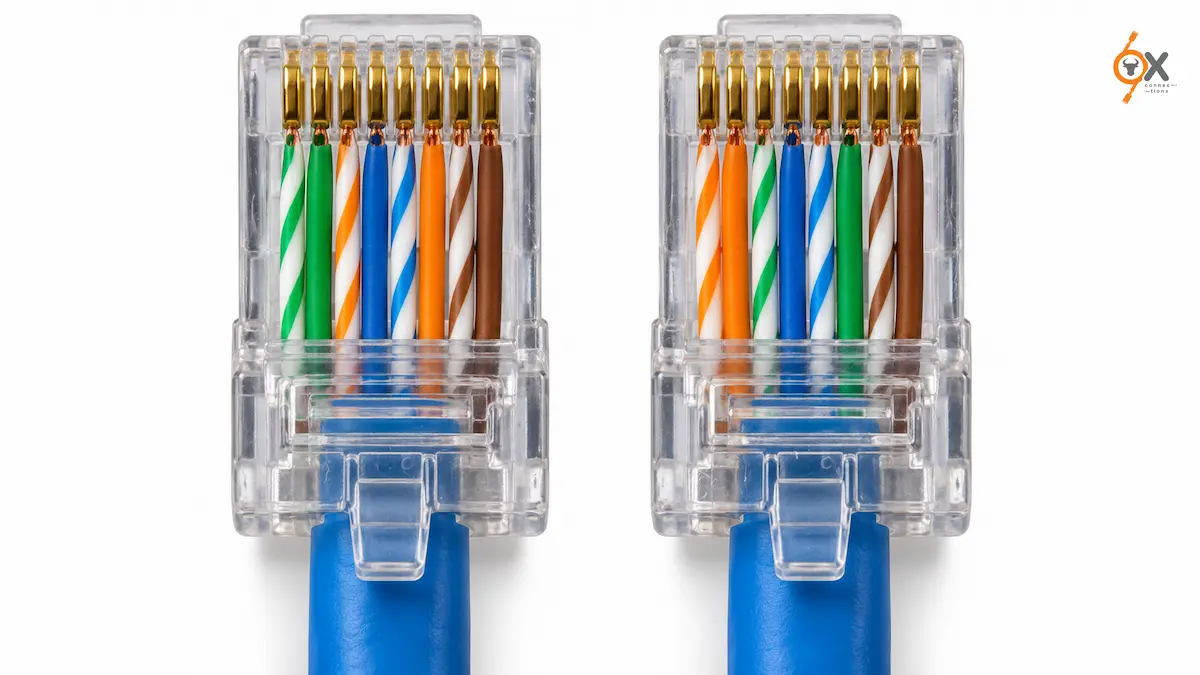
T568A: White/Green, Green, White/Orange, Blue, White/Blue, Orange, White/Brown, Brown.
T568B: White/Orange, Orange, White/Green, Blue, White/Blue, Green, White/Brown, Brown.
| Pin | 1 | 2 | 3 | 4 | 5 | 6 | 7 | 8 |
| T568A | White/Green | Green | White/Orange | Blue | White/Blue | Orange | White/Brown | Brown |
| T568B | White/Orange | Orange | White/Green | Blue | White/Blue | Green | White/Brown | Brown |
Fig. 1: RJ45 pin-to-wire colour mapping for T568A and T568B (clip facing down, contacts up).
Neither standard is technically superior. The decision that actually matters is site-wide consistency: pick one T568A vs T568B standard for the entire installation and document it in the panel drawings, so the next electrician who opens that panel doesn’t have to guess. T568B tends to be the default on most commercial and industrial sites in India, while T568A still shows up on older or government-spec installations, so it’s worth confirming the site standard before terminating the first cable, not the last.
Selection Table: Matching the Connector to the Application
Not every RJ45 termination on a panel or shop floor needs the same connector. Matching the type to where it actually sits reduces field failures more than any single wiring technique does.
| Application on the Panel or Floor | Recommended Connector Type | Mounting | Standard to Follow |
| Control panel door or gland plate, exposed to panel-shop dust and vibration | Shielded RJ45 female socket | Panel/gland mount | Match the standard used on the rest of the site |
| Patch cords between switches, PLCs, or HMIs inside the panel | Male RJ45 plug, moulded type | Cable mount | Same standard both ends |
| Cable extension or a coupler joining two shorter runs | Transition (coupler) connector | In-line | Not applicable, pass-through only |
| Office or admin-block structured cabling on the same site | Female socket, vertical or horizontal, unshielded is usually sufficient | Wall/rack mount | Whichever standard the site has standardised on |
Table 1: A quick reference for picking the right RJ45 configuration by application, not just by what’s in stock.
Straight-Through vs Crossover: Where Each Still Applies
A straight-through cable, same standard on both ends, connects dissimilar devices such as a PLC to a managed switch, and covers most panel and site wiring. A crossover cable, T568A on one end and T568B on the other, was historically needed to link two similar devices directly, such as switch to switch, without an intermediate device.
Most modern switches and industrial Ethernet devices auto-sense the connection with Auto-MDIX and no longer need a dedicated crossover cable. It’s still worth keeping a couple on hand for older or auto-sense devices that don’t support it, particularly on legacy retrofit jobs.
Terminating and Testing: Where Panel Failures Actually Start
Most field failures trace back to three points in the termination process, not to the connector itself:
Untwisted pair length: Pulling the twist apart too far back from the plug increases crosstalk. Keep the untwisted section as short as the connector allows.
Uneven wire seating: If the eight conductors aren’t trimmed flush before crimping, some won’t seat against the gold contacts, which shows up as an intermittent link rather than a dead one, making it harder to trace later.
Strain relief: A cable that isn’t gripped by the jacket, only by the conductors, will eventually fail from panel-door movement or cable dressing pulls. A quick tug test after crimping catches this before the panel ships.
A basic cable tester checking continuity across all eight pins, run before the panel is closed up, catches open circuits, shorts, and split pairs. On a production run, testing every cable on the bench costs far less than tracing an intermittent fault after commissioning.
Sourcing RJ45 Connectors for Panel Builds
Ox Connections stocks RJ45, RJ11, and RJ48 connectors across multiple pin configurations, including female sockets in vertical and horizontal mount, moulded male plugs, and shielded variants, with over 5,000 products in stock for quick dispatch across India. For OEMs and panel builders running multiple sites, standardising the connector source keeps termination quality consistent from the first panel to the last. Explore the full range on the Ethernet & USB Cables and Connectors page.
Need RJ45 connectors for an upcoming panel build or a bulk stocking order? Get in touch with Ox Connections for a quotation, or request the product catalogue for the full connector portfolio.
Leave A Comment