
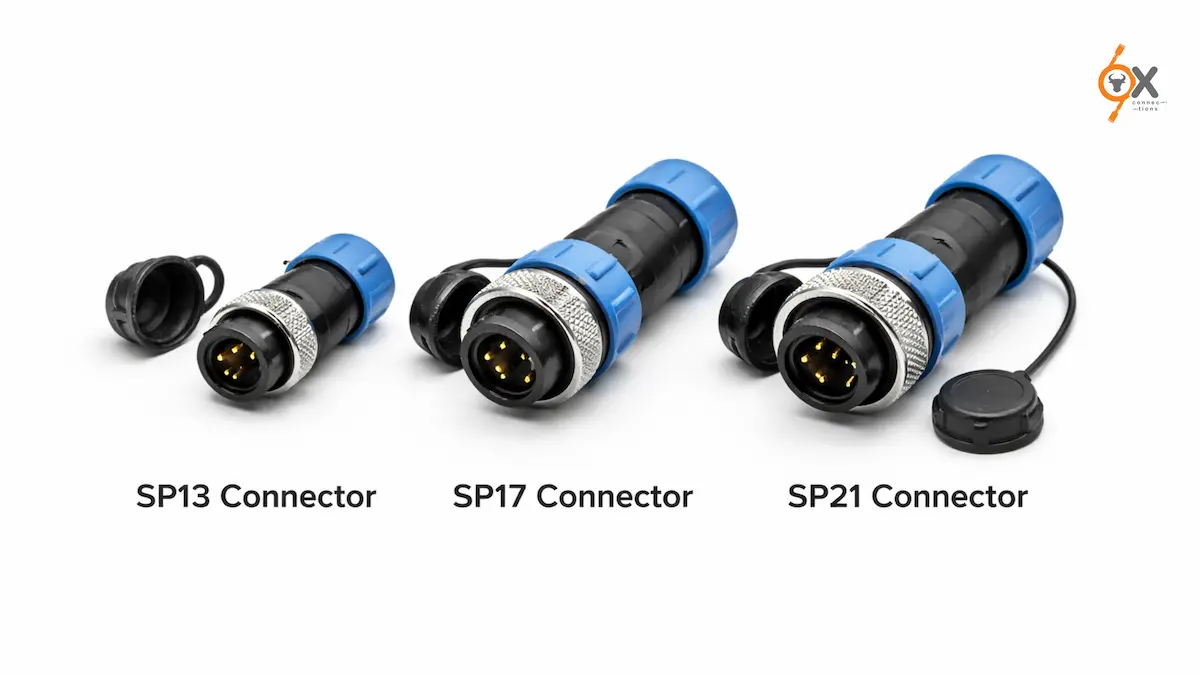
This guide explains the key considerations when comparing SP13 vs SP17 vs SP21 Connectors, helping OEMs, system integrators, and industrial equipment manufacturers make informed sourcing decisions.
Selecting the right connector is a critical decision in any industrial design. While connectors may appear to be a small component within a larger system, their performance directly impacts reliability, safety, maintenance requirements, and overall equipment uptime.
Among the most widely used waterproof circular connector families in industrial applications are the SP13, SP17, and SP21 connectors. These connectors are commonly chosen for applications that require secure electrical connections, environmental protection, and dependable performance in demanding operating conditions.
However, engineers and procurement teams often face a common challenge: Which connector size is best suited for a particular application?
Choosing a connector that is too small may limit current-carrying capability or future scalability. Selecting one that is unnecessarily large can increase costs, occupy valuable panel space, and complicate installation.
Understanding SP Series Waterproof Circular Connectors
SP Series connectors are designed for applications requiring reliable electrical connectivity in environments exposed to dust, moisture, vibration, and mechanical stress.
These connectors are commonly found in:
- Industrial automation systems
- Control panels
- Renewable energy equipment
- Medical devices
- Communication systems
- Transportation equipment
- Outdoor monitoring systems
- LED lighting installations
- Test and measurement equipment
Their popularity comes from a combination of:
- Rugged construction
- Secure locking mechanisms
- Environmental protection
- Ease of installation
- Long operational life
For many industrial applications, SP series connectors provide an excellent balance between durability and cost-effectiveness.
What Is an SP13 Connector?
The SP13 connector is generally considered the most compact option within the SP connector family.
Its smaller form factor makes it suitable for applications where space is limited and compact equipment design is a priority.
Typical applications include:
- Portable devices
- Compact control systems
- Small industrial sensors
- Data acquisition systems
- Communication equipment
- Instrumentation devices
Engineers often select SP13 connectors when:
- Panel space is limited
- Weight reduction is important
- Signal transmission requirements are relatively modest
- Compact enclosure design is a key objective
For manufacturers producing compact electronic assemblies, the SP13 connector can offer an efficient solution without compromising reliability.
What Is an SP17 Connector?
The SP17 connector occupies the middle ground between the SP13 and SP21 families.
Many engineers view SP17 connectors as a versatile choice because they offer a balance of size, robustness, and flexibility.
Common applications include:
- Industrial control systems
- Automation equipment
- Factory machinery
- Monitoring systems
- Security equipment
- Communication infrastructure
SP17 connectors are often selected when:
- More connection capacity is required than SP13 can comfortably provide
- Equipment operates in moderately demanding environments
- Additional mechanical durability is needed
- Future scalability may be required
For many OEM designs, the SP17 represents a practical compromise between compactness and performance.
What Is an SP21 Connector?
The SP21 connector is the largest and most rugged option among the three connector sizes.
Its larger body and robust construction make it particularly suitable for demanding industrial and outdoor environments.
Applications commonly include:
- Renewable energy systems
- Outdoor equipment
- Heavy industrial machinery
- Power distribution systems
- Marine applications
- Environmental monitoring stations
- Transportation systems
SP21 connectors are frequently chosen when:
- Higher power requirements exist
- Mechanical strength is a priority
- Harsh environmental conditions are expected
- Long-term reliability is critical
For applications operating in challenging conditions, the SP21 connector often provides the additional durability required to ensure consistent performance.
SP13 vs SP17 vs SP21 Connectors: Key Differences
Although all three connector families share similar waterproof and industrial-grade characteristics, their suitability varies depending on application requirements.
SP13
Best suited for:
- Compact equipment
- Space-constrained installations
- Sensor systems
- Signal-level applications
Advantages:
- Smaller footprint
- Lightweight design
- Easier integration into compact assemblies
SP17
Best suited for:
- General industrial equipment
- Control systems
- Automation applications
Advantages:
- Balanced size and performance
- Flexible application range
- Suitable for many OEM requirements
SP21
Best suited for:
- Harsh environments
- Outdoor installations
- Heavy-duty industrial equipment
Advantages:
- Increased mechanical robustness
- Better suited for demanding conditions
- Preferred for larger industrial systems
Rather than assuming that larger is always better, engineers should focus on matching connector size to actual application requirements.
Factors to Consider When Selecting Connector Size
1. Available Installation Space
One of the first considerations is physical space.
A connector that fits comfortably into a control panel may not be suitable for a compact handheld device. Reviewing enclosure dimensions early in the design process can prevent costly redesigns later.
2. Environmental Conditions
Applications exposed to dust, moisture, vibration, or outdoor weather conditions require connectors capable of maintaining reliable performance over time.
Environmental exposure should always influence connector selection.
3. Power and Signal Requirements
Different applications have different electrical demands.
Industrial control systems, communication equipment, sensors, and power distribution systems all have unique requirements. Engineers should evaluate current, voltage, and signal needs before finalizing connector selection.
4. Mechanical Stress
Equipment operating in factories, transportation systems, or outdoor installations often experiences vibration and repeated movement.
Connector durability becomes increasingly important in such environments.
5. Maintenance Accessibility
Maintenance teams must be able to access and service connectors efficiently.
A connector that is difficult to access can increase maintenance time and operational downtime.
6. Future Expansion Requirements
Forward-thinking design teams often plan for future upgrades.
Selecting a connector solely for current requirements may limit future flexibility if additional functionality is required later.
Common Connector Selection Mistakes
Choosing Based Only on Initial Cost
Selecting the lowest-cost connector without considering lifecycle performance can result in higher maintenance costs and system failures.
Ignoring Environmental Factors
Indoor and outdoor operating conditions differ significantly.
Failing to account for moisture, dust, or vibration can reduce connector lifespan.
Oversizing the Connector
A larger connector may appear to offer additional flexibility, but unnecessary oversizing can increase enclosure dimensions, material costs, and assembly complexity.
Neglecting Supply Chain Considerations
A technically suitable connector still becomes a problem if it has long lead times or inconsistent availability.
For OEMs operating in competitive markets, component availability can be just as important as technical specifications.
Why Connector Availability Matters for Indian OEMs
Manufacturers across India are under increasing pressure to reduce project timelines, manage procurement costs, and maintain production schedules.
Long international lead times can delay equipment delivery and increase inventory carrying costs.
As a result, many procurement teams now prioritise suppliers capable of offering:
- Consistent stock availability
- Reliable delivery schedules
- Technical support
- Competitive commercial terms
- Quality assurance documentation
For OEMs in sectors such as renewable energy, automation, medical equipment, home appliances, and industrial electronics, dependable sourcing has become a strategic advantage rather than simply a procurement consideration.
Conclusion
There is no universal answer to the SP13 vs SP17 vs SP21 Connectors question.
The right choice depends on a combination of:
- Installation space
- Environmental conditions
- Mechanical requirements
- Electrical demands
- Maintenance considerations
- Future scalability
SP13 connectors are ideal for compact applications, SP17 connectors provide a versatile middle-ground solution, and SP21 connectors are typically preferred for more demanding industrial environments.
By evaluating application requirements carefully, engineers can select the connector size that delivers the best balance of performance, reliability, and long-term value.
Source Reliable SP Series Connectors from OX Connections
For OEMs, system integrators, and industrial equipment manufacturers seeking dependable connector solutions, OX Connections supplies a comprehensive range of SP Series Waterproof Circular Connectors designed for demanding industrial applications.
As a stocking distributor, OX Connections supports customers with consistent availability, competitive commercial terms, dependable quality standards, and a proven track record serving OEMs across renewable energy, industrial automation, medical equipment, home appliances, EV, and electronics sectors. Whether your application requires SP13, SP17, or SP21 connectors, our team can help identify the most suitable solution for your design and procurement requirements.
Disclaimer
Connector selection should always be based on detailed technical requirements, environmental conditions, applicable industry standards, and project-specific engineering considerations. Product suitability may vary depending on the application. Consult OXConnections for detailed technical guidance and product availability before finalising specifications.