
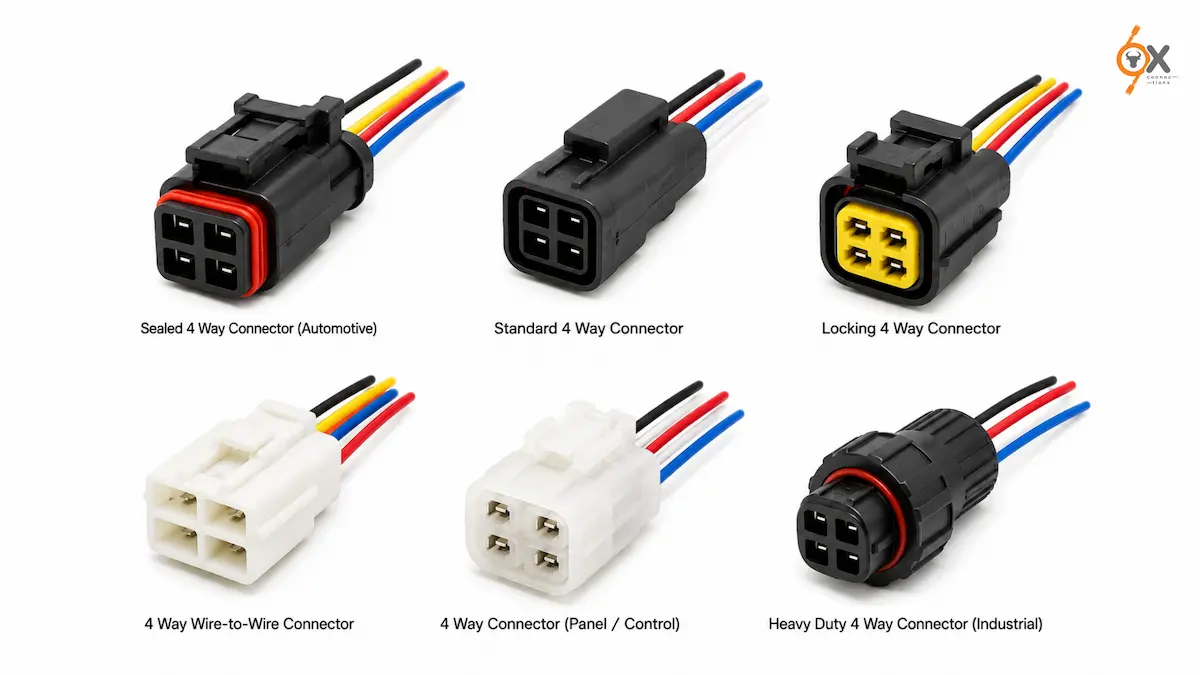
Anyone who has pulled apart a trailer harness on the roadside knows this feeling. So does anyone who has opened a factory control panel that some electrician wired “temporarily” three years ago. Both know why the humble 4 way connectors deserves more respect than it gets.
It is not glamorous. Nobody puts a connector on a mood board. But it is usually the difference between a wiring job that survives ten years of vibration, heat, and monsoon moisture, and one that fails for no apparent reason.
At Ox Connections, one pattern keeps showing up across the automotive and industrial projects we supply for. Teams blame most failures on “bad wiring.” In reality, most of those failures happen at the connection point. The wire is fine. The connector is not. This is why understanding where a 4 way connector earns its place matters. In both automotive and industrial systems, it is not a technical footnote. It is the whole story.
Why the Automotive World Leans on 4 Way Connectors
Open the hood of almost any car built in the last two decades. You will find a small army of 4-pin connections doing quiet, unglamorous work. A 4 pin connector automotive setup typically handles jobs where you need power plus a couple of signal lines in one compact housing, rather than running a tangle of separate wires.
A few places you will actually find these in day-to-day vehicle wiring:
- Oxygen sensors and MAF sensors, where the connector has to survive under-hood heat cycling without the pins loosening over time.
- Trailer and towing harnesses, where the 4-way flat connector is practically the industry default for lights and indicators on light vehicles.
- Relay packs, blower motors, and wiper systems, where a secure 4-pin connection prevents intermittent faults that are maddening to diagnose.
- Ignition and fuel system wiring, where a loose connector does not just cause inconvenience. It can cause a breakdown.
What ties all of these together is vibration resistance and a reliable locking mechanism. Automotive environments shake, heat up, cool down, and get exposed to road grime. A 4 way connector built for this duty needs a firm mechanical lock, corrosion-resistant plating on the pins, and a housing material that will not turn brittle after two summers.
Where Industrial Wiring Needs a Tougher 4 Way Connector
Move from a car engine bay to a factory floor and the demands change. But the core logic stays the same: fewer loose wires, more secure junctions, faster maintenance. This is where broader categories of electrical wire connectors come into play across panels, machinery, and control systems.
In industrial settings, 4-way connectors typically show up in:
- Control panel wiring, where technicians need to quickly identify and swap a faulty line without rewiring an entire board.
- Motor and actuator connections on production lines, where downtime costs lost output, not just time.
- Sensor and automation wiring, particularly where the job needs sealed, IP-rated housings to keep out dust and moisture on the shop floor.
- Junction boxes and distribution points, where a 4-way split lets one supply line branch cleanly to multiple loads.
The practical difference between automotive and industrial use really comes down to scale and access. A car’s connector might get touched once every few years during a repair. An industrial connector, though, might get opened, tested, and reseated dozens of times during routine maintenance. The housing and the contact points need to tolerate repeated mating cycles. The grip cannot weaken. That is exactly where cheaper, uncertified electrical wire connectors tend to fall apart, quite literally.
What Separates a Reliable 4 Way Connector from a Risky One
Across Indian manufacturing floors and automotive workshops, lookalike connectors flood the market. On paper, two 4-way connectors can look identical. In practice, the gap between them shows up six months later, usually as a nuisance fault that takes an afternoon to trace.
A few things worth checking before specifying a connector for a project:
- Contact material and plating. Tin or gold-flashed contacts resist oxidation far better than uncoated brass, especially in humid Indian climates.
- Current rating versus actual load. A connector rated just at the edge of your load will run hot and degrade faster than one with headroom.
- Locking mechanism. If you can pull a connector apart by hand with light tension, it is not fit for vibration-prone automotive or machinery use.
- IP rating for sealed applications. Anything exposed to dust, oil mist, or occasional moisture needs a genuinely sealed housing, not just a snug-fitting one.
This is really the heart of why a properly engineered 4 way connector matters more than its size suggests. It sits at the exact point where two systems meet. That point is always the weakest link, unless engineers deliberately build it not to be.
Choosing the Right 4 Way Connectors for Your Application
There is no single “best” connector across automotive and industrial use, because the environments ask for different things. A workshop wiring up a trailer harness cares about weatherproofing and a tight mechanical lock. A panel builder wiring a control cabinet cares about something else. Ease of identification, quick disconnects for maintenance, and consistent quality across a large batch order matter more there.
What stays constant is this: buying electrical wire connectors on price alone almost always costs more later. Callbacks, downtime, and warranty claims add up fast. A slightly higher upfront cost on a certified, properly rated 4 pin connector automotive or industrial-grade unit tends to pay for itself within the first year. It simply does not fail.
If there is one habit worth building into any wiring project, it is this: treat connector selection with the same seriousness as wire gauge selection, automotive or industrial. Wire gets all the attention in specification sheets. Connectors quietly decide whether that wire actually does its job for the long haul.
Common Mistakes That Wear Out a 4 Way Connector Early
Even a well-built connector will fail early if someone installs it carelessly. Over the years, a handful of recurring mistakes show up again and again. They appear on both shop floors and vehicle wiring jobs. Almost none of them are about the connector itself.
- Forcing a mismatched connector. Pairing a slightly wrong-size housing just because “it fits with some pressure” cracks locking tabs fast. That tab would otherwise last for years.
- Skipping strain relief. A connector doing double duty as a cable anchor, with no separate strain relief, will eventually pull at the pins. That loosens the contact from the inside.
- Ignoring ambient conditions. A standard, unsealed connector in an engine bay or near workshop coolant spray invites early corrosion, no matter how good the base connector is.
- Reusing damaged housings. It is tempting to reuse a connector during a quick repair. But a housing with a weakened latch rarely holds as firmly the second time around.
None of this is complicated. But it is exactly the kind of detail people skip when they rush a job. A good 4 way connector installed carelessly will still fail early. The component and the installation practice have to work together.
A Quick Word on Sourcing 4 Way Connectors
For anyone specifying connectors at scale, consistency across units matters as much as the spec sheet of a single sample. This holds whether you’re ordering a batch of vehicle harnesses or an industrial control panel run. Teams often test one connector, approve it, and then receive a production batch where tolerances drift. That drift causes fitment issues on the line. Working with a supplier that maintains tight quality control across large orders of electrical wire connectors saves far more time than it seems to on paper. This matters most for teams running continuous production rather than one-off repairs.
Final Word
The next time a wiring job causes more grief than it should, check the connectors first. Do that before blaming the wire, the sensor, or the switch. A dependable 4 way connector is a small component with an outsized job. It keeps current and signal flowing reliably, connection after connection, in conditions that are rarely kind to electronics. Get that piece right, and a lot of downstream headaches simply never happen. At OxConnections, every connector leaving our facility is built to meet this standard, whether it is a single sample for prototyping or a full production order.