
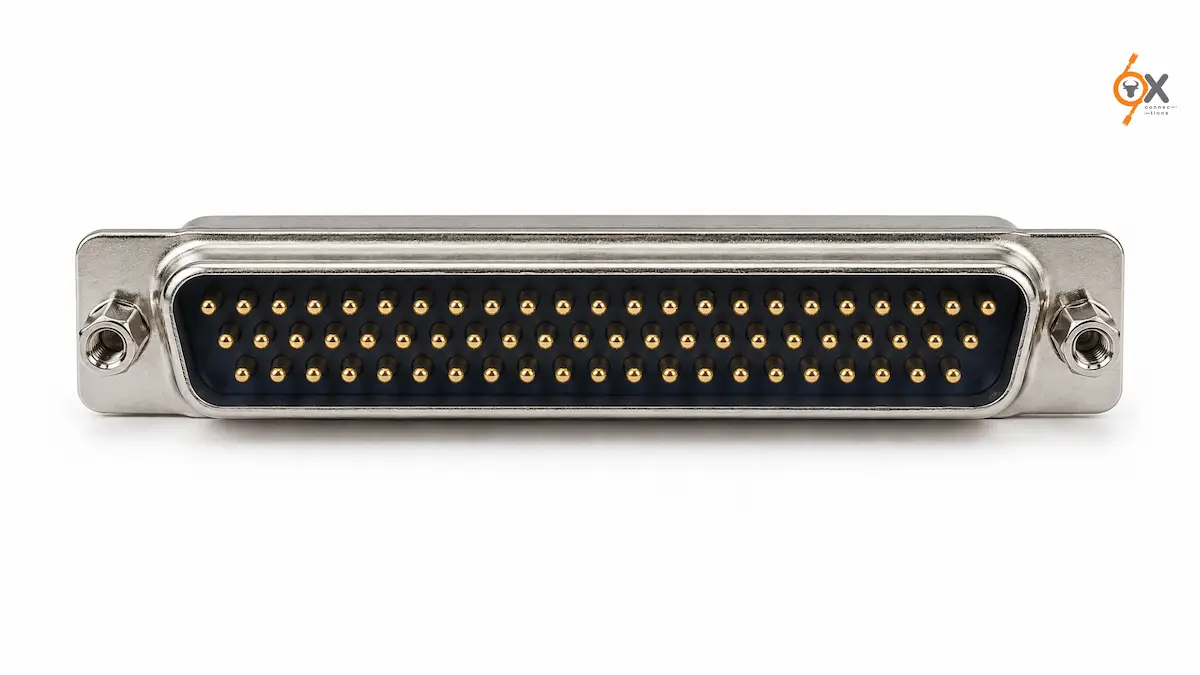
Discover where 78-pin D-Sub connector are used, why continuity testing matters, and how they support high-density industrial and data acquisition systems.
A handful of projects need almost as many signal lines as a single connector can physically carry. The 78-Pin D-Sub Connector serves that narrow but demanding niche. It sits near the top of the D-Sub range. It suits equipment where the signal count genuinely justifies this much density.
A Pin Count Reserved for Serious Density
Seventy-eight pins belong to the high-density D-Sub family, using a tighter pitch than standard sizes. That tighter spacing packs far more contacts into a shell only slightly larger than a standard 50-pin connector. Few designs actually need this many signal paths. The ones that do usually involve equipment where consolidating everything into one connector matters more than anything else.
Where This Density Genuinely Earns Its Place
Large data acquisition systems reading dozens of channels at once reach for this pin count as standard practice. Complex instrumentation racks with many independent measurement points consolidate their wiring here instead of running several smaller connectors. Industrial equipment coordinating multiple subsystems from one compact interface also relies on this density. Test benches built for exhaustive device validation often need every one of these 78 contacts. A design team choosing this size purely for headroom, without a genuine channel requirement, usually ends up carrying unused capacity for the life of the product.
D-Sub Connector Applications That Need This Much Room
D-Sub Connector Applications at this pin count involve equipment with genuinely dense signal requirements. Automation systems use it to bring a large sensor array back to one controller. Communication equipment with many parallel data lines relies on it to avoid running multiple connectors between racks. Research and calibration labs running several parallel channels also choose this size. Nothing smaller can carry the full load.
Mounting Choices Across Every Build Style
Ox Connections offers the 78-pin D-Sub across solder-type, crimp, IDC, and PCB-mounting versions. A solder-type connector suits low-volume, hand-terminated assemblies. A crimp version suits panel builders running larger batches, keeping termination quality consistent. IDC versions save time on ribbon cable jobs. PCB-mount versions, in straight or right-angle orientation, solder directly onto a board for a compact layout.
Manufacturing Precision Gets Serious at This Density
Seventy-eight contacts in one shell leave essentially no room for inconsistency. Pin spacing, plating, and retention force all need to hold steady across every position. A secure locking mechanism keeps the shell seated correctly under vibration. Threaded jack screws also resist the pull of a genuinely heavy cable bundle. A single weak contact among 78 can be difficult to trace once the connector sits buried inside a populated panel.
Sourcing a D-Sub Connector India Complex Builds Rely On
D-Sub Connector India buyers working on dense, high-channel-count panels need a supplier who treats this size as reliable stock. Ox Connections carries the 78-pin version alongside 9, 15, 25, 26, 37, 44, 50, 62, and 104 pin configurations. Over 5,000 products sit in stock. Quick dispatch across India keeps large, complex builds on schedule.
Testing Before Commissioning Really Matters Here
A connector carrying this many signals deserves a proper continuity check before a system goes live. Testing every pin individually catches a marginal contact long before it causes trouble in the field. Skipping this step to save time during installation often costs far more time later. A strange reading downstream can take hours to trace back through 78 possible contacts without a clear starting point. Building this check into a standard commissioning checklist removes the guesswork entirely.
Final Word
The 78-Pin D-Sub Connector belongs on projects where the signal count genuinely demands this much density. Match mounting style and locking hardware to the actual application. Test every pin during commissioning rather than assuming a well-built connector couldn’t be the source of a fault. Ox Connections offers D-Sub connectors across the full 9 to 104 pin range. Choices include solder, crimp, IDC, power, waterproof, and Centronics variants. Over 5,000 products stay in stock, with quick dispatch across India.
FAQ
What kind of equipment needs a 78-pin D-Sub connector?
Equipment with a genuinely large signal count, such as data acquisition systems, complex instrumentation racks, and multi-subsystem industrial controllers.
Does this connector need special testing before use?
Yes. Test continuity across all 78 pins during commissioning to catch a marginal contact before it causes a hard-to-trace fault.
How does it compare to a 62-pin connector?
It carries even more signal capacity in a similarly dense shell. It suits projects that have outgrown even the 62-pin option.
Leave A Comment