
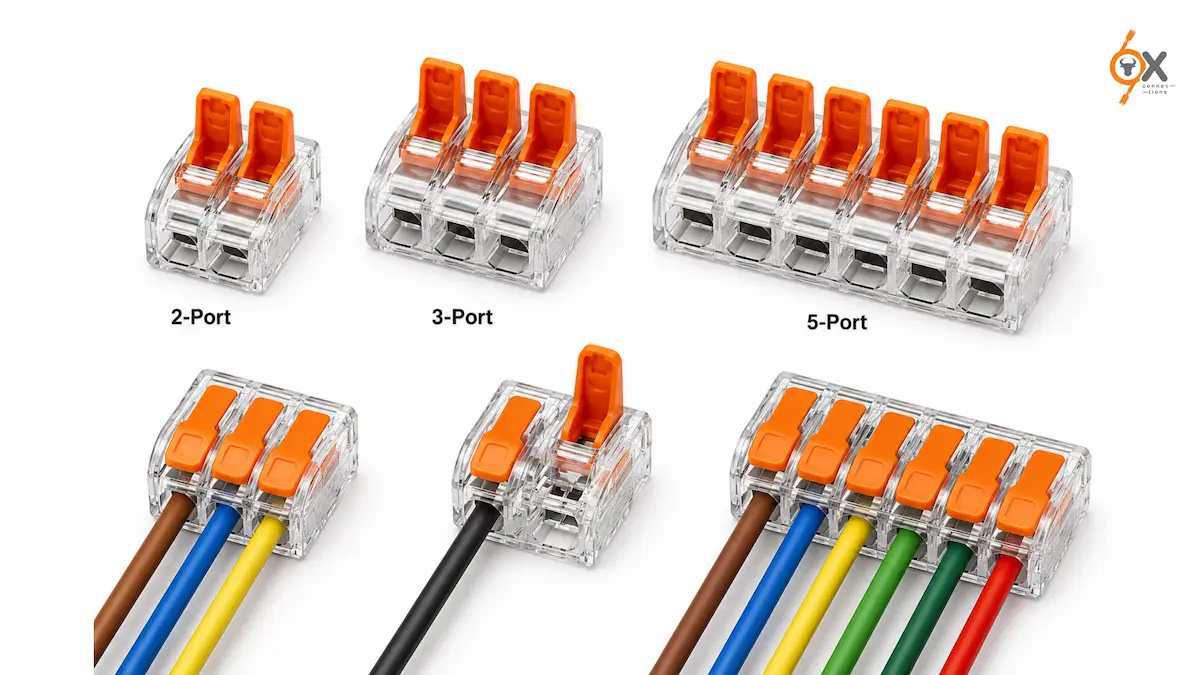
Why does an electrician still reach for a screwdriver and a roll of tape when a connector can skip both steps entirely? A PCT connector is exactly that: a lever-operated, spring-loaded terminal block. It lets you join wires by hand, with no crimping tool, no screw, and no twisting required.
PCT Connector, Defined Simply
A PCT connector is a type of push wire connector. It uses a small terminal block housing with spring-loaded brass contacts inside flame-retardant plastic. Each port has a lever on top.
Lift the lever, push the stripped wire in, and close the lever. The spring clamp then holds the conductor with steady pressure. That is the entire installation process.
The name comes from the way it works, not a specific brand. ‘Push’ describes how the wire goes in. The lever-operated mechanism opens and closes the spring clamp. It uses a simple flip lever rather than a screw thread.
It belongs to the same broader family as traditional wire nuts and screw terminal blocks. However, it solves the same job without tools or twisting.
How a PCT Connector Actually Works
A spring-loaded brass contact sits inside the housing. Lifting the lever opens the clamp. Inserting a stripped wire and closing the lever locks it in place under constant spring pressure.
That pressure does not rely on how tightly someone turns a screw. This makes the connection consistent from one installer to the next.
Most PCT connectors also have a clear or translucent housing. This lets you visually confirm that the wire sits at the correct depth. A small test port on each channel also lets you check voltage or continuity without opening the connection.
Where You Will Actually Find PCT Connectors
Ceiling and Junction Box Wiring
Tool-free installation matters most in tight spaces. This is exactly where PCT connectors show up most often in residential lighting circuits.
Branch Circuit and Neutral Distribution
Commercial buildings use them to split a supply across multiple outlets or combine neutral conductors cleanly.
Control Panels
Sensor and actuator wiring inside industrial panels benefits from the compact footprint and built-in test points.
Appliance Field Wiring
Kitchen equipment, water heaters, and HVAC units often need a field connection between factory wiring and building supply. PCT connectors can open and reuse for servicing without destroying the joint.
Quick Spec Snapshot
PCT series connectors are typically rated for 400V AC at 32A, with a surge rating around 4kV.
They accept solid conductors from 0.08 to 2.5mm² and stranded conductors from 0.08 to 4.0mm². The housing is usually a UL94 V-0 flame-retardant nylon.
Port counts range from 2-way up to 5-way as standard. Higher-port configurations are also available for larger distribution needs.
PCT Connector vs. Wire Nut vs. Screw Terminal
A wire nut relies on twisting conductors together and trusting friction to hold them. This varies with installer technique and can loosen with vibration over time.
A screw terminal depends on torque. When tightened correctly, it holds well. However, it is easy to under- or over-tighten.
A PCT connector removes both variables. The spring does the clamping, not the installer’s hand strength or a screwdriver’s torque setting.
Unlike a wire nut, a PCT connector can open and reuse for troubleshooting or a circuit change.
Is a PCT Connector Right for Your Job?
If a connection needs to be made fast, inspected visually, and potentially reopened later for maintenance, a PCT connector is usually the more practical choice over a permanent crimp or a wire nut.
For applications needing a genuinely permanent, vibration-proof joint in a sealed enclosure, a crimped or soldered connection may still be preferable.
Always confirm the connector’s voltage and current rating against your circuit before specifying it. Also, check that local electrical code permits push wire connectors for the application in question.
Installing a PCT Connector the Right Way
Strip length matters more than it looks. Most PCT models call for 9 to 11mm of exposed conductor, marked directly on the housing.
Too short, and the spring clamp cannot get a proper grip. Too long, and bare wire sits exposed outside the housing.
Insert the wire fully until it seats against the internal stop before closing the lever. Use the transparent housing to visually confirm depth rather than guessing by feel.
It is also worth checking whether the connector is rated for solid, stranded, or fine-stranded wire before use.
Fine-stranded conductors generally need a ferrule for a secure grip. The spring clamp is designed around a certain conductor stiffness.
Where to Source PCT Connectors in India
OxConnections stocks PCT series push wire connectors ex-India. The range includes the standard 2-port through 5-port configurations. These are ready for fast dispatch rather than an overseas order.
For a full technical breakdown of available PCT models, wire compatibility, and installation guidelines, the detailed PCT Series product guide on the Ox Connections blog covers specifications port by port.
Share your port configuration and quantity. The team can confirm availability directly.
PCT Connector: Frequently Asked Questions
1. What is a PCT connector used for?
A PCT connector is used to join or splice electrical wires without tools. Common applications include lighting circuits, junction boxes, control panels, and appliance field wiring.
It works anywhere a fast, reusable connection is more practical than a permanent crimp.
2. Is a PCT connector the same as a push wire connector?
Yes. PCT is a specific series name for a lever-operated push wire connector.
The broader category, push wire connectors, covers any spring-loaded terminal block that connects wires without screws or crimping.
3. Can a PCT connector be reused after installation?
Yes, the lever can be reopened to release the wire. This is one of its main advantages over a wire nut or crimped joint.
Practical reuse is generally limited to a moderate number of cycles, since repeated insertion can work-harden the conductor itself.