
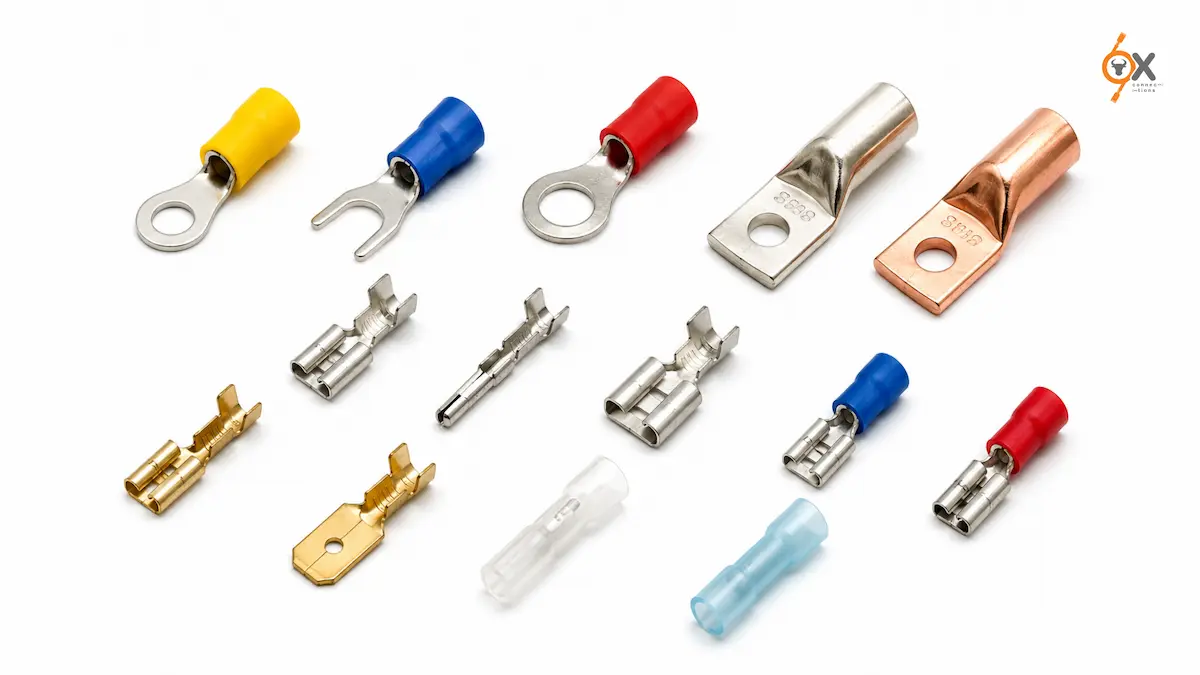
Why do so many electrical faults in Indian workshops and factories get blamed on the wire, when the actual problem is sitting one inch away at the terminal? A loose terminal rarely announces itself right away. It runs a little warm, resists a little, and then one day it lets go, usually at the worst possible moment, whether that is a delivery van stalled in Mumbai traffic or a production line stopping cold in an industrial belt around Pune or Chennai. Across automotive workshops and industrial panels in every metro city, the single most common cause of this is not a bad wire or a faulty component. It is a mismatch between the wire terminal connectors being used and the wire they were crimped onto.
At Ox Connections, working out of Mumbai, this is one of the most frequent questions that comes up from technicians and procurement teams across India: which terminal, which crimp, which size for this wire? The honest answer is that terminal selection is not guesswork once you understand the logic behind it, and it matters just as much in a Bandra workshop as it does in an industrial park outside Delhi or Bengaluru. This guide breaks down the crimp types that matter, how crimp connector sizes actually work, and how to read a wire gauge chart without getting lost in the numbers.
Wire Terminal Connectors
Why Terminal Choice Matters More Than It Looks
A terminal’s job looks simple: hold a wire, pass current, stay put. But a barrel that is even slightly too large for the conductor leaves an air gap that a crimping tool cannot close, no matter how hard it is squeezed. The result is a “cold crimp,” where the metal never fully deforms around the strands. It looks fine, tests fine on day one, and then loosens under vibration, heat cycling, or just time. A barrel that is too small does the opposite: it damages or shears strands during crimping, weakening the conductor at exactly the point where it needs to be strongest.
This is why wire terminal connectors are never a one-size-fits-most component. Every terminal on the market is designed around a specific range of wire gauges, and stepping outside that range is where most field failures actually begin.
The Crimp Types Worth Knowing
Not all crimps are built the same way, and the difference matters more in high-vibration or high-current settings than most people expect.
Open-barrel crimps use a U-shaped section that folds around the wire strands, common in automotive connector pins and PCB terminations. They allow fast, high-volume automated crimping but need tighter process control to avoid an inconsistent grip.
Closed-barrel crimps fully enclose the wire, as seen in ring terminals, butt splices, and most lugs. They tend to offer better pull-out resistance and are the safer default for permanent, high-current connections.
Insulated crimps come with a colored plastic sleeve that both protects against shorts and signals the wire range, red for thinner gauges, blue for mid-range, yellow for heavier ones. Fast to identify, but not built for very high temperatures.
Non-insulated crimps skip the sleeve entirely and are typically used with heat-shrink tubing added afterward, common where higher current or higher temperature resistance is needed.
Heat-shrink and sealed crimps combine a crimp barrel with an adhesive-lined shrink sleeve, standard in marine, automotive, and outdoor industrial wiring where moisture ingress is a real risk, exactly the kind of risk monsoon season brings to open panels and vehicle wiring across most Indian cities.
Making Sense of Crimp Connector Sizes
Once the crimp type is settled, the next decision is sizing, and this is where the color-coding system exists to save time on the shop floor. Standard crimp connector sizes for insulated terminals follow a fairly consistent convention across manufacturers:
Red terminals: built for 22 to 16 AWG wire, the thinner end of the spectrum, common in signal wiring and low-current circuits.
Blue terminals: built for 16 to 14 AWG wire, the most common range in general automotive and light industrial wiring.
Yellow terminals: built for 12 to 10 AWG wire, used for higher-current circuits like starter motors, battery feeds, and heavier machinery loads.
Anything larger than 10 AWG typically moves into non-insulated lugs, since a color-coded sleeve stops being a reliable size indicator at that point, and a separate insulating boot or heat-shrink sleeve takes over that job.
It is worth noting that the color only tells you the intended wire range, not the crimp quality. Two blue terminals from two different suppliers can behave very differently under the same crimping tool if the barrel wall thickness or plating is inconsistent, which is exactly the kind of detail that separates a batch that holds up from one that does not.
Reading a Wire Gauge Chart Without the Confusion
The AWG system trips people up because it runs backwards from intuition: a higher number means a thinner wire, not a thicker one. An 18 AWG wire is thinner than a 10 AWG wire, even though 18 is the larger number. Once that inversion clicks, a wire gauge chart becomes a genuinely fast lookup tool rather than a source of second-guessing.
A practical way to use one on the shop floor:
Start with the conductor, not the terminal. Confirm the actual AWG or mm² rating of the wire before touching the parts bin.
Check stranding, not just gauge. An 18 AWG wire with 19 fine strands behaves differently under a crimp than an 18 AWG wire with 16 coarser strands, even though both are labelled the same gauge.
Match insulation diameter too. Two wires of the same gauge can have noticeably different insulation thickness, which affects how well a terminal’s insulation grip performs.
Cross-check against the terminal’s stud size where relevant, since ring and fork terminals are rated by both wire range and the bolt or stud diameter they need to fit.
Common Mistakes That Undo a Good Terminal
Even the right terminal, correctly sized, can fail if the crimping process itself is rushed. A handful of mistakes show up repeatedly across both automotive workshops and industrial assembly lines.
Over-stripping or under-stripping the wire. Too much bare wire exposed beyond the barrel invites shorts and corrosion; too little leaves strands uncaptured by the crimp, weakening the pull-out strength.
Using the wrong die on the crimping tool. A die meant for a red terminal will not properly compress a blue or yellow one, even if it physically fits, leading to an under-crimped connection that looks acceptable but fails a pull test.
Skipping the pull test altogether. A quick tug-test after crimping catches a shockingly high number of bad terminations before they ever leave the workbench, and takes seconds to do.
Mixing stranded and solid-core assumptions. A terminal rated for stranded wire will not seat the same way on solid-core conductors, and forcing the fit usually damages the barrel.
Ignoring the environment after crimping. A perfectly good crimp left exposed to engine bay moisture or workshop coolant without a sealed or heat-shrink terminal will corrode from the outside in, regardless of how solid the original connection was.
None of these mistakes are about the quality of the terminal itself. They are process gaps, and they are exactly why the best-rated wire terminal connectors still need a careful hand at the crimping stage to actually deliver on their spec sheet.
A Quick Word on Sourcing
For teams placing bulk orders of wire terminal connectors, whether for an automotive workshop in Mumbai or a manufacturing unit anywhere else in India, the risk rarely shows up in the first sample tested and approved. It shows up two or three thousand units into a production batch, when barrel tolerances drift just enough to cause inconsistent crimps on the line. Consistency across an entire order matters as much as the spec sheet of a single piece, particularly for teams running continuous production rather than one-off repairs or small maintenance jobs.
Final Word
Terminal selection is one of those decisions that looks minor until it is not. Getting the crimp type, size, and wire gauge match right the first time is far cheaper than tracing an intermittent fault six months later. At Ox Connections, every batch of terminals we supply out of Mumbai is built to hold that match consistently, whether it is a small trial order for a local workshop or a full production run supplying automotive or industrial wiring needs across India’s metro cities.