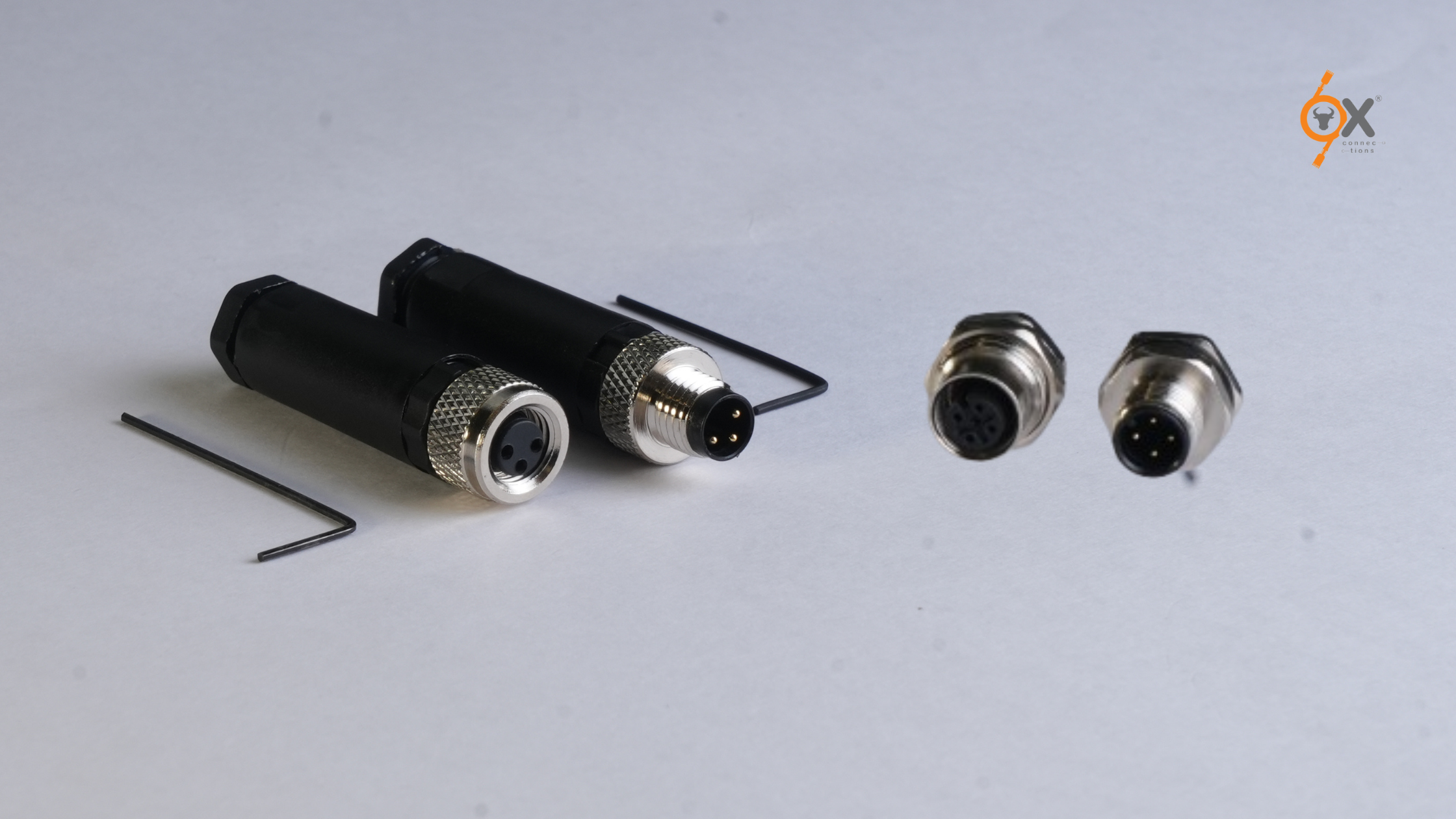
Walk through any modern factory automation installation and you’ll see them everywhere—those small, threaded circular connectors linking sensors to controllers, actuators to PLCs, and IO modules to networks. M-Series connectors have quietly become the universal language of industrial sensing and control, standardizing connections across equipment from dozens of manufacturers worldwide.
The “M” stands for metric thread diameter. M12 means 12mm threading, M8 is 8mm, and so on. This standardization means sensors from one manufacturer plug into controllers from another using the same connector interface. No proprietary connectors, no adapter hassles, no vendor lock-in.
Why Did M-Series Connectors Become the Industrial Standard?
Before M-Series connectors, every sensor manufacturer had their own connection scheme. Field installation was slow and error-prone with wire stripping, color code matching, and polarity concerns.
M-Series changed this with plug-and-play connections. Sensors come pre-wired with male M12 connectors. Field cables have female connectors on both ends. Installation: plug sensor into cable, plug cable into IO module. Done. When a sensor fails, swap it in seconds rather than twenty minutes of re-wiring.
The quick-locking mechanism creates secure connection while maintaining IP67 environmental sealing. The threaded coupling doesn’t work loose in high-vibration environments, and the compact design fits modern automation equipment where mounting spaces are increasingly tight.
What Are the Different M-Series Connector Sizes?
M5 is the smallest, used on miniature sensors in tight spaces. Common on compact photoelectric sensors, small inductive switches, and applications where mounting clearance is extremely limited. Pin counts typically 3-4 pins.
M8 serves the mid-range of compact sensors. Three or four pin configurations handle standard DC sensor wiring—power, ground, switching output. You’ll find M8 on many photoelectric sensors, smaller proximity switches, and general-purpose sensing applications where M12 would be unnecessarily large.
M12 is the workhorse size in factory automation. Available in 3, 4, 5, 8, and 12 pin configurations, it handles everything from basic sensor connections to Ethernet networks and IO-Link communication. This is probably the most common connector size you’ll encounter in modern automation installations.
M16 and M20 step up for applications needing more pins or higher current capacity. Often used for actuator connections, motor feedback systems, or applications combining power and multiple signal lines.
M23 handles high pin counts and power requirements. Common on servo motors, larger actuators, multi-axis control connections, and anywhere you’re consolidating multiple circuits through a single connector.
Why Does M-Series Connector Coding Matter?
M-Series connectors use different mechanical keyings—called coding—to prevent incompatible connections. The keying determines pin arrangement and intended application. You can’t accidentally plug an Ethernet cable into a DC power socket because the mechanical keys won’t align.
A-coding is standard for DC sensors and actuators. Four or five pin configurations handle typical sensor wiring—24V power, ground, switching output, diagnostic signal. This is what you’ll find on most proximity sensors and photoelectric sensors.
D-coding is designed for Ethernet networks—100 Mbps Fast Ethernet and Gigabit Ethernet in industrial applications. Common on industrial Ethernet switches, IP cameras, and distributed IO modules using Ethernet/IP or Profinet.
X-coding serves IO-Link communication, enabling intelligent sensors that provide diagnostic data, parameter settings, and condition monitoring beyond simple on/off signals.
S-coding handles power applications with larger contacts rated for 12-16A per pin. Used on motor connections and power distribution to remote IO.
The coding system prevents mistakes. An A-coded cable won’t mate with a D-coded socket—mechanical incompatibility that protects equipment from incorrect connections.
Real Applications in Factory Automation
Proximity sensors on assembly lines use A-coded M12 connectors almost universally. The sensor detects part presence, sends signal through M12 connection to remote IO. When sensors need replacement, technicians swap them in seconds without stopping the line.
Ethernet-connected IP cameras use D-coded M12 connectors, providing both data and power through the same connector. Cameras can be repositioned without running new cables.
IO-Link sensors with X-coded M12 provide richer data than traditional sensors—actual measurements, temperature, operating hours, diagnostic information—enabling predictive maintenance rather than just binary alerts.
Servo motors use larger M23 connectors to consolidate motor power, encoder feedback, and control signals, simplifying cable management on moving equipment like robot arms.
Distributed IO systems use M12 extensively. Remote IO blocks mount near sensors with short M12 cables, and a single Ethernet cable runs back to the controller, reducing wiring labor substantially.
What OX Connections Provides
OX Connections maintain comprehensive M-Series connector inventory in stock because factory automation projects don’t wait for international shipments. When you’re commissioning equipment and need M12 A-coded female corsets tomorrow, that availability matters.
Our inventory covers M5 through M23 in common coding’s and pin counts. Straight and angled versions for different mounting constraints. Panel mounting sockets for building custom IO boxes. PCB-mount versions for equipment manufacturers. Field-attachable connectors for making custom cable lengths on-site.
Quality meets OEM standards at competitive pricing. Proper contact materials maintaining reliable connections over thousands of mating cycles. Housing construction that withstands mechanical abuse during installation. IP67 sealing that actually keeps moisture and contaminants out. These aren’t premium-priced specialty items—they’re industrial-grade connectors at pricing that makes sense for automation projects.
For standard configurations, stock availability means days to delivery, not months. For specialized requirements—higher pin counts, specific cable lengths, custom assemblies—we work on order basis with lead times measured in weeks.
Selecting M-Series Connectors
Start with your device specifications. Most sensors specify connector requirements—M12 A-coded 4-pin straight male, for example. Match that with appropriate cable or socket.
Consider cable routing. Straight connectors work when cables exit perpendicular to mounting surface. Angled connectors work better in tight spaces or when routing cables parallel to surfaces.
Verify coding matches application—A-coded for DC sensors, D-coded for Ethernet, X-coded for IO-Link. The mechanical keys prevent cross-connection.
Most M-Series connectors achieve IP67 when properly mated. Some applications may require IP68 or IP69K ratings available in specialized versions.
Common Questions
Can I use standard M12 cables with any M12 device?
Only if the coding matches. An A-coded cable mates only with A-coded devices, D-coded with D-coded, and so on. The mechanical keying prevents incorrect connections. Always verify coding compatibility before ordering.
What’s the difference between moulded and field-attachable connectors?
Moulded connectors come pre-assembled on cables, factory-sealed for maximum reliability. Field-attachable connectors allow making custom cable lengths on-site without special tools—you insert stripped wires and tighten screws. Moulded offers better IP rating and reliability, field-attachable offers flexibility for custom installations.
How many mating cycles can M-Series connectors handle?
Quality M-Series connectors typically rate for 500-1000 mating cycles. Applications where connectors are rarely disconnected—permanently installed sensors—this is essentially lifetime durability. Applications requiring frequent connection changes should consider the cycle rating when selecting connectors.
Are M-Series connectors compatible across manufacturers?
Yes, when they conform to IEC 61076-2-101 standards. An M12 A-coded 4-pin connector from one manufacturer should mate with corresponding sockets from another, assuming both meet the specification. This standardization is precisely what makes M-Series useful—interchangeability across equipment from different vendors.
Getting Started
Determine your requirements—connector size, coding, pin count, straight or angled, cable length if pre-made assemblies. Match these specifications to available products or request quotes for custom configurations.
We provide technical specifications including mechanical drawings, pin assignments, and electrical ratings. For applications requiring specific cable constructions—shielded versions for EMC-sensitive environments, drag chain rated cables for moving applications—we can discuss available options.
Contact om.advani@oxconnections.com with your requirements. Include application context, quantities needed, and any specific constraints. We typically respond within 24-48 hours with availability confirmation and technical recommendations if needed.
M-Series connectors are straightforward once you understand the sizing and coding system. Getting the right ones quickly makes all the difference.