
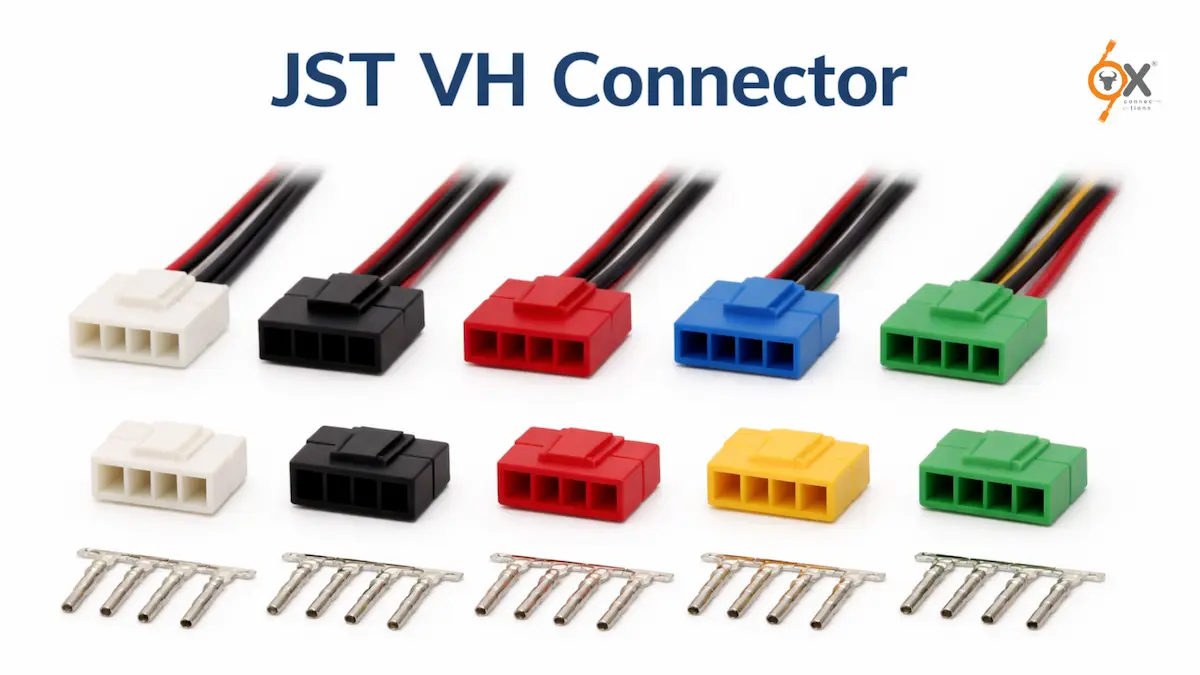
In the world of power electronics and industrial systems, connectors are often overlooked until something fails. And when it comes to handling higher current loads reliably, the JST VH series is one of the most widely used connector types.
But today, engineers and procurement teams aren’t just searching for JST VH connector specifications – they’re also looking for faster, more cost-effective alternatives without compromising on quality.
Let’s break down both sides: the technical clarity you need, and the sourcing reality you deal with.
What is a JST VH Connector?
The JST VH connector is a 3.96mm pitch wire-to-board connector, designed for applications where higher current and stable connections are essential.
You’ll typically find these connectors in:
- Power supply units
- Industrial control panels
- Home appliances
- LED drivers
What makes the VH series stand out is its ability to handle significantly higher current compared to smaller connector families like PH or XH.
And this is exactly where companies like OX step in offering equivalent VH connectors that match performance expectations while solving supply and pricing challenges.
JST VH Connector Specifications (What Actually Matters)
If you’ve been searching for JST VH connector specifications, here are the core parameters you should focus on:
- Pitch: 3.96 mm
- Connection Type: Wire-to-board
- Mounting Style: Through-hole
- Wire Compatibility: Typically 18–22 AWG
- Operating Temperature: Approx. -25°C to +85°C
Now, instead of just treating these as datasheet numbers, let’s understand their real impact.
The 3.96 mm pitch ensures better spacing, which improves insulation and reduces electrical risks – especially in higher voltage setups.
OX’s VH equivalents are designed to match these exact dimensional and electrical parameters, ensuring easy drop-in replacement without redesigning your PCB.
JST VH Connector Current Rating
One of the most critical factors is the JST VH connector current rating.
The VH series typically supports:
- Up to 10A per pin
This makes it ideal for applications where power delivery is non-negotiable.
Why This Is Important
Using a connector with insufficient current capacity can lead to:
- Overheating
- Reduced efficiency
- Long-term failure
Compared to other series:
- PH connectors: ~2A
- XH connectors: ~3A
The VH series clearly operates in a different league.
OX ensures that its equivalent connectors are built to meet the same current handling capabilities, making them suitable for OEM-level applications across industries.
JST VH Connector Voltage Rating
Another key parameter is the JST VH connector voltage rating.
Typically, VH connectors support:
- Up to 250V AC/DC
This makes them suitable for both consumer and industrial-grade electrical systems.
Why Voltage Rating Matters
Higher voltage handling means:
- Better insulation design
- Reduced risk of electrical breakdown
- Safer operation in demanding environments
OX connectors are manufactured with strict adherence to safety standards, ensuring that voltage performance is aligned with global compliance requirements like UL, RoHS, and CE.
Real-World Applications of VH Connectors
Understanding JST VH connector specifications becomes more meaningful when you see where they’re used.
Home Appliances
From washing machines to air conditioners, these connectors ensure stable internal wiring.
Industrial Systems
Control panels and automation setups rely heavily on VH connectors for consistent performance.
LED & Power Systems
Used in LED drivers and power distribution modules.
Renewable Energy
Solar inverters and battery systems require connectors that can handle both current and voltage reliably – and this is where VH connectors, including OX equivalents, are widely used.
EV & Advanced Electronics
Auxiliary systems in EVs and high-performance electronics depend on connectors that meet strict reliability standards.
OX already supplies to OEMs across all these sectors, proving that equivalent connectors can perform just as reliably in real-world conditions.
The Hidden Challenge: Sourcing JST Connectors
Here’s the reality most engineers face after finalizing JST VH connector specifications:
- High pricing from original brands
- Long lead times
- High MOQ requirements
This creates friction in:
- Production timelines
- Inventory planning
- Cost management
And this issue isn’t limited to VH – it applies across JST families like XH, PH, and HY as well.
How OX Solves This Problem
Instead of adjusting your production around supply constraints, OX flips the equation.
OX offers:
- JST VH equivalent connectors at nearly half the price
- No lead time – ready stock availability
- Low or no MOQ flexibility
This means:
- Faster prototyping
- Smoother production cycles
- Lower overall BOM cost
And since OX connectors meet JST VH connector current rating and JST VH connector voltage rating benchmarks, you’re not trading quality for cost – you’re optimizing both.
Designed for OEMs That Can’t Afford Delays
OX connectors are already being used across industries where failure is not an option:
- Solar and renewable energy
- Home appliances
- Medical equipment
- EV manufacturing
- Industrial automation
In these sectors, connectors must perform consistently under load, temperature variation, and long operating cycles.
That’s why OX focuses not just on compatibility with JST VH connector specifications, but also on real-world durability and certification compliance.
Common Selection Mistakes (And How to Avoid Them)
Even when engineers understand JST VH connector specifications, small oversights can cause big problems:
- Ignoring current derating in real conditions
- Using incorrect wire gauge
- Overlooking voltage safety margins
- Choosing suppliers based only on brand, not availability
The smarter approach?
Balance:
- Technical specs
- Supply reliability
- Cost efficiency
This is exactly where OX stands out – not just as a product supplier, but as a practical sourcing solution.
Why the Shift Towards Equivalent Connectors Is Growing
The industry is evolving.
OEMs are no longer tied to a single brand – they’re looking for:
- Faster turnaround
- Better pricing
- Certified alternatives
And as long as connectors meet the required JST VH connector current rating and VH connector voltage rating, switching to a reliable equivalent like OX becomes a logical decision.
Final Thoughts
The JST VH series continues to be a strong choice for high-current, reliable connections. Understanding the JST VH connector specifications, JST VH connector current rating, and VH connector voltage rating is essential for building safe and efficient systems.
But in today’s manufacturing landscape, performance alone isn’t enough.
You also need:
- Immediate availability
- Cost efficiency
- Supply flexibility
OXconnection delivers on all three – offering high-quality JST-compatible connectors at nearly half the cost, without the delays or MOQ limitations.
Looking Ahead
If your designs depend on VH connectors and you’re tired of long lead times and inflated costs, it might be time to rethink your sourcing strategy.
Because the right connector doesn’t just power your circuit – it powers your entire production timeline.