
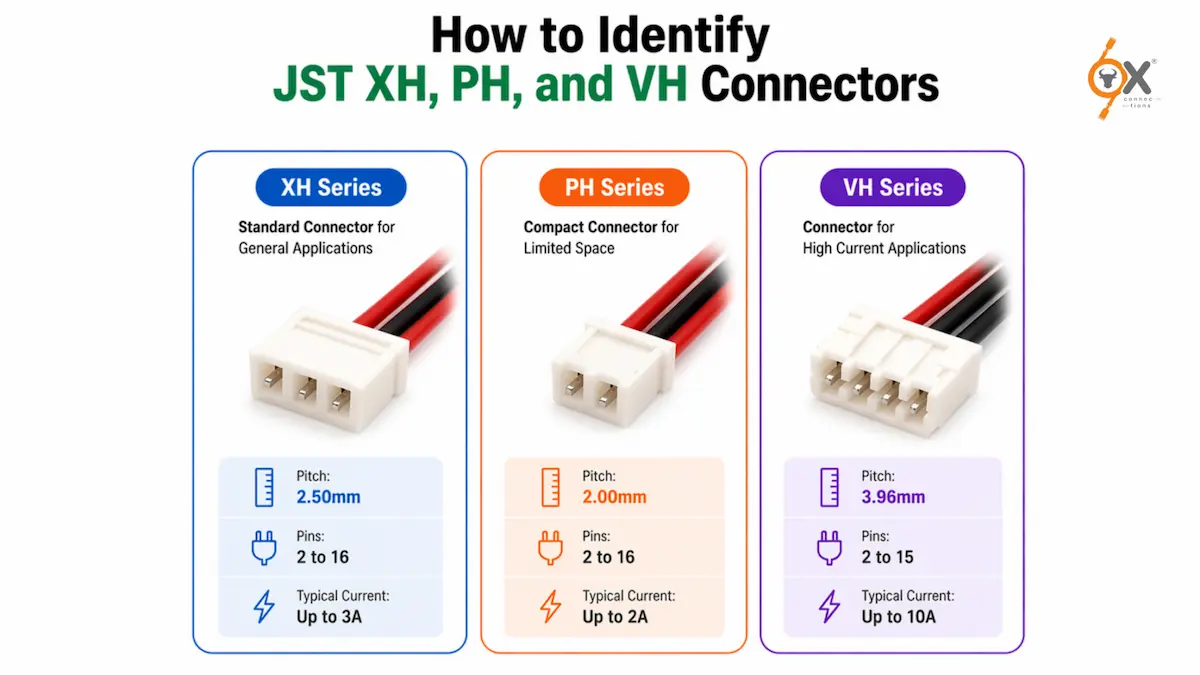
Understanding JST connector types is the first step toward making the right choice. And when it comes to the most commonly used variants – JST XH vs PH vs VH – knowing the differences can save you from costly mistakes, especially in the Indian manufacturing ecosystem where timelines and budgets are tight.
In the world of electronics manufacturing and assembly, choosing the right connector is not just a technical decision – it directly impacts performance, cost, and reliability. If you’ve ever struggled to tell one JST connector apart from another, you’re not alone. Many engineers, procurement teams, and even hobbyists often confuse these connectors due to their similar appearance.
Why Identifying JST Connectors Correctly Matters in India
In cities like Mumbai, Pune, and Bengaluru, where electronics manufacturing is growing rapidly, incorrect connector selection can delay production cycles. Many OEMs still rely on imported connectors, often facing long lead times and high minimum order quantities.
This is where understanding JST connector types becomes practical – not theoretical. When you know exactly what you’re looking at, you can source faster, substitute smarter, and avoid dependency on expensive imports.
Understanding the Basics of JST Connector Types
Before jumping into identification, it’s important to grasp how JST connector types are categorized. The primary differentiator is pitch – the distance between pins.
Each series is designed for a specific application:
- Smaller pitch = compact electronics
- Larger pitch = higher current applications
This is where confusion usually begins, especially between JST XH vs PH vs VH, because visually they can look quite similar unless you know what to check.
JST XH vs PH vs VH: The Core Differences
Let’s simplify this without turning it into a textbook.
PH Series (Compact & Lightweight)
- Very small in size
- Used in compact devices like consumer electronics, LED lighting, and small PCBs
- Lower current handling
If you’re dealing with tight spaces, PH is usually the go-to. But it’s not meant for heavy-duty applications.
XH Series (Balanced & Versatile)
- Medium size, more robust than PH
- Widely used in appliances, battery packs, and industrial electronics
- Offers better current capacity than PH
This is one of the most commonly used connectors in India, making it a key part of JST connector types discussions.
VH Series (High Power Applications)
- Larger and more durable
- Designed for higher current loads
- Used in industrial machinery, power supplies, and heavy-duty equipment
If your application involves power rather than just signal transmission, VH is typically the safer choice.
Using a JST Connector Size Chart for Easy Identification
Instead of guessing, professionals rely on a JST connector size chart to quickly identify connectors based on pitch and dimensions.
Here’s how you can use it in real-world scenarios:
- Measure the distance between pins
- Compare it with a JST connector size chart
- Match it with the corresponding series
This simple step eliminates confusion between JST XH vs PH vs VH, especially when connectors are unlabelled.
In Indian manufacturing setups where speed matters, having access to a reliable JST connector size chart can significantly reduce downtime.
Common Mistakes While Identifying JST Connectors
Even experienced teams make these mistakes:
- Assuming all white connectors are the same
- Ignoring pitch measurement
- Choosing based on availability rather than specification
This is exactly why understanding JST connector types is critical. A wrong assumption can lead to poor fitting, overheating, or even system failure.
Indian Market Reality: Cost, Availability & Alternatives
Here’s the part most blogs won’t tell you.
Original JST connectors, especially XH, PH, and VH series, are:
- Expensive
- Come with long lead times
- Require high MOQs
For Indian OEMs, startups, and mid-scale manufacturers, this becomes a bottleneck.
This is where OX Connections steps in.
OX offers high-quality equivalents for JST connector types, including solutions comparable to JST XH vs PH vs VH, at nearly half the price. More importantly:
- No long waiting periods
- No bulk order pressure
- Certifications like UL, RoHS, and CE
This makes a huge difference for industries like:
- Solar manufacturing
- EV components
- Home appliances
- Medical devices
Instead of waiting weeks for imports, companies can move faster with locally available alternatives – without compromising on quality.
How to Quickly Identify JST XH, PH, and VH in Practice
If you’re on the shop floor or working with a sample, here’s a practical way to identify:
- Check the size visually
- Very small → Likely PH
- Medium → Likely XH
- Large → Likely VH
- Measure the pitch
- Use a caliper and compare with a JST connector size chart
- Assess application usage
- Signal / compact → PH
- General electronics → XH
- Power → VH
- Cross-check with requirements
This helps confirm your understanding of JST XH vs PH vs VH in real conditions.
Why This Knowledge Gives You an Edge
In today’s competitive environment, especially across Indian manufacturing hubs, speed and cost efficiency define success.
When you clearly understand:
- JST connector types
- The differences in JST XH vs PH vs VH
- How to use a JST connector size chart
You’re not just identifying connectors – you’re making smarter sourcing and design decisions.
Final Thoughts
Identifying JST connectors doesn’t have to be complicated. Once you break it down into size, pitch, and application, the confusion disappears.
For Indian businesses, this knowledge goes a step further – it helps reduce dependency on expensive imports and opens doors to faster, more efficient alternatives like OXconnection.
Because in the end, it’s not just about connectors. It’s about building systems that are reliable, scalable, and cost-effective.