
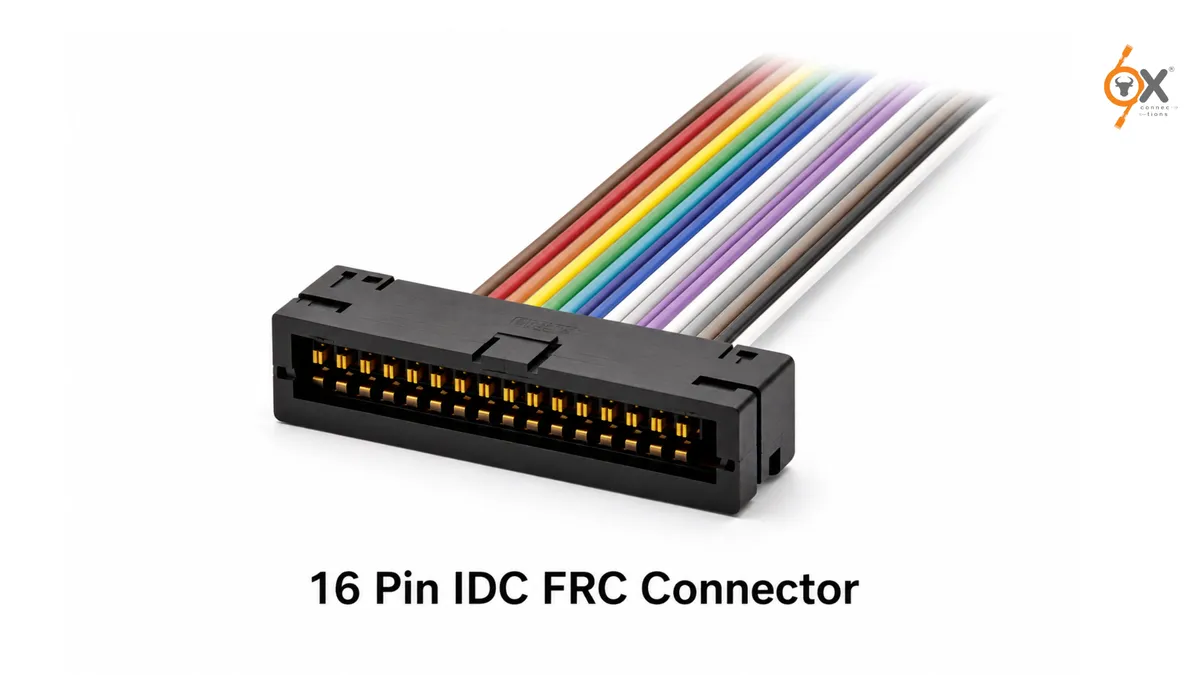
In modern electronic systems, reliable board-to-board and wire-to-board connectivity is critical for ensuring consistent performance, signal integrity, and easy assembly. Among the various interconnection solutions available today, the 16 Pin IDC FRC Connector remains one of the most widely used options for compact and organized cable connections in industrial electronics, consumer devices, automation equipment, telecommunications systems, and embedded applications.
Designed to work seamlessly with flat ribbon cables, IDC (Insulation Displacement Contact) technology simplifies assembly while reducing installation time and wiring errors. Whether used in control panels, PCB assemblies, instrumentation systems, or communication devices, a 16 Pin IDC FRC Connector offers an efficient and cost-effective solution for transmitting signals between components.
This guide explores the construction, pin configuration, benefits, applications, and selection considerations of the 16 Pin IDC FRC Connector, helping engineers, OEMs, and procurement professionals make informed decisions.
What is a 16 Pin IDC FRC Connector?
A 16 Pin IDC FRC Connector is a type of IDC Ribbon Cable Connector specifically designed to terminate a 16-conductor flat ribbon cable. IDC technology allows the connector contacts to pierce through the cable insulation and establish electrical contact directly with the conductor without requiring wire stripping or soldering.
The connector typically consists of:
- Connector housing
- Insulation displacement contacts
- Strain relief mechanism
- Polarization key
- Flat ribbon cable interface
The result is a secure and reliable connection that significantly simplifies cable assembly and maintenance.
Because of its simplicity and reliability, the FRC Connector is widely used in applications requiring multiple signal connections in a compact footprint.
Understanding IDC Technology
IDC stands for Insulation Displacement Contact.
Unlike conventional connectors that require wires to be stripped before termination, IDC connectors use specially engineered metal contacts that cut through the insulation and establish direct contact with the conductor.
Advantages of IDC Technology
- Faster assembly process
- No soldering required
- Reduced labor costs
- Consistent electrical performance
- Lower risk of wiring mistakes
- Suitable for mass production
- High reliability in industrial environments
These benefits have made IDC Ribbon Cable Connectors a preferred choice for OEMs and electronics manufacturers worldwide.
16 Pin IDC FRC Connector Pin Configuration
A 16 Pin IDC FRC Connector contains sixteen electrical contacts arranged in two rows.
The most common arrangement is:
| Pin Row | Pins |
| Row 1 | 1, 3, 5, 7, 9, 11, 13, 15 |
| Row 2 | 2, 4, 6, 8, 10, 12, 14, 16 |
Pin 1 is typically identified using:
- Red stripe on ribbon cable
- Connector marking
- Polarization key
- Housing indicator
Proper pin alignment is essential to prevent incorrect connections and signal routing errors during installation.
Key Features of a 16 Pin IDC FRC Connector
Compact Design
The connector supports multiple signal paths within a small footprint, making it suitable for space-constrained electronic assemblies.
Quick Cable Termination
IDC technology eliminates manual wire stripping and soldering, enabling rapid assembly.
Secure Connection
The insulation displacement contacts create a stable electrical connection capable of withstanding vibration and regular handling.
Polarized Housing
Most connectors include keying mechanisms that prevent incorrect insertion.
Cost-Effective Solution
The simple assembly process lowers production costs and improves manufacturing efficiency.
High Signal Integrity
The uniform cable arrangement helps maintain reliable signal transmission in electronic systems.
Benefits of Using a 16 Pin IDC FRC Connector
Organized Wiring
Flat ribbon cables keep multiple conductors neatly aligned, improving cable management and reducing clutter inside equipment.
Reduced Assembly Time
Production teams can terminate ribbon cables quickly, increasing manufacturing throughput.
Simplified Maintenance
Clearly organized wiring makes troubleshooting and component replacement easier.
Improved Reliability
Consistent termination quality reduces connection failures and enhances long-term performance.
Scalability
Suitable for both low-volume prototypes and high-volume production environments.
Common Applications of 16 Pin IDC FRC Connectors
Industrial Automation Equipment
Automation systems frequently rely on FRC Connectors for connecting sensors, PLC modules, controllers, and communication boards.
Typical applications include:
- PLC interfaces
- I/O modules
- HMI panels
- Industrial controllers
Consumer Electronics
Many electronic devices utilize Ribbon Cable Connectors to establish internal connections between circuit boards and peripheral components.
Examples include:
- Printers
- Audio equipment
- Home appliances
- Gaming devices
Instrumentation Systems
Testing and measurement equipment often require compact signal transmission solutions.
Applications include:
- Data acquisition systems
- Laboratory instruments
- Monitoring equipment
- Calibration systems
Telecommunications Equipment
Communication hardware frequently uses IDC Ribbon Cable Connectors for internal signal routing and board interconnections.
Examples include:
- Network switches
- Communication gateways
- Telecom control units
- Interface modules
Computer and Embedded Systems
Historically and even today in specialized systems, ribbon cable assemblies remain common in:
- Embedded controllers
- Development boards
- Legacy computer hardware
- Interface cards
Selecting the Right 16 Pin IDC FRC Connector
Choosing the appropriate connector requires consideration of several technical factors.
Pitch Size
Common pitches include:
- 54 mm
- 00 mm
- 27 mm
The pitch must match the PCB header and ribbon cable specifications.
Current Rating
Verify that the connector supports the required operating current.
Voltage Rating
Ensure compatibility with system voltage requirements.
Operating Environment
Industrial environments may require connectors with enhanced durability and temperature resistance.
Cable Compatibility
Confirm compatibility with:
- Cable width
- Conductor count
- Wire gauge
Mounting Style
Options may include:
- Box headers
- Straight headers
- Right-angle headers
- PCB-mounted versions
Installation Best Practices
To achieve optimal performance, consider the following guidelines:
Verify Pin Orientation
Always align Pin 1 with the cable’s red stripe indicator.
Use Proper IDC Press Tools
Consistent pressure ensures reliable contact between conductors and IDC terminals.
Avoid Excessive Cable Stress
Provide adequate strain relief to minimize mechanical stress on connections.
Inspect Connections
Check for:
- Proper contact engagement
- Alignment accuracy
- Housing integrity
- Cable positioning
Follow Manufacturer Specifications
Always adhere to recommended assembly procedures and operating limits.
Why Manufacturers Prefer IDC FRC Connectors
The popularity of IDC Ribbon Cable Connectors stems from their combination of simplicity, reliability, and cost efficiency.
Key reasons include:
- Faster production cycles
- Lower assembly costs
- Reduced installation errors
- Compact design
- Easy maintenance
- Proven reliability
These advantages make them a practical solution across a broad range of industries.
Quality Matters in Connector Selection
Connector quality directly impacts system performance and long-term reliability. Poor-quality connectors can result in:
- Signal loss
- Intermittent connections
- Increased maintenance costs
- System downtime
For OEMs and industrial manufacturers seeking dependable alternatives to high-cost connector brands, OXConnections offers high-quality connector solutions engineered to deliver reliable performance, industry-standard compatibility, and cost-effective procurement advantages. With certifications including UL, RoHS, and CE, OX supports industries such as solar, home appliances, medical devices, renewable energy systems, EV manufacturing, and industrial automation.
Conclusion
The 16 Pin IDC FRC Connector remains one of the most efficient and dependable connectivity solutions for modern electronic assemblies. Its ability to provide fast, organized, and reliable ribbon cable termination makes it a preferred choice across industrial automation, telecommunications, instrumentation, consumer electronics, and embedded systems.
With advantages such as quick assembly, compact design, excellent signal integrity, and cost-effective deployment, the FRC Connector continues to play a vital role in PCB interconnection and cable management applications. Selecting the right IDC Ribbon Cable Connector and following proper installation practices can significantly improve system reliability and operational efficiency for years to come.
FAQs
1. What is a 16 Pin IDC FRC Connector used for?
A 16 Pin IDC FRC Connector is used to connect flat ribbon cables to PCBs and electronic devices for signal transmission in industrial, telecom, instrumentation, and consumer electronic applications.
2. What does IDC mean in IDC Ribbon Cable Connector?
IDC stands for Insulation Displacement Contact, a termination method that allows conductors to connect directly without stripping insulation or soldering.
3. How do I identify Pin 1 on a 16 Pin IDC FRC Connector?
Pin 1 is usually identified by the red stripe on the ribbon cable, a molded marking on the connector housing, or a polarization key that ensures correct orientation.