
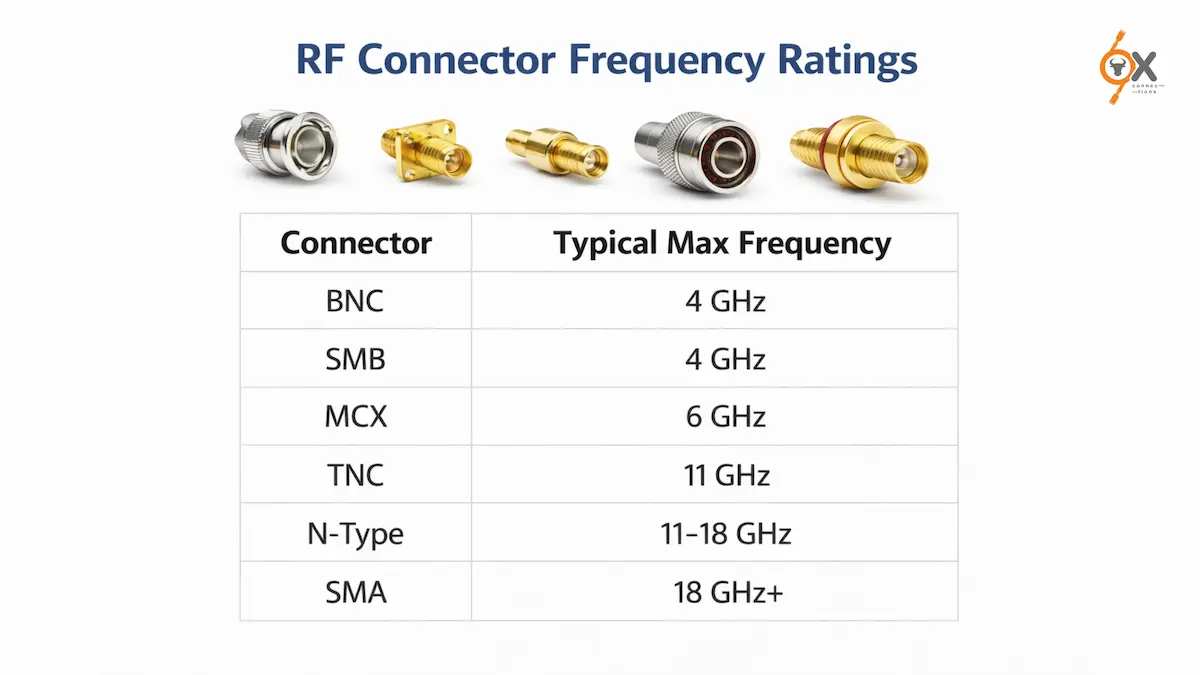
This guide explains how RF connector frequency range specifications affect wireless systems and what engineers and procurement teams should consider when selecting an SMA connector for 5G, LoRa, and other IoT applications.
As wireless technologies continue to evolve, are you paying enough attention to one of the smallest yet most critical components in your RF signal chain , the connector?
Whether you’re designing a 5G communication device, deploying a LoRa-based IoT network, building industrial gateways, or integrating wireless modules into smart products, connector selection can significantly influence signal integrity and overall system performance. While engineers often focus on antennas, transceivers, and PCB design, connector frequency ratings are sometimes overlooked until performance issues emerge during testing.
Understanding RF connector frequency ratings is essential when selecting the right interconnect solution. Among the most widely used RF connectors in modern wireless applications is the SMA connector, valued for its compact size, reliable performance, and suitability for high-frequency environments.
Understanding RF Connector Frequency Ratings
Every RF connector is designed to operate effectively within a specified frequency range. The frequency rating indicates the maximum frequency at which the connector can maintain acceptable electrical performance characteristics such as:
- Impedance consistency
- Return loss
- Insertion loss
- VSWR (Voltage Standing Wave Ratio)
- Signal integrity
As operating frequencies increase, even minor discontinuities within the connector can create reflections, losses, and performance degradation.
This is why RF connector frequency ratings are not merely product specifications , they directly impact system reliability and communication efficiency.
For applications involving high-frequency wireless signals, selecting an appropriately rated connector becomes as important as selecting the antenna itself.
Why Frequency Ratings Matter in RF Design
RF signals become increasingly sensitive to mechanical and electrical variations as frequency rises.
At lower frequencies, a connector mismatch may produce negligible performance differences. However, at higher frequencies used in advanced wireless systems, connector quality and frequency capability can significantly affect:
- Signal strength
- Data throughput
- Network coverage
- Antenna efficiency
- Receiver sensitivity
For engineers designing wireless products, connector selection should be considered early in the design process rather than as a final procurement decision.
The Role of SMA Connectors in Modern Wireless Systems
The SMA connector has become one of the industry’s most widely adopted RF interfaces due to its combination of:
- Compact form factor
- Threaded coupling mechanism
- Consistent impedance characteristics
- Suitability for microwave frequencies
- Mechanical reliability
Today, SMA connectors are commonly found in:
- Cellular communication equipment
- Wireless routers
- IoT gateways
- GPS systems
- Test and measurement equipment
- RF modules
- Antenna assemblies
- Industrial wireless devices
The popularity of SMA connectors stems largely from their ability to support demanding RF applications while maintaining reliable electrical performance.
Understanding SMA Connector Frequency Range
One of the first specifications engineers evaluate is the SMA connector frequency range.
Different SMA connector designs may support different maximum frequencies depending on factors such as:
- Connector construction
- Center contact design
- Material quality
- Manufacturing tolerances
- Cable interface design
In practical applications, the usable frequency range of an SMA connector should always match or exceed the operating requirements of the system.
When designing RF systems, selecting a connector solely based on physical compatibility can introduce performance bottlenecks if frequency requirements are not considered.
This is especially important in modern wireless environments where multiple protocols and frequency bands may coexist within the same device.
Choosing an SMA Connector for 5G Applications
The rapid expansion of 5G infrastructure has introduced new challenges for RF engineers.
Compared to earlier wireless generations, 5G systems operate across a broader range of frequencies and require tighter performance tolerances.
When selecting an SMA connector for 5G, engineers should evaluate:
Frequency Capability
The connector should comfortably support the intended operating frequencies without approaching performance limits.
Signal Integrity
High-frequency signals are more vulnerable to losses and reflections, making connector quality increasingly important.
Mechanical Stability
Outdoor telecom equipment, small cells, and wireless gateways often experience vibration and environmental stress. A secure threaded SMA interface helps maintain consistent electrical contact.
Consistent Impedance
Impedance discontinuities can negatively affect antenna performance and overall RF efficiency.
For telecom OEMs, network equipment manufacturers, and antenna designers, choosing the right SMA connector contributes to maintaining reliable wireless communication performance.
Why SMA Connectors Are Popular in LoRa Networks
LoRa technology has become a preferred solution for long-range, low-power IoT deployments.
Applications include:
- Smart agriculture
- Utility metering
- Environmental monitoring
- Smart cities
- Industrial sensing
- Asset tracking
Although LoRa typically operates at lower frequencies than many 5G applications, connector quality still plays an important role.
When selecting an SMA connector for LoRa, engineers should consider:
Outdoor Reliability
Many LoRa gateways are deployed in outdoor environments where connector durability is critical.
Antenna Performance
Antenna efficiency directly affects communication range. Connector losses can reduce overall system effectiveness.
Long-Term Stability
Industrial IoT deployments often remain operational for years. Reliable connector interfaces help reduce maintenance requirements.
Network Scalability
Consistent RF performance becomes increasingly important as network density and deployment scale grow.
For large-scale IoT projects, connector reliability contributes directly to long-term operational success.
Key Factors in RF Connector Selection
Choosing the correct connector involves more than simply reviewing a frequency rating.
Effective RF connector selection should include consideration of several interconnected factors.
Impedance Matching
Most RF systems require consistent impedance throughout the signal path.
Impedance mismatches can lead to reflections and reduced signal quality.
Connector Type
Different applications may require:
- SMA connectors
- RP-SMA connectors
- N-type connectors
- TNC connectors
- MMCX connectors
Selection depends on frequency, size constraints, environmental requirements, and mechanical considerations.
Mounting Method
Connector mounting style should align with enclosure design and PCB layout requirements.
Common configurations include:
- PCB mount
- Bulkhead mount
- Panel mount
- Cable mount
- Right-angle designs
Environmental Conditions
Industrial deployments often require consideration of:
- Moisture exposure
- Dust protection
- Temperature fluctuations
- Mechanical vibration
Cable Compatibility
Connector performance depends heavily on proper cable matching and assembly quality.
High-Frequency RF Connectors and Emerging Wireless Technologies
The demand for high frequency RF connectors continues to grow as industries adopt increasingly sophisticated wireless technologies.
Examples include:
- Private 5G networks
- Industrial automation
- Smart manufacturing
- Connected transportation
- Edge computing
- Advanced IoT infrastructure
As frequencies increase and bandwidth requirements expand, connector performance becomes increasingly critical to overall system functionality.
Engineers can no longer treat RF connectors as commodity hardware. Instead, they must be viewed as active contributors to system performance.
Common Mistakes When Selecting RF Connectors
Even experienced engineering teams sometimes overlook connector-related considerations.
Common mistakes include:
Selecting Based Only on Cost
A lower-cost connector may not deliver the electrical performance required for demanding RF applications.
Ignoring Frequency Requirements
Connectors should be selected with sufficient performance margin above operating frequencies.
Overlooking Environmental Factors
Field failures often result from environmental exposure rather than electrical limitations.
Focusing Only on Mechanical Fit
A connector that physically fits may still introduce signal degradation if frequency performance is inadequate.
Delaying Connector Selection
Connector decisions made late in the design process can create unexpected integration challenges.
Avoiding these mistakes can improve both product performance and long-term reliability.
Supporting Wireless Innovation Through Better Connector Choices
As wireless technologies continue advancing, connector performance remains a foundational element of successful RF system design.
Whether developing next-generation telecom infrastructure, deploying industrial IoT networks, or building connected devices, understanding RF connector frequency ratings helps engineers make more informed design decisions.
Selecting the appropriate SMA connector frequency range for the intended application helps preserve signal integrity, improve reliability, and support long-term system performance.
From choosing an SMA connector for 5G infrastructure to deploying resilient SMA connectors for LoRa gateways, connector selection should be viewed as a strategic engineering decision rather than a procurement afterthought.
The result is a more robust RF design capable of meeting the demands of modern wireless communication.
Why Partner with OX Connections?
For OEMs, system integrators, telecom equipment manufacturers, and industrial IoT developers, sourcing dependable RF interconnect components is critical to maintaining product quality and supply chain continuity.
OX Connections supplies a broad range of RF connectivity solutions designed to support diverse application requirements across telecommunications, industrial automation, wireless infrastructure, renewable energy, electronics manufacturing, and embedded systems.
As a Mumbai-based connector supplier serving customers across India and international markets, OX Connections focuses on:
- Reliable product availability
- Consistent quality standards
- Competitive commercial solutions
- OEM and industrial supply support
- Technical assistance for connector selection
Whether your project requires SMA connectors, RF cable assemblies, or other specialized interconnect solutions, OXConnections can support your sourcing and engineering requirements.
Disclaimer
The information provided in this article is intended for general educational and informational purposes only. Actual connector performance depends on specific product design, manufacturing tolerances, installation practices, cable selection, operating conditions, and application requirements. Engineers should always review applicable product documentation, technical specifications, testing data, and compliance requirements before making final design or procurement decisions.
FAQs
1. What are RF connector frequency ratings?
RF connector frequency ratings indicate the maximum frequency range within which a connector can maintain acceptable electrical performance, signal integrity, and impedance characteristics.
2. Why is SMA connector frequency range important?
The SMA connector frequency range helps determine whether the connector can support the operating frequencies of a wireless system without introducing excessive signal loss or reflections.
3. Can SMA connectors be used for both 5G and LoRa applications?
Yes. SMA connectors are commonly used in both 5G and LoRa systems. However, engineers should verify that the specific connector selected meets the frequency, environmental, and performance requirements of the intended application.