
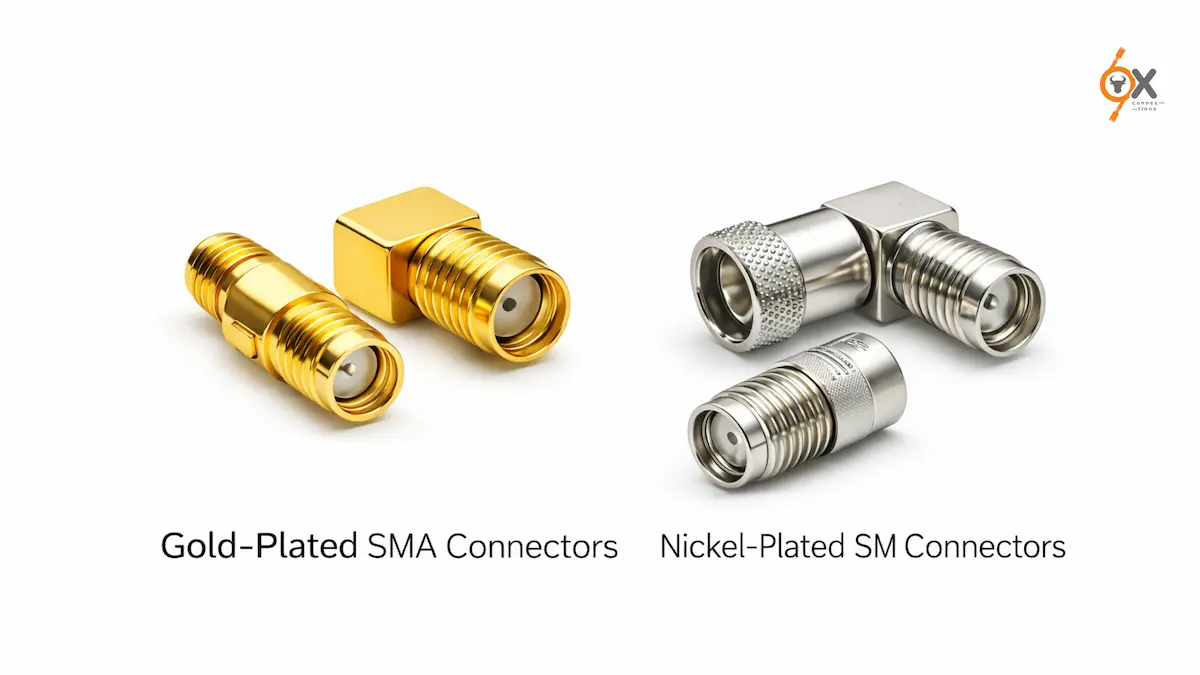
This guide explains the differences between gold-plated vs nickel-plated SMA connectors and how to select the most suitable option for your application.
When selecting an SMA connector, most engineers focus on impedance, frequency range, mounting style, and cable compatibility. However, one specification that often receives less attention but can significantly impact long-term reliability is the connector plating.
Should you choose a gold plated SMA connector or a nickel plated SMA connector?
The answer depends on the application, operating environment, maintenance requirements, and expected product lifespan. While both plating options are widely used in RF systems, they offer distinct advantages and trade-offs that can affect durability, corrosion resistance, contact reliability, and overall RF connector performance.
For OEMs, telecom equipment manufacturers, industrial automation companies, and IoT device developers, understanding the role of SMA connector plating can help improve product reliability while avoiding unnecessary costs.
Why Connector Plating Matters in RF Systems
Connector plating serves several important purposes beyond appearance.
The plating layer helps protect the base metal from environmental exposure while providing a reliable electrical contact surface. It influences factors such as:
- Corrosion resistance
- Contact reliability
- Wear resistance
- Mechanical durability
- Long-term signal stability
- Mating cycle performance
In RF applications, maintaining a stable electrical connection is essential for preserving signal integrity throughout the life of the equipment.
A poorly selected plating option may lead to oxidation, increased contact resistance, or premature wear, particularly in demanding industrial environments.
Understanding SMA Connector Plating
Most SMA connectors consist of a base metal body and center contact that are coated with a protective plating material.
Two of the most commonly used plating options are:
Gold Plating
Gold plating is widely used in RF connectors because gold is highly resistant to oxidation and corrosion.
Gold-plated surfaces maintain stable electrical contact characteristics even after extended periods of use.
Nickel Plating
Nickel plating is often selected for its durability, hardness, and cost-effectiveness and provides a strong protective layer that performs well in many industrial and commercial applications.
Both options can be suitable depending on the application requirements.
Gold-Plated SMA Connectors: Key Advantages
A gold plated SMA connector is often preferred for applications where signal reliability and environmental resistance are critical.
Excellent Corrosion Resistance
One of gold’s biggest advantages is that it does not readily oxidize.
This characteristic helps maintain a clean contact surface over long periods, even in challenging environments.
For outdoor communication equipment and critical RF systems, corrosion resistance can significantly influence long-term reliability.
Stable Electrical Contact
Gold plating helps ensure consistent electrical conductivity throughout the connector’s service life.
This stability supports reliable RF performance in applications where signal quality is essential.
Reduced Contact Resistance
Gold-plated contacts generally maintain low contact resistance, helping minimize potential signal degradation.
Suitable for Frequent Mating Cycles
requiring repeated connection and disconnection often benefit from gold-plated contacts due to their ability to maintain reliable electrical performance over time.
Common applications include:
- RF testing equipment
- Laboratory instruments
- Telecom infrastructure
- Aerospace systems
- High-performance wireless devices
Nickel-Plated SMA Connectors: Key Advantages
A nickel plated SMA connector remains a popular choice across many industries.
Excellent Mechanical Durability
Nickel is a relatively hard material that provides strong resistance to mechanical wear and physical damage.
This makes nickel-plated connectors attractive for rugged industrial environments.
Cost-Effective Solution
For large-volume manufacturing projects, nickel plating often provides a practical balance between performance and budget considerations.
Good Environmental Protection
Nickel plating offers effective protection for the underlying connector body and helps improve durability in general-purpose applications.
Industrial Suitability
Many industrial systems prioritize robustness and cost efficiency, making nickel-plated connectors a suitable option.
Common applications include:
- Industrial control systems
- General electronics
- Wireless equipment
- Factory automation
- Instrumentation systems
Comparing Gold-Plated vs Nickel-Plated SMA Connectors
When evaluating connector options, engineers should consider the complete operating environment rather than focusing solely on plating type.
Corrosion Resistance
Gold generally offers superior resistance to oxidation and corrosion.
Applications exposed to humidity, salt air, or long service intervals may benefit from gold plating.
Wear Resistance
Nickel’s hardness can provide excellent resistance to mechanical wear in certain environments.
Electrical Stability
Gold plating is often preferred when maintaining consistent electrical contact characteristics is a high priority.
Cost Considerations
Nickel-plated connectors are typically selected when balancing performance and procurement budgets.
Long-Term Reliability
For mission-critical RF systems, connector reliability often outweighs initial component cost considerations.
How Plating Affects RF Connector Performance
One common question among engineers is whether plating directly affects RF connector performance.
The answer is nuanced.
Most RF performance characteristics are determined by factors such as:
- Connector geometry
- Impedance control
- Manufacturing precision
- Mechanical design
- Assembly quality
However, plating can influence long-term performance through its effect on contact reliability.
As connectors age, oxidation or contamination may increase contact resistance and potentially affect signal transmission.
By maintaining a cleaner and more stable contact interface, suitable plating can help preserve performance throughout the connector’s operational life.
For systems expected to remain in service for many years, this consideration becomes increasingly important.
Selecting the Right Connector for Telecom and 5G Applications
Modern telecom infrastructure places demanding requirements on RF interconnect components.
When evaluating a gold plated SMA connector or nickel plated SMA connector for telecom applications, engineers should assess:
- Environmental exposure
- Maintenance schedules
- Equipment accessibility
- Operational lifespan
- Reliability expectations
Because telecom infrastructure often operates continuously for extended periods, long-term contact reliability becomes a major consideration.
For outdoor deployments, corrosion resistance may carry greater importance than initial component cost.
Connector Selection for Industrial IoT Systems
Industrial IoT deployments frequently combine wireless connectivity with harsh operating environments.
Examples include:
- Smart factories
- Renewable energy systems
- Agricultural monitoring
- Utility infrastructure
- Remote sensing equipment
In these environments, connector durability and environmental protection often become critical factors.
The optimal plating choice depends on the specific deployment conditions, maintenance accessibility, and expected equipment lifespan.
Rather than assuming one option is universally superior, engineers should evaluate the total cost of ownership over the product lifecycle.
Common Mistakes When Choosing SMA Connector Plating
Many procurement teams and product designers encounter issues because plating selection is treated as a secondary specification.
Common mistakes include:
Selecting Based Solely on Price
A lower-cost connector may not provide the reliability required for the application.
Ignoring Environmental Conditions
Outdoor and industrial environments can accelerate connector degradation.
Overlooking Maintenance Requirements
Connectors located in difficult-to-access installations may require enhanced corrosion resistance.
Focusing Only on Initial Performance
A connector may perform well during installation but experience reliability issues years later if plating requirements were not properly considered.
Making the Right Choice
The debate between gold plated vs nickel plated SMA connectors options does not have a universal winner.
The correct choice depends on application-specific requirements.
Gold plating is often preferred where long-term contact reliability, corrosion resistance, and stable electrical performance are priorities.
Nickel plating remains an effective solution where mechanical durability, cost efficiency, and general industrial robustness are key considerations.
By evaluating environmental conditions, service expectations, maintenance accessibility, and lifecycle costs, engineers can select the connector plating that best aligns with their project goals.
Ultimately, connector plating is more than a cosmetic feature it is an important contributor to long-term system reliability and overall RF connector performance.
Why Partner with OX Connections?
For OEMs, telecom manufacturers, industrial automation companies, and electronics developers, selecting the right RF connector is only part of the challenge. Consistent availability, dependable quality, and responsive support are equally important.
OXConnections supplies a wide range of RF connectivity solutions for telecom, industrial, renewable energy, electronics manufacturing, and embedded applications.
As a Mumbai-based connector supplier serving customers across India and global markets, OX Connections focuses on:
- Reliable inventory availability
- Competitive commercial solutions
- Consistent product quality
- Support for OEM and production requirements
- Technical assistance in connector selection
Whether your application requires SMA connectors, RF cable assemblies, or specialized interconnect solutions, OX Connections can help support your sourcing and engineering objectives.
Disclaimer
The information provided in this article is intended for general educational purposes only. Actual connector performance depends on connector design, materials, manufacturing quality, operating conditions, installation practices, maintenance schedules, and application-specific requirements. Users should review applicable technical documentation and specifications before making design or procurement decisions.
FAQs
1. Is a gold plated SMA connector better than a nickel plated SMA connector?
Neither is universally better. Gold plating is often preferred for corrosion resistance and stable electrical contact, while nickel plating is valued for durability and cost efficiency.
2. Does connector plating affect RF connector performance?
Plating primarily affects long-term contact reliability and environmental resistance, which can indirectly influence long-term RF connector performance.
3. Which SMA connector plating is best for outdoor applications?
Outdoor applications often require strong corrosion resistance. Engineers should evaluate environmental conditions and product specifications when selecting between gold-plated and nickel-plated SMA connectors.