
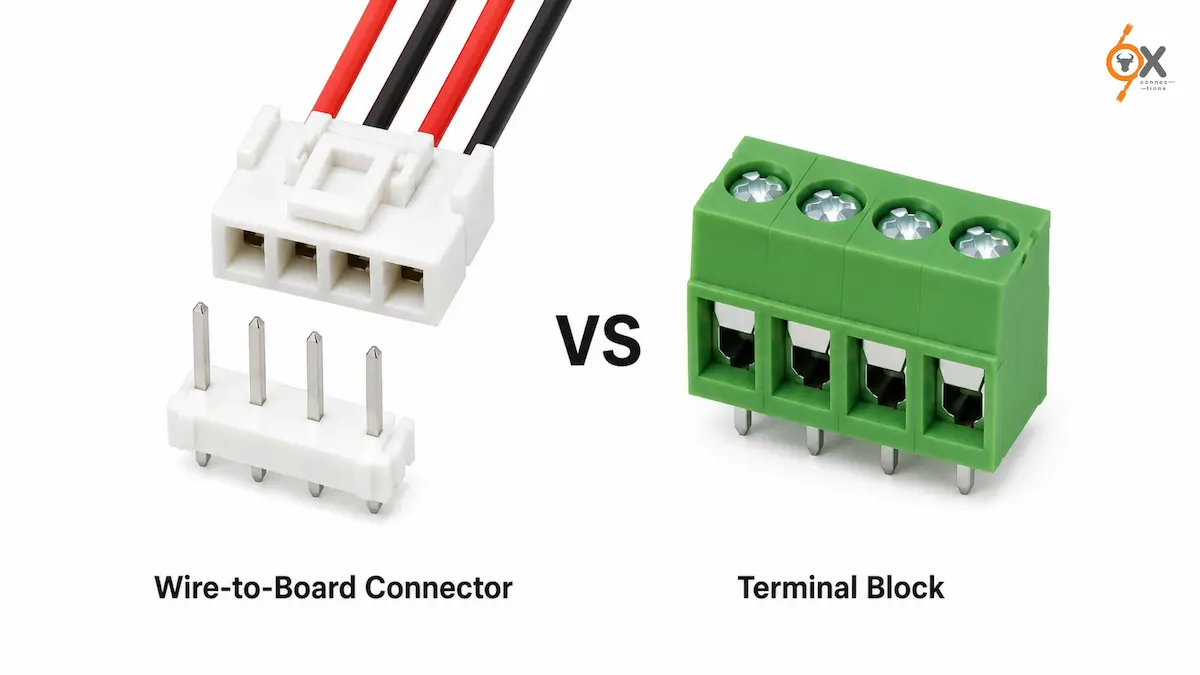
Wire-to-Board Connector vs terminal block are two of the most common PCB connection solutions, each designed for different applications. In this guide, we’ll compare their features, advantages, and limitations to help you choose the right solution for your project.
Are You Still Calling Every PCB Connection a Terminal Block?
Walk into an electronics manufacturing unit in Mumbai, Pune, Ahmedabad, or Bengaluru, and you’ll often hear people referring to any board-mounted wire connection as a “terminal block.”
But here’s the question:
Is every PCB wiring connection actually a terminal block?
The answer is no.
In fact, one of the most common misconceptions in the electronics industry is confusing a Wire to Board Connector vs Terminal Block Connector. While both are used to connect wires to a PCB, they are fundamentally different products designed for different assembly methods, maintenance requirements, and manufacturing environments.
For engineers, purchasing teams, and OEMs, understanding this difference is important because selecting the wrong connection solution can affect production efficiency, serviceability, inventory planning, and even long-term product reliability.
In this guide, we’ll break down the differences in simple terms and help you determine which option is best suited for your application.
What Is a Wire-to-Board Connector?
A Wire to Board Connector is a connector system designed to create a removable connection between a wiring harness and a printed circuit board.
The system typically consists of:
- A PCB-mounted header
- A wire housing
- Crimp terminals
- A mating connection mechanism
The wires are first crimped into terminals and inserted into a housing. The housing then plugs into the PCB-mounted header.
This allows the wiring assembly to be disconnected and reconnected whenever required.
One of the most widely used examples in industrial electronics is the CPU Connector 5.08mm, a wire-to-board connector commonly used in power supplies, industrial control boards, solar electronics, UPS systems, and home appliance PCBs.
What Is a Terminal Block Connector?
A Terminal Block Connector connects wires directly to a PCB using screws, clamps, or spring-loaded mechanisms.
Instead of plugging in a connector assembly, each wire is inserted individually and secured into position.
Terminal blocks have been used in electrical systems for decades and remain common in applications where wiring changes may occur frequently or where field installation is performed manually.
Unlike a Wire to Board Connector, terminal blocks generally do not use crimped housings and mating connector systems.
The Key Difference in One Sentence
If you remember only one thing from this article, remember this:
A Wire to Board Connector plugs into a PCB, while a Terminal Block Connector secures individual wires directly onto the PCB.
That difference may seem small, but it creates major differences in manufacturing, servicing, and production efficiency.
Why Many OEMs Are Moving Toward Wire-to-Board Connectors
As manufacturing volumes increase, OEMs are constantly looking for ways to improve assembly speed and consistency.
This is where the Wire to Board Connector offers a significant advantage.
Imagine an electronics manufacturer producing thousands of inverter control boards every month.
With a terminal block, each wire must be inserted and tightened individually during assembly.
With a wire-to-board connector, wiring harnesses can be prepared separately and simply plugged into the PCB during final assembly.
The result is:
- Faster production
- Reduced assembly time
- Lower risk of wiring mistakes
- Improved repeatability
- Easier servicing
For high-volume manufacturers, these efficiencies can translate into substantial operational benefits.
Comparing Wire-to-Board Connectors vs Terminal Block
Assembly Speed
Wire to Board Connector
- Faster installation
- Plug-and-play assembly
- Suitable for high-volume manufacturing
Terminal Block Connector
- Manual wire termination
- More assembly time required
- Better suited for low-volume or field wiring
Maintenance
Wire to Board Connector
- Easy disconnect and reconnect
- Simplifies PCB replacement
- Supports modular servicing
Terminal Block Connector
- Wires often need to be loosened and reconnected
- More time-consuming during maintenance
Manufacturing Efficiency
For OEM production environments, the Wire to Board Connector typically offers greater consistency and faster throughput.
Terminal blocks remain effective but often require more manual effort during assembly.
Inventory Management
Many manufacturers standardize on a connector family such as the CPU Connector 5.08mm across multiple products.
This simplifies:
- Procurement
- Inventory planning
- Production scheduling
- Spare parts management
Applications Where Wire-to-Board Connectors Excel
SMPS and Power Supplies
Power supply manufacturers often require quick and reliable wire connections between internal assemblies and PCB control circuits.
A PCB Connector system that allows easy assembly and servicing is often preferred.
Solar Inverters
India’s solar industry continues to expand rapidly, creating demand for dependable interconnect solutions.
Wire-to-board connectors help manufacturers streamline assembly while maintaining organized internal wiring.
Industrial Control Panels
Control panels often contain multiple boards, relays, sensors, and power modules.
Using standardized connector systems helps simplify installation and future maintenance.
UPS Systems
UPS manufacturers frequently use removable connector systems because they simplify servicing and component replacement.
Battery Management Systems
As EV and energy storage markets grow, battery management systems increasingly require reliable PCB connectivity solutions.
Home Appliances
Modern appliances rely heavily on PCB-based control systems.
Removable connector systems make assembly faster and help simplify after-sales servicing.
When a Terminal Block May Still Be the Better Choice
While Wire to Board Connectors offer several advantages, terminal blocks still have their place.
A terminal block may be suitable when:
- Wiring changes frequently
- Field installation is performed by technicians
- Connect-and-disconnect cycles are infrequent
- Space constraints are less critical
- Individual wire access is preferred
The best choice depends entirely on the application and operating environment.
Why the CPU Connector 5.08mm Is Often Confused with a Terminal Block
One reason for the confusion is appearance.
Both products are mounted on PCBs and both connect external wiring to electronic assemblies.
However, the CPU Connector 5.08mm is specifically a Wire to Board Connector.
It uses:
- Crimp terminals
- Wire housing
- PCB header
- Mating connector system
It does not use screw terminals or direct wire clamping methods typically associated with terminal blocks.
Understanding this distinction helps engineers specify the correct component and helps procurement teams source the right product.
Factors to Consider Before Choosing
Before selecting either solution, engineers should evaluate:
Production Volume
High-volume manufacturing often benefits from wire-to-board connector systems.
Serviceability
Will the assembly need regular maintenance or replacement?
Wiring Complexity
Large wiring harnesses are generally easier to manage with connectorized systems.
Procurement and Supply Chain
Can the product be sourced consistently with reliable lead times?
Standardization
Can the same connector family be used across multiple products?
Answering these questions usually makes the decision much clearer.
The Future of PCB Connectivity
As electronics become more compact and manufacturing processes become increasingly automated, connectorized assemblies continue to gain popularity.
OEMs today are looking beyond simple functionality.
They are evaluating:
- Manufacturing efficiency
- Serviceability
- Supply chain reliability
- Product consistency
- Cost optimization
For many applications, Wire to Board Connectors offer an effective balance of these requirements.
That is why they continue to be widely used across power electronics, industrial automation, renewable energy systems, and appliance manufacturing.
Conclusion
Although they are often confused with one another, a Wire to Board Connector vs Terminal Block Connector serve different purposes.
A terminal block secures wires directly to a PCB using screws or clamping mechanisms, while a wire-to-board connector creates a removable, connectorized interface between wiring and the board.
For OEMs focused on manufacturing efficiency, faster assembly, easier maintenance, and standardized production processes, wire-to-board connectors are increasingly becoming the preferred solution.
The CPU Connector 5.08mm remains one of the most widely used wire-to-board connector formats for applications such as SMPS units, solar inverters, UPS systems, industrial controls, LED drivers, and appliance electronics.
For more information about OX’s CPU Connector range, visit the OX CPU Connector product page and explore available configurations for your application.
About OX Connections LLP
OX Connections LLP is a stocking distributor of CPU Connector 5.08mm solutions serving OEMs, panel builders, electronics manufacturers, and industrial customers across India. We maintain a large ready inventory for immediate dispatch, ensuring dependable availability for both development and production requirements.
Customers choose OX Connections for consistent product quality, competitive pricing, responsive support, and reliable supply. Whether you need samples for evaluation or bulk quantities for manufacturing, our team can help you source the right CPU Connector solution with minimal lead times.
Contact OXConnections today for samples, technical assistance, or bulk supply enquiries.
Frequently Asked Questions
Is a CPU Connector the same as a terminal block?
No. A CPU Connector is a wire-to-board connector that uses crimp terminals and a mating housing, whereas a terminal block secures wires directly using screws or clamps.
What is a wire-to-board connector used for?
Wire-to-board connectors are used to connect wiring harnesses to PCB-mounted headers in applications such as power supplies, solar inverters, UPS systems, industrial controls, and appliances.
Why do OEMs prefer wire-to-board connectors?
They offer faster assembly, easier maintenance, improved production consistency, and better suitability for high-volume manufacturing.
Where is the CPU Connector 5.08mm commonly used?
Common applications include SMPS units, LED drivers, solar inverters, battery management systems, UPS systems, industrial control panels, and appliance control boards.