
Why does a connector designed decades ago still show up on control panels, test benches, and industrial machines? You’ll find it across Mumbai and every other manufacturing hub in India. Most people expected USB and wireless to make it obsolete years ago. The answer is simple: a D-sub connectors does one job extremely well, and nothing has really replaced it for that job. It locks in place mechanically. It shields against electrical noise. And it keeps working in the kind of dusty, vibration-heavy environment common on factory floors, from an industrial estate in Bhiwandi to a plant on the outskirts of Pune or Chennai. USB is convenient. It is not built for a machine that runs three shifts a day next to heavy motors.
At Ox Connections, we field a version of the same question from technicians and panel builders across India almost every week. Which D-sub variant actually fits this application? And why do the pin counts and shell sizes matter as much as they do? This guide answers that plainly. It starts with the most common variant of them all, the DB9 connector, and works through the D-sub pin configuration logic that applies across the whole family.
The D-Sub Connectors Family, Explained Without the Jargon
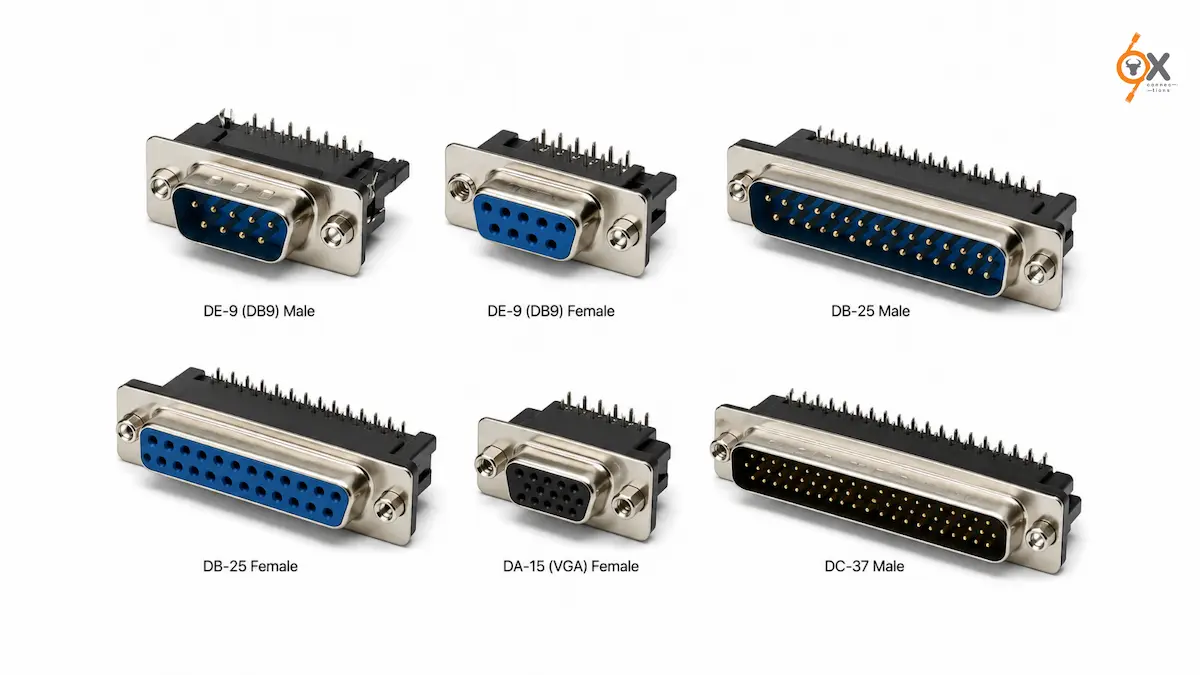
Every D-sub connector is named for two things: a shell letter and a pin count. The shell letter (E, A, B, C, D) sets the physical size of the D-shaped metal shield. The number tells you how many contacts sit inside it. The confusing part is that common usage does not always match the technically correct name.
What most people call a “DB9” is technically a DE-9. It uses the smaller E-size shell, not the B-size shell that DB25 actually uses. On an Indian shop floor, nobody stops to make that distinction in day-to-day conversation, and that is fine. It just matters that the person ordering parts knows which physical connector they actually need.
A quick reference for the shell sizes that matter most:
- E-shell (commonly called DB9 or DE-9): 9 pins in two rows, 5 over 4. It is the default for RS-232 serial communication and one of the most widely stocked connectors in any Indian electronics market.
- A-shell (DA-15): 15 pins in two rows, 8 over 7. Once common for legacy game ports and older networking equipment, it is now rare outside older industrial gear.
- B-shell (DB-25): 25 pins in two rows, 13 over 12. It was historically used for parallel printer ports and full RS-232 pinouts, and it is still active in some industrial and telecom equipment.
- C-shell (DC-37) and D-shell (DD-50): higher pin counts. Specialised industrial, telecom, and data acquisition setups use these where a large number of signal lines need to travel through one connector.
Why the DB9 Connector Refuses to Disappear
Ask any maintenance engineer working with PLCs, CNC machines, or older test instruments in India. The DB9 connector is probably still sitting somewhere on their equipment. It remains the standard interface for RS-232 serial communication, and RS-232 itself is far from dead in industrial settings. Configuring a PLC, connecting to a network switch’s console port, or talking to a piece of laboratory or scientific equipment often still runs through a 9-pin serial line. That is simply because it is simple, well understood, and needs no special drivers or protocols to function.
One detail regularly catches technicians off guard: two DB9 connectors can be physically identical but wired for completely different standards. The RS-232 pinout and the CAN bus pinout use the same 9-pin, two-row shell. But pin 2 carries a receive signal in one and a differential CAN line in the other. Assuming compatibility just because the connector fits can damage equipment. At best, it simply fails to communicate at all.
Reading a D-Sub Pin Configuration Correctly
Getting the D sub pin configuration right is less about memorising every standard. It is more about following a consistent process every time someone specifies or wires a connector.
- Confirm the actual standard first. RS-232, RS-422, RS-485, and CAN bus can all use the same shell size with entirely different pin assignments. Never assume the default serial pinout applies.
- Check standard density versus high density. A high-density D-sub crammed into the same shell carries more pins on tighter spacing. That usually means a lower current rating per contact — an important detail for anything carrying real power rather than just signal.
- Match male and female correctly at both ends. It sounds obvious, but a rushed panel-wiring job in a factory setting is where this mistake happens most often. Multiple cable assemblies can look nearly identical.
- Verify the termination type. Solder-cup, crimp, and insulation-displacement contacts all attach differently. Mixing termination assumptions mid-project causes more rework than almost any other D-sub mistake.
- Check the backshell where EMI matters. A metal backshell with a proper 360-degree shield termination makes the difference between clean data and a noisy line. This matters most on any cable running near motors, drives, or high-current equipment — a common situation on Indian industrial floors with dense machinery layouts.
Common Mistakes That Cause Connector Failures
Most D-sub connector problems trace back to a handful of avoidable habits rather than a defective part. Watching out for these saves a lot of troubleshooting time later.
- Forcing a mismatched shell. Applying force to seat a connector that does not quite align bends pins permanently. A bent pin on a 9 or 25-pin shell is often not worth trying to straighten back into service.
- Skipping the screw locks. Manufacturers design D-sub connectors with screw-down hardware specifically because friction alone will not hold a connection under vibration. Leaving the screws loose “for now” is one of the most common causes of intermittent signal loss on a factory floor.
- Assuming a standard pinout. Defaulting to the familiar RS-232 pin assignment on any 9-pin connector is risky. Without checking whether the equipment actually expects CAN bus or a custom industrial pinout, you can damage both ends of a connection fast.
- Ignoring shielding on noisy lines. Running an unshielded or poorly grounded D-sub cable near motor drives or high-current equipment invites exactly the electrical noise the metal shell exists to prevent.
- Reusing a connector with worn contacts. Repeated mating cycles gradually wear down contact plating. Reusing a worn connector for one more “quick fix” often introduces resistance that shows up as an unreliable connection weeks later.
Where D-Sub Connectors Still Earn Their Place
Despite decades of newer interfaces, D-sub connectors remain the practical choice across a specific set of applications:
- Industrial automation, where PLCs, sensor arrays, and robotics controllers rely on the mechanical security and noise shielding a D-sub shell provides. This matters most in a busy, high-interference factory environment.
- Test and measurement equipment, including oscilloscopes and signal analyzers, where reliable signal integrity matters more than compact size.
- Legacy and hybrid systems. Older machinery still in active use across Indian manufacturing plants was never built around USB or Ethernet in the first place.
- Telecom and networking hardware, particularly console ports on switches and routers that remain the standard way to configure equipment locally.
A Quick Word on Sourcing D-Sub Connector
The trouble with D-sub connectors rarely shows up in a single unit. It shows up across a batch, when contact plating, shell tolerances, or termination quality drift just enough between units. That drift causes an inconsistent fit on a production line, whether that line is in Mumbai, Pune, or anywhere else in India. Consistency across an entire order of connectors matters as much as the datasheet of the one sample that got approved.
Final Word
A D-sub connector rarely gets credit for being clever. It is simple, mechanical, and predictable. That is exactly why it has outlasted so many newer interfaces on factory floors and equipment racks across India. Getting the shell size, pin configuration, and termination right the first time saves far more trouble than tracing a signal fault later. At OxConnections, every D-sub connector leaving our Mumbai facility is built to hold that reliability consistently. It doesn’t matter whether it’s a small trial order or a full production run supplying automotive, industrial, or telecom applications across India’s metro cities.