
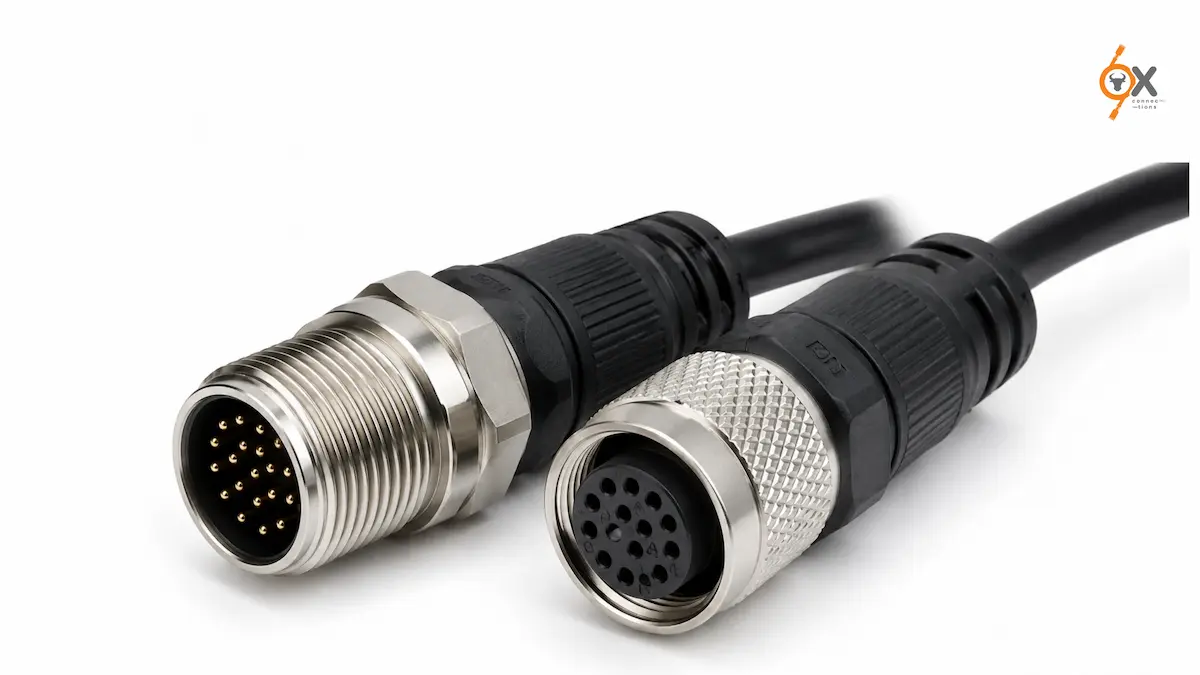
Robotic arms and automated cells rarely need just one type of connection at a joint or housing. They need power for motors, signal lines for feedback, and sometimes auxiliary control circuits. These connections must fit within limited space as robots become more compact. This practical need drives the use of M16 connectors robotics applications. A single connector body can carry multiple circuit types. This approach also reduces cable clutter and potential failure points.
One Connector, Two Jobs
M16 stands out within the M-Series range because it works as a genuine power and signal connector. It supports more than a single circuit type. Multi-pin configurations can carry motor power, brake control, and low-level signal lines through one connector body. This setup simplifies wiring on robotic joints where space for cable glands and connector housings remains limited.
This combined-circuit design reduces the number of separate connectors at each joint. It also reduces potential failure points and simplifies assembly and field servicing.
Cable Management Benefits at the Joint
Combining circuits also offers practical mechanical benefits. Fewer connectors at a robotic joint mean less bulk for the cable harness to carry through a moving section. This setup reduces strain on the overall assembly. It also makes routing through cable carriers or drag chains simpler.
A bulky cable bundle at a joint can restrict the robot’s range of motion. It can also create a wear point where cables repeatedly rub against the housing.
Fewer connectors also simplify documentation and troubleshooting. A technician can trace faults with fewer connection points during troubleshooting.
Why Robotics Applications Lean on M16 Connectors
Robotic arms move constantly during operation. Every cable and connector at a joint experiences repeated flexing, twisting, and vibration. A connector in this position needs a locking mechanism that can handle continuous mechanical stress. It also needs shielding to prevent power and signal circuits from interfering with each other within the same housing.
These requirements make M16 suitable for robotic joint wiring, collaborative robot arms, and automated cells. It can support applications where motor drives sit close to sensitive feedback electronics.
Shielding Between Circuit Types
Running power and signal through the same connector body creates an important design challenge. Higher-current power lines can introduce noise into nearby low-level signal pins. Proper internal shielding and pin arrangement can help manage this issue.
Engineers should confirm these details with a supplier before specifying an M16 connector robotics design at scale. A poorly arranged pinout can affect signal quality even when the system uses good external shielding.
Beyond Robotics: Where Else M16 Is Used
Robotics provides the clearest use case for M16. This connector size also suits applications that need combined power and control wiring in a compact housing. Examples include certain machine tool axes and automated material handling equipment.
These applications share several requirements. They need multiple circuit types, limited mounting space, and a connector that can remain secure during constant motion.
Automated guided vehicles and mobile robotic platforms also use similar connection requirements. Their onboard motor drives and control electronics need reliable, vibration-resistant connections within compact enclosures.
Format and Mounting Options
M16 connectors generally come in straight and angled body styles. They also come in panel mount and field-attachable versions. The right option depends on whether the wiring remains fixed during equipment design or needs on-site adjustment.
As with other sizes in the range, engineers should check sealing performance against the operating environment. A robotic cell on a factory floor has different protection needs from one operating in a cleanroom.
Cable strain relief also deserves attention in joint-mounted applications. Repeated flexing at a robotic joint places more mechanical stress on the cable-to-connector transition than a fixed installation does.
Sourcing M16 Connectors from Ox Connections
Ox Connections stocks over 5,000 products with dispatch within 48 hours. This helps keep robotic and automation assembly lines on schedule without long waits for combined power and signal wiring components.
As an M16 connector supplier india, Ox Connections can help OEMs building automation and robotics equipment. Our team can confirm the right pin configuration and shielding setup for your specific joint or housing design.
For robotics manufacturers standardising connector selection across a product range, sourcing the full M-Series line from a single supplier also simplifies documentation and spares planning. Specifications and lead times can remain consistent from one project to the next.
If you’re designing a new robotic joint or standardising power and signal wiring across an existing product line, get in touch to request a sample or download our full product catalogue.