
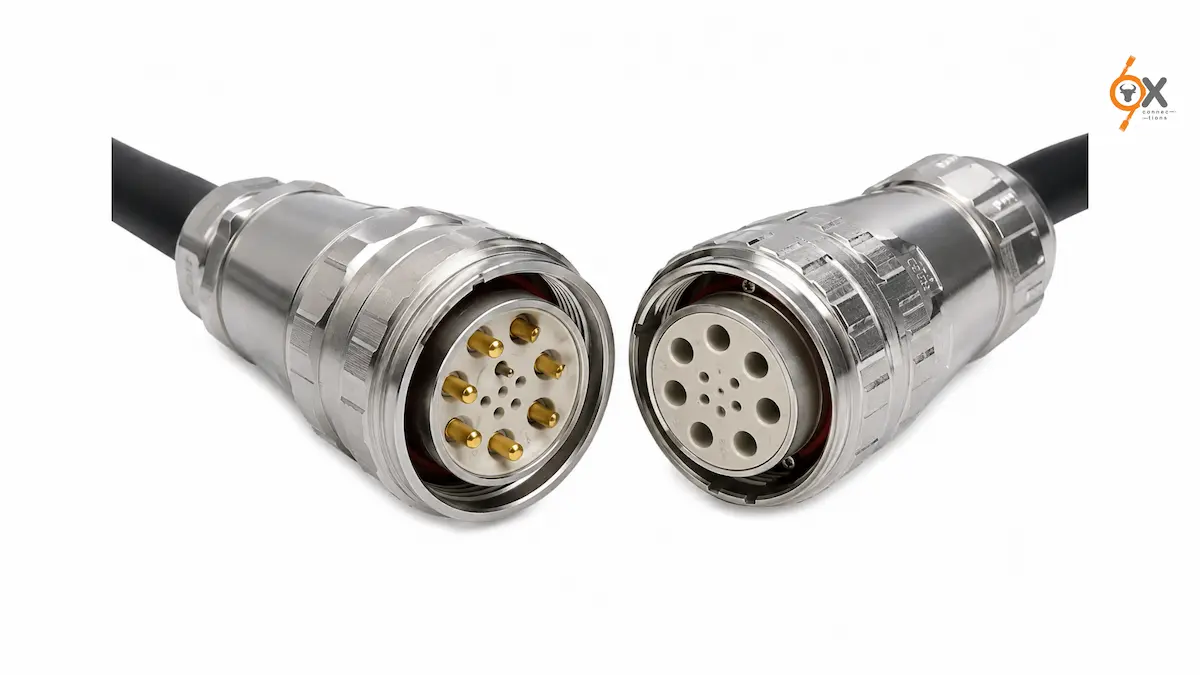
At the top of the M-Series range sits the connector built for the heaviest jobs: driving large motors, feeding industrial drives, and holding up under continuous high-current load in some of the toughest plant environments. This is the territory of the M23 connectors high current applications depend on, the largest and most robust size in the family. This blog covers what makes M23 different and where it earns its place on a bill of materials.
Built for the Top of the Load Range
M23 connectors is the largest thread size in the M-Series family. That extra diameter translates directly into more room for larger contacts and higher current-carrying capacity. Industry-standard M23 power variants are commonly used to run servo motors, industrial drives, and other equipment where the connector has to reliably deliver both the steady-state running current and the higher inrush current that motors draw at start-up.
Because of this, M23 tends to appear on equipment where downtime from a connector failure is expensive. It’s often sitting between a drive and the motor it’s powering on a production-critical line.
Servo Motors and Drives: The Core Application
The clearest and most common use case for this size is servo motor and drive connectivity. As an M23 connectors servo motor applications rely on, it frequently combines a high-current power interface with the option to bundle in additional signal or brake contacts. This lets a single connector handle both the motor’s power supply and its associated control wiring in one rugged housing.
This combined approach reduces the number of separate cable runs needed at the motor. This simplifies both the original installation and any future maintenance or motor replacement.
Shielding and Signal Integrity at High Power
Running high current through the same general connector family used for sensitive signal wiring elsewhere in the M-Series range means shielding takes on real importance. Fully shielded M23 housings are common, using a metal shell that forms a continuous barrier around the internal contacts. This helps limit electromagnetic interference escaping from or entering the connector.
This matters particularly in installations where high-current power cabling runs close to encoder feedback or communication lines. Unshielded interference at this scale can introduce genuine reliability problems into a motion control system rather than just minor signal noise.
Mechanical Durability for Harsh Environments
A threaded, screw-lock coupling is the standard mating method for this size. This gives a secure connection that resists loosening under the vibration generated by large motors and drives during continuous operation. IP-rated sealing options protect against dust and moisture ingress.
This is an important consideration for equipment installed in demanding industrial settings such as heavy manufacturing plants, outdoor installations, and other environments where cabling is exposed to harsh conditions.
Metal-shelled construction is typical at this size. It is chosen for its combination of mechanical strength and EMC shielding performance in demanding applications.
Contact plating also plays a role in long-term reliability at this current level. Repeated mating cycles and continuous current flow can gradually wear standard platings. Higher-grade contact platings are generally specified for applications with frequent connector cycling or where long-term contact resistance stability is a priority.
Common Duty-Cycle Considerations
Drives and large motors rarely run at a single constant load. Duty cycles that include frequent starts, stops, or direction reversals put repeated thermal and mechanical stress on a power connector. Each start-up event draws a current spike well above the steady running load.
Confirming a connector’s rated current against the application’s actual duty cycle, rather than only its average running current, helps avoid premature wear on contacts that see this kind of repeated cycling.
Ambient temperature inside an enclosure also affects how much current a connector can safely carry. Heat from nearby drives or transformers can reduce a connector’s effective current rating compared to its rating in open air.
This is worth factoring in during panel design, particularly for enclosures with limited ventilation.
M23 in Context: The Top of the M-Series Range
Compared to M20, M23 generally supports a higher current-carrying capacity and larger contact sizes. This makes it the natural choice when a project’s power requirements exceed what M20 comfortably handles.
As a general rule, moving up to M23 makes sense once load calculations, including motor inrush current, point toward a connector class built specifically for heavy-duty power transmission rather than general industrial wiring.
Sourcing M23 Connectors from Ox Connections
Ox Connections stocks over 5,000 products with dispatch within 48 hours. This helps keep drive and motor assembly projects moving without long waits on heavy-duty power connectors.
As an M23 connectors supplier india OEMs building high-current motor and drive systems can rely on, our team can help confirm the right pin configuration, shielding, and current rating for your specific application.
Having now covered the full M-Series range from the compact M5 through to the heavy-duty M23, most industrial connector requirements across sensor wiring, networking, feedback, robotics, and high-current power can be sourced from a single, consistent product family rather than mixing suppliers project to project.
If you’re specifying connectors for a new drive or motor project, or standardising heavy-duty power wiring across an existing product line, get in touch to request a sample or download our full product catalogue for detailed specifications.