
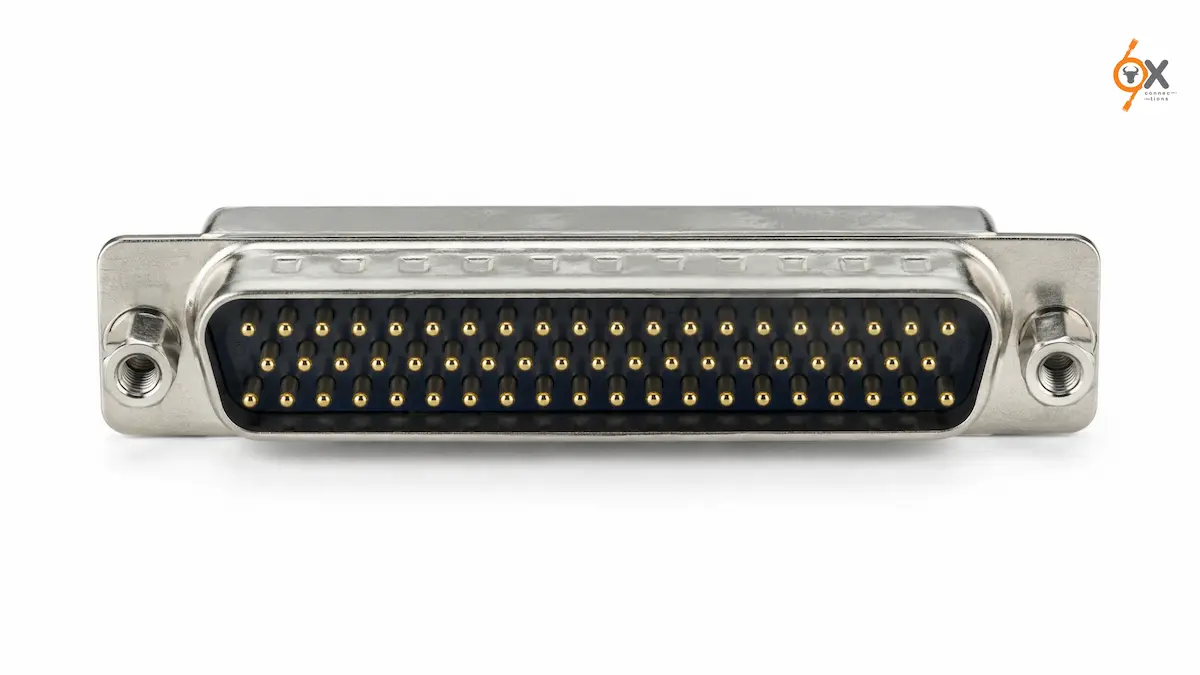
Learn how a 62-pin D-Sub connector works, including its pin layout, applications, mounting options and selection tips for Indian OEMs.
Some panels need dozens of signals but can’t spare the space a large standard connector would take. The 62-Pin D-Sub Connector solves that exact problem. It packs a high pin count into a shell that stays close to the size of far smaller connectors.
A High-Density Design With a Clear Job
This connector belongs to the high-density D-Sub family, alongside the 44-pin version. Both use a tighter pin pitch than standard sizes like 37 or 50 pins. That tighter spacing packs 62 contacts into a shell barely larger than a connector with half as many signals. Designers reach for it when panel space runs short but the signal count doesn’t.
Where This Density Actually Pays Off
Compact test equipment benefits most from this pin count. A rack with limited front-panel space can carry dozens of measurement channels through one connector instead of several smaller ones. Embedded systems with many sensors packed into a tight enclosure use this density for the same reason. Data acquisition modules built for space-constrained cabinets also rely on this connector to keep their footprint small. Portable diagnostic equipment, where every gram and millimetre matters, frequently defaults to this pin count for exactly the same trade-off.
D-Sub Connector Applications Built Around Density
D-Sub Connector Applications at this pin count usually involve equipment where panel space is genuinely scarce. Industrial automation systems use it to bring a large number of sensor and actuator lines into a compact enclosure. Test and measurement equipment relies on it to keep multi-channel setups from sprawling across an entire rack. Communication systems with dense signal needs choose this connector when a 50-pin part takes up too much room.
Mounting Options That Match Your Build
Ox Connections offers the 62-pin D-Sub across solder-type, crimp, IDC, and PCB-mounting versions. A solder-type connector suits low-volume, hand-terminated assemblies. A crimp version suits panel builders running larger batches, since it keeps every termination consistent. IDC versions save time on ribbon cable jobs. PCB-mount versions, in straight or right-angle orientation, solder directly onto a board for a compact layout.
Precision Becomes Non-Negotiable at This Pitch
Sixty-two contacts packed into a dense shell leave almost no room for manufacturing drift. Each pin needs consistent spacing and plating to avoid a weak connection hiding among the rest. A secure locking mechanism keeps the shell seated correctly under vibration. Threaded jack screws resist the pull of a heavier cable bundle too. Careless handling during mating can bend several closely spaced pins in one motion.
Sourcing a D-Sub Connector India Compact Builds Depend On
D-Sub Connector India buyers building space-constrained, high-density panels need a supplier who stocks this size reliably. Ox Connections carries the 62-pin version alongside 9, 15, 25, 26, 37, 44, 50, 78, and 104 pin configurations. Over 5,000 products sit in stock. Quick dispatch across India keeps tightly engineered builds on schedule.
Careful Handling for a Dense Contact Field
Technicians should mate this connector slowly and check alignment before applying any pressure. A rushed attempt at this pitch risks damaging several pins at once. Hand-tightening the jack screws evenly on both sides keeps the shell flat against its mating half. A magnifying tool helps during inspection, since bent pins are harder to spot at this density. Routine checks during maintenance catch early wear before it causes a confusing fault. Keeping a labelled spare cable nearby also shortens downtime considerably when a connector eventually needs replacing.
Final Word
The 62-Pin D-Sub Connector gives space-constrained panels a way to carry a large signal count without the extra bulk. Match mounting style and locking hardware to the actual application. Confirm pitch and pin layout against the exact datasheet before ordering. High-density parts vary more between manufacturers than standard sizes do. Ox Connections offers D-Sub connectors across the full 9 to 104 pin range. Choices include solder, crimp, IDC, power, waterproof, and Centronics variants. Over 5,000 products stay in stock, with quick dispatch across India.
FAQ
What makes a 62-pin D-Sub connector different?
It uses a high-density pitch to pack 62 contacts into a shell close to the size of a standard 50-pin part.
Who typically needs this pin count?
Space-constrained equipment with a large signal count, such as compact test racks, embedded systems, and dense data acquisition modules.
Does the tighter pitch change how I should handle it?
Yes. Mate this connector slowly and check alignment first, since a rushed attempt can bend several closely spaced pins at once.
Leave A Comment