
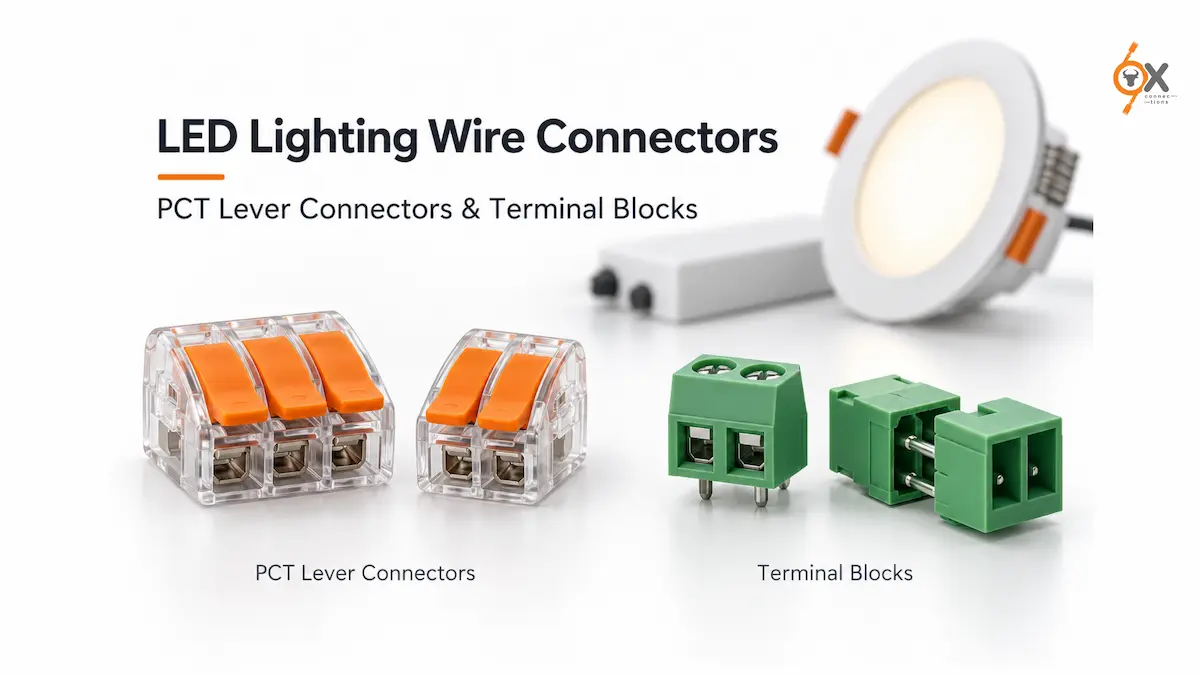
LED lighting wire connectors help create secure, serviceable connections between supply wires, LED drivers and fixtures. Loose joints can cause flickering. However, driver faults and dimmer incompatibility can also cause this problem. This guide explains how to select PCT lever connectors and terminal blocks for indoor lighting installations.
It covers junction box splicing, driver-to-fixture wiring and panel-side circuit connections. However, it excludes LED strip clip connectors. Those belong to a different product category with separate mounting and pitch requirements.
LED Lighting Wire Connectors
Why Lighting Wiring Still Needs Proper Termination
A lighting circuit can contain several splice points, even when it carries a relatively small load. For example, one junction box might feed four downlights. Similarly, a driver output might split into two fixture runs. Control wires may also join at several switch points along a corridor.
Each connection requires a suitable lighting wire connector. Poor connections can cause flickering, inconsistent dimming or intermittent faults. Therefore, proper termination matters throughout the installation.
Multi-Wire Joining: PCT Lever Connectors
PCT connectors for lights provide a reusable option for joining conductors. Installers can use suitable models in junction boxes, ceiling voids and fixture entry points.
Ox Connections’ PCT Series uses a spring-loaded lever. First, lift the lever and insert the stripped conductor. Then, close the lever to secure the connection. This process requires neither solder nor a screwdriver.
The series includes 2, 3, 4 and 5-pin configurations. These options support different splice requirements, from wire extensions to connections serving multiple fixtures.
The published range supports solid and stranded conductors from 0.5 to 4 sq. mm. In addition, the transparent housing lets installers check whether each wire sits correctly. This visual check helps identify partially inserted conductors before closing the fixture.
Ox describes the PCT Series connections as gas-tight and resistant to vibration and pull-out. These features matter where thermal cycling or building movement can affect wire joints. However, installers should always follow the selected model’s specifications.
Terminal Blocks: Driver Boards and Panel-Side Wiring
PCB terminal blocks suit connections on LED driver boards and lighting control boards. Unlike loose wire splices, these applications require a board-mounted connection.
Ox distributes the Zhonga and Xinya terminal block ranges. Options include PCB screw, PCB spring and pluggable Combicon-style terminal blocks. The listed ranges cover pitches from 2.54 mm to 10.16 mm and 2 to 16-pin configurations.
Before choosing a replacement, check the exact model’s dimensions, ratings and mating arrangement. A similar form factor alone does not confirm compatibility.
Panel-side lighting circuits can carry the combined load of several fixtures. Consequently, connector selection must account for the total circuit requirements. Barrier or screw terminal blocks offer options for these applications.
The ranges described here include 6.35 mm, 7.65 mm, 8.25 mm and 9.5 mm pitches across 2 to 16 poles. Confirm the required configuration against the specific product datasheet.
Maintenance Access Matters More in Lighting Than It Looks
Lighting installations often change during a building’s life. For example, offices change their partitions, retailers update layouts and maintenance teams replace fixtures.
Cutting and terminating a joint during every replacement adds work. Therefore, reusable connections can simplify future servicing.
Installers can open and close a PCT lever connector to release and reconnect a conductor. Similarly, a pluggable terminal block allows disconnection from its base without disturbing the board wiring.
Both options can make maintenance easier where technicians need regular access. However, the selected connector must still match the electrical and mechanical requirements.
Installation Considerations
Match the wire gauge to the connector’s rated range.
Physical fit alone does not confirm suitability. Therefore, check the supported conductor size before installation.
Check the connection count against the actual splice.
Do not force extra conductors into an entry that does not permit them. Instead, select a connector with the required number of suitable entries.
Use the transparent housing as a checkpoint.
Confirm that each wire sits fully inside the connector before closing the fixture. This check matters especially in ceiling spaces with limited future access.
Match the connector to its location and circuit requirements.
A suitable PCT lever connector can serve fixture-level splicing. Meanwhile, PCB or barrier terminal blocks can serve appropriate board and panel connections. Always check the specific model’s ratings.
Selection Factors at a Glance
| Selection Factor | PCT Lever Connector Considerations | Terminal Block Considerations |
|---|---|---|
| Number of wires joining at one point | Choose a suitable 2, 3, 4 or 5-entry model for the intended splice. | Select the required number of poles and verify the connection arrangement. |
| Future maintenance access | Reusable levers allow conductors to disconnect and reconnect. | Pluggable versions allow disconnection from the base. |
| Connection location | Suitable models support junction box and fixture-level splicing. | PCB versions suit driver or control boards; suitable barrier blocks support panel wiring. |
| Circuit current and wire size | The published PCT range covers 0.5–4 sq. mm; verify model-specific ratings. | Check current, voltage and conductor ratings for the selected model. |
Sourcing PCT and Terminal Block Connectors
Ox Connections stocks PCT lever connectors alongside the Zhonga and Xinya terminal block ranges. Together, these categories cover fixture-level splicing and suitable board or panel connections.
Browse the Releasable Connectors range for PCT options. Alternatively, explore Green Terminal Blocks and Barrier Terminal Blocks for terminal block options.
Specifying connectors for a lighting installation or planning a bulk order? Get in touch with Ox Connections for a quotation. You can also request the product catalogue to explore the full range.
Leave A Comment