
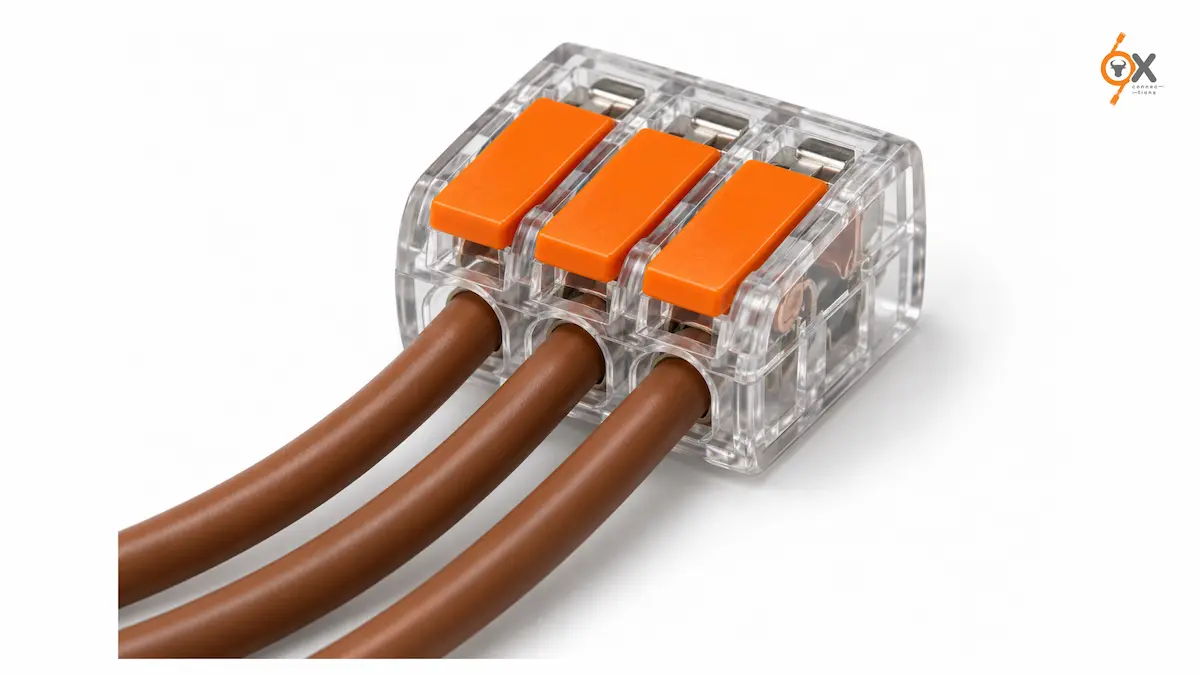
Three conductors meet at one point, and the panel has no room for another terminal block. What do you do? Many wiring teams reach for a 3-way wire connector at exactly this moment. It joins three conductors in a small footprint and lets a technician release them later. This guide looks at the PCT-223 connector from OX Connections, a three-port lever connector built for that job. It covers construction, wiring, lever handling, lighting and control panel use, and the mistakes that cause rework.
Why a 3-Way Wire Connector Earns Its Place in Compact Wiring
Most circuits reach a point where three conductors must meet. A lighting loop is a common case. The feed arrives, one run continues to the next fitting, and a third drops to a driver. A 3-way wire connector handles that junction without a terminal strip and without twisting and taping.
OX Connections lists the PCT range under releasable connectors. Its page describes lever nut wire connectors, quick splice connectors, push-in terminal blocks and reusable spring connectors. Because the joint can be released, a design change on site does not force a full rewire.
Inside the PCT-223 Connector: What OX Confirms
The PCT-223 connector is the three pin member of the PCT series. OX lists the series as PCT-222 to PCT-225, in 2, 3, 4 and 5 pin configurations. Each connector uses a spring-loaded lever instead of a screw. The lever opens the spring clamp, and the clamp holds the conductor once closed.
OX lists the series for solid and stranded conductors from 0.5 sq. mm to 4 sq. mm. The housing is transparent, so an installer can see whether the wire has entered fully. OX describes the joint as gas tight and resistant to vibration and pull-out. The series is listed as RoHS compliant and reusable.
The OX page does not publish voltage, current, temperature or housing material data for the PCT-223. Treat these as open questions. Request the approved datasheet before you freeze a bill of materials.
Wiring Three Conductors: A Repeatable Five Step Sequence
A 3-way wire connector only saves time when every technician follows the same sequence. This one suits a production line or a site crew.
- Cut and strip all three conductors first, using the strip length in the datasheet.
- Check each conductor against the 0.5 to 4 sq. mm range.
- Lift the lever, insert one stripped conductor fully, and push the lever down.
- Repeat the same action for the other two conductors.
- Inspect each entry through the transparent housing, then give each wire a light pull.
Preparing all three wires first stops half wired connectors sitting open on the bench. The pull check is common shop practice rather than an OX instruction. Add it to your own work instruction if your quality plan allows it.
Lever Operation: Small Habits That Prevent Big Rework
The lever is the heart of the PCT-223 connector. OX describes the action in three moves: lift the lever, insert the stripped wire, push down. Keep your work instruction that simple.
Two habits matter most. Push each conductor in until it stops before closing the lever. Then look through the housing before moving on. OX describes the operation as tool free, so avoid prying or forcing a lever. A damaged lever removes the reuse advantage.
OX presents the connector as reusable, but it does not publish a release cycle limit. If your application expects frequent re-making, ask OX for guidance first.
Lighting Installations and Control Panels: Where the 3-Way Connector Fits
OX names lighting installations, HVAC control wiring, junction box connections and rapid prototyping among uses for its releasable range. OX also mentions electrical panels, industrial control systems and OEM assemblies in its own PCT-223 guide.
In lighting, the three position layout suits a tap where one feed serves two loads. Commercial fit-outs in Mumbai, Pune or Bengaluru often see circuit changes during snagging. A releasable joint lets an electrician alter the circuit without redoing the run.
In control panels, the connector can serve where three control wires share one point, such as a common tap. Confirm the electrical rating and how the three ports link internally before using it on any circuit. It does not replace a numbered terminal block where every conductor needs a marked, individually testable point.
PCT-223 Selection Table: Match the Job Before You Order
| Application | Why the PCT-223 fits | Confirm with OX before ordering |
| Lighting junction or fixture tap | Joins three conductors in a compact body. Releasable for site changes. | Rated current and voltage for the lighting load. Wire size. |
| Control panel common tap | Joins three control wires without adding a terminal block. | Datasheet ratings. How the three ports link internally. Labelling method. |
| HVAC control wiring | OX lists HVAC control wiring among uses for its releasable range. | Wire type and gauge. Operating temperature. |
| OEM production wiring | Same lever sequence on every unit. Visual check through the housing. | Strip length. Expected release cycles. Ferrule suitability. |
| Maintenance and retrofit | Opens and re-makes without screws. | How often the joint will be re-made. Condition of existing conductors. |
| Prototype builds | OX lists rapid prototyping among uses for the range. | Whether the final design moves to a fixed terminal later. |
PCT-223 vs PCT-222: A Quick Comparison
Both connectors belong to the same OX PCT series. Both list 0.5 to 4 sq. mm and use the lever mechanism. The difference is the count. PCT-222 offers two positions and the PCT-223 offers three. Choose by the number of conductors at the joint. Do not force three wires into a pair, and do not pay for a third position you will never use. PCT-224 and PCT-225 cover four and five positions.
Installation Mistakes That Cost Rework
- Half inserted conductors. A wire that is not fully seated can look acceptable at a glance. Inspect through the housing every time.
- Wrong strip length. Too short can weaken the contact, and too long leaves bare copper exposed. Follow the datasheet.
- Wire outside the listed range. OX lists 0.5 to 4 sq. mm. Ask before using very fine or unusual cable.
- Mixing circuits. A splice style connector may join all its ports. Confirm the internal arrangement before joining different circuits.
- Assumed ratings. The OX page lists no current or voltage for this connector. Do not borrow figures from reseller listings.
Sourcing the PCT-223 Connector in India: Send the Right Enquiry
OX Connections supplies connectors to OEMs, panel builders and manufacturers across India. OX states that it holds more than 5,000 products in stock and dispatches quickly. The PCT-223 sits in the releasable connectors range beside the PCT-222, PCT-224 and PCT-225.
Planning a trial batch or a running order? Send OX your conductor size, application, monthly quantity and delivery date. Ask for the PCT-223 datasheet and a quotation. Write to om.advani@oxconnections.com or use the Contact Us page on oxconnections.com.
Leave A Comment