
This comparison helps OEMs, panel builders, electricians and procurement teams specify the right part. It covers construction, mounting, termination, maintenance and space. It also includes a connector strip vs terminal block table for reviewing a BOM.
A BOM lists “connector strip” against a line item. Three weeks later, the panel builder receives a soldered pin header. However, the job needed a wire connection that a technician could open with a screwdriver during commissioning.
People sometimes use these terms interchangeably. As a result, an unclear purchase order can lead to the wrong component.
What Each Term Actually Refers To
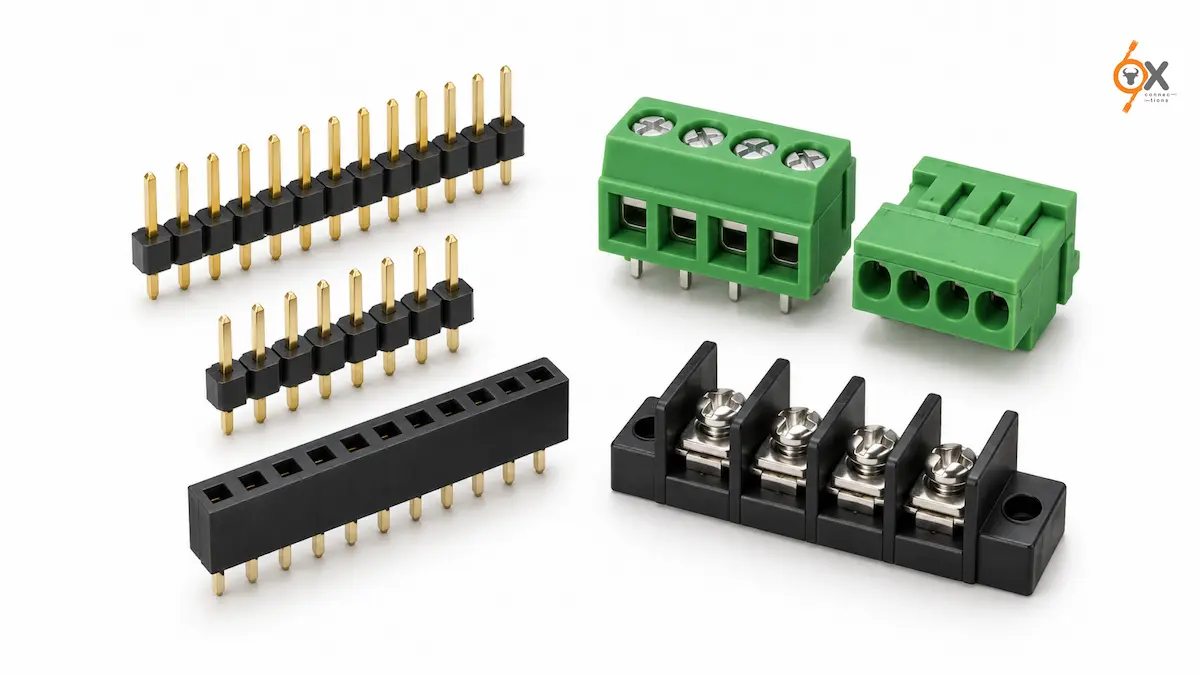
“Connector strip” can describe different products, including terminal strips. Therefore, this guide uses electrical connector strip to mean a PCB pin or socket header.
This type consists of a row of contacts sharing one insulating body. Typically, its mounting pins solder directly onto a PCB. However, a matching socket or cable connector can still disconnect without desoldering the header.
A terminal block provides a clamping mechanism for connecting conductors. Depending on the model, it uses screws, springs or cage clamps.
In addition, pluggable terminal blocks let technicians unplug the wired section from its board-mounted base. This arrangement makes field wiring and maintenance easier.
Connector Strip vs Terminal Block: A Side-by-Side Comparison
| Aspect | Connector Strip | Terminal Block |
|---|---|---|
| Construction | A row of contacts in a shared insulating body, often a pin or socket strip | An insulating housing with screw or spring contacts for securing conductors |
| Mounting | Usually solders directly onto a PCB | PCB, DIN-rail or panel mounting, depending on the series |
| Wire termination | Mating connectors may use crimp, IDC or solder termination | Screw or spring termination; pluggable versions also provide a detachable interface |
| Maintenance | Mating connectors can unplug; replacing a soldered header usually requires desoldering | Technicians can release and reconnect wires without disturbing the board |
| Space requirements | Often compact and suitable for closely spaced board connections | Requires space for the terminals, wire entry and service access |
| Typical applications | Internal board-to-board links, header interfaces and signal connections | Control panels, power distribution, PCB connections and field wiring |
Why the Distinction Matters on a Real Job
Space and maintenance both influence the decision. A compact header often suits internal board connections where space is limited. For example, it can connect two boards through a matching socket.
In contrast, a terminal block suits applications that require direct wire termination and convenient access. These include field wiring, power distribution and serviceable control panels.
However, neither category automatically makes a connection permanent or removable. The complete connector arrangement determines how technicians disconnect it.
Getting the selection wrong still has a cost. A soldered wire joint can make service work slower when the application needs a releasable connection. Conversely, a larger terminal block may add unnecessary space and cost where a compact header would suffice.
Therefore, specify the termination method and service requirements alongside the product name.
Where Xinya and Zhonga Fit
Ox Connections offers Xinya and Zhonga terminal block ranges in India. These include green PCB terminal blocks and barrier terminal blocks for different wiring requirements.
The following table summarises the ranges described in this guide. However, confirm each specification against the selected part number before ordering.
| Spec | Green Terminal Blocks | Barrier Terminal Blocks |
|---|---|---|
| Pitch range | 2.54mm to 10.16mm, depending on the series | 6.35mm, 7.65mm, 8.25mm and 9.5mm options |
| Pin configuration | Confirm available pole counts for the selected series | 2 to 16 positions, depending on the series |
| Series | 126, 127, 128, 129, 300, 301, 303 and 2500 | 25C, 35C, 45C and HB9500 |
| Type | PCB screw, PCB spring and pluggable types, including straight and right-angle options | Terminal strips and PCB versions, including straight and right-angle options with caps |
Some products may resemble terminal blocks from Phoenix Contact, WAGO or Degson. However, appearance and matching pitch alone do not establish compatibility.
Before substituting a part, compare its footprint, dimensions, mating geometry, conductor range and electrical ratings. Also, check the exact model’s material specifications and approval documentation. Do not assume that a certification applies to every product in a brand’s range.
For control panels and power distribution, start with the application’s requirements. Then, select the appropriate terminal block or connector instead of relying on the BOM’s wording alone.
A Quick Way to Decide
Will anyone need to disconnect a wire after commissioning?
If yes, consider a terminal block or a suitable removable connector. Choose the arrangement that provides the required access and service life.
Is the connection internal to the board assembly?
A connector strip may offer a compact, economical interface. However, confirm the mating arrangement and electrical ratings first.
Does the design need to match an existing Phoenix Contact, WAGO or Degson footprint?
Check suitable Xinya and Zhonga models against the original part’s datasheet. Confirm mechanical and electrical compatibility before changing the BOM.
Sourcing Terminal Blocks and Connector Strips
Ox Connections offers Xinya and Zhonga terminal block ranges alongside wire-to-board connector options. These provide choices for PCB connections, panel wiring and serviceable assemblies.
Browse the Green Terminal Blocks and Barrier Terminal Blocks pages. Alternatively, explore the Zhonga and Xinya ranges.
Need help specifying a terminal block for a panel build or a bulk quotation across pitches? Get in touch with Ox Connections, or request the product catalogue for the complete range.
Leave A Comment