
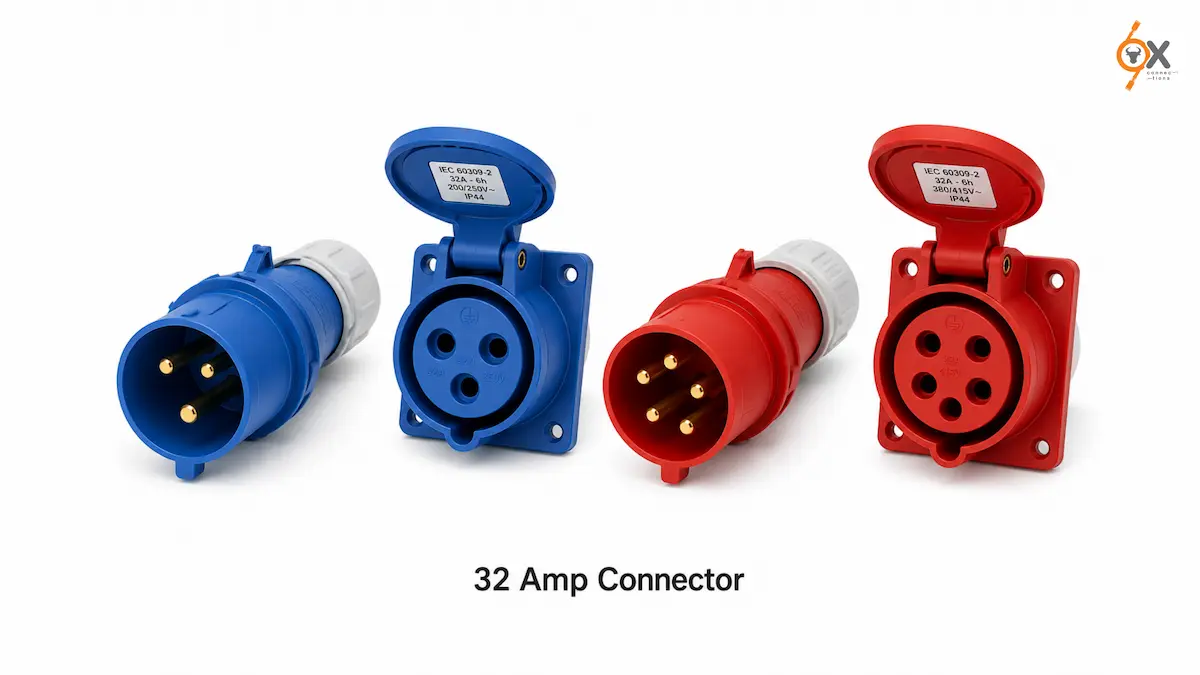
Ever wondered why a construction site in Bhiwandi runs everything off connectors that look nothing like the ones inside an office building? That’s not a design preference. Industrial sites draw more current, sit outdoors through the monsoon, and need connectors that survive a genuinely rough environment. A 32 amp connector sits right in the middle of that world, doing a job a standard domestic plug was never built for.
At Ox Connections, we get a version of the same question from panel builders and site engineers across India almost every week. Which 32 amp connector actually fits this application? And which standard does it need to meet? This guide works through both, in plain language, the way it actually comes up on a job site.
What a 32 Amp Connector Actually Does
A 32 amp connector is built to carry higher current safely than a standard plug and socket. A household socket handles light loads like lamps or laptops. A 32 amp connector handles motors, compressors, welding equipment, and portable generators instead. It has to lock in place mechanically, resist moisture and dust, and keep contact quality steady even after hundreds of connect-disconnect cycles on a busy site.
The build reflects that job. Thicker contacts carry more current without overheating. A robust housing resists impact from tools, trolleys, and general site traffic. A locking sleeve or ring keeps the connector seated even when a cable gets tugged or a machine vibrates through a full shift.
Where 32 Amp Connectors Show Up in the Real World
Construction sites are the most visible example. Temporary power distribution across a build in Pune or Chennai often runs through 32 amp connectors, feeding everything from concrete mixers to site lighting towers. These connectors need to handle rough handling, occasional rain, and constant relocation as the site progresses.
Industrial floors use them just as heavily, though less visibly. Motor starters, compressors, and HVAC units across manufacturing plants in Taloja and Vasai often draw enough current to need a 32 amp connector rather than a standard socket. A 3 phase 32 amp connector is especially common wherever three-phase motors or heavy machinery run continuously, since single-phase supply simply can’t carry that load. Portable welding equipment is another common case. Welding sets draw high current in short bursts and need a connection that won’t loosen mid-weld.
Events and temporary installations lean on them too. Concert setups, exhibition stalls, and outdoor event power distribution all use 32 amp connectors for exactly the same reason construction sites do: high current, temporary setup, and an environment that a domestic-grade plug simply wasn’t built to handle.
Standards That Matter for a 32 Amp Connector
Most industrial 32 amp connectors in India follow IEC 60309, the international standard for industrial plugs and sockets. An IEC 60309 connector defines current rating, voltage, and, crucially, a colour-coding and pin-position system that prevents someone from plugging a 415V three-phase connector into a 230V single-phase socket by mistake. Blue connectors indicate 230V single-phase. Red indicates 415V three-phase. The pin position inside the housing physically blocks the wrong mating, which matters far more on a busy site than a label ever could.
IP rating matters just as much as the current rating itself. A 32 amp connector rated IP44 handles occasional splashes, which suits many indoor industrial settings. Anything genuinely outdoors, especially through an Indian monsoon, needs IP67 or higher. Standing water and driving rain will find their way into anything less. Skipping this check to save a little on unit cost is one of the most common reasons a connector fails within its first year on an outdoor site.
Safety Considerations Every Buyer Should Know
A 32 amp connector carries enough current that a poor connection isn’t just an inconvenience – it’s a genuine safety risk. Loose contacts run hot. A cracked housing exposes live pins. A connector rated for the wrong voltage, forced into place because “it fits with some pressure,” can damage equipment or injure whoever’s holding the cable when it fails.
This is why checking the actual standard, not just the physical fit, matters before any bulk order goes out. Confirm voltage, phase, and current draw against the equipment nameplate rather than the panel drawing. Confirm IP rating against where the connector will actually sit, not where it’s supposed to sit on paper. Where a site runs both single-phase and three-phase power, keep the colour coding consistent across every connector on order. A mismatched colour on a delivery is exactly how the wrong plug ends up in the wrong socket during a rushed shift.
Common Mistakes That Shorten a 32 Amp Connector’s Life
Most failures trace back to a handful of avoidable habits rather than a defective part. Forcing a connector into a socket that doesn’t quite match, just because it fits with some pressure, bends pins and cracks locking rings that would otherwise last for years. It’s a shortcut that looks harmless in the moment and rarely stays that way.
Leaving the locking sleeve loose “for now” is another common one. A 32 amp connector relies on that mechanical lock to stay seated under vibration and repeated movement across a site. Skip it, and the connection loosens gradually, usually showing up as an intermittent fault weeks later rather than an immediate failure.
Reusing a connector with worn or pitted contacts causes similar trouble. Every mating cycle wears the plating down slightly, and a connector nearing the end of its service life introduces resistance that heats up under load. On a site running heavy equipment for full shifts, that heat build-up is exactly how connectors fail early.
A Quick Word on Sourcing 32 Amp Connectors
The trouble with 32 amp connectors, like most industrial connectors, rarely shows up in a single unit. It shows up across a batch, when contact plating or housing tolerances drift just enough to cause an inconsistent fit on a site in Mumbai, Kurla, or anywhere else a large order gets deployed at once. Testing one sample and assuming the rest of the order matches it is a common shortcut. It’s exactly the shortcut that causes expensive surprises once installation is already underway.
FAQs
What’s the difference between a 16 amp and a 32 amp connector?
Current capacity, mainly. A 16 amp connector suits smaller tools and lighter loads, while a 32 amp connector handles heavier equipment like compressors, welding sets, and site machinery. The housing and contact size scale up accordingly, so the two aren’t interchangeable even if they look similar at a glance.
Can a 32 amp connector be used outdoors without extra protection?
Only if its IP rating already accounts for it. A connector rated IP67 or higher can handle genuine outdoor exposure, including monsoon conditions. Anything rated lower needs additional weatherproof housing, or it will corrode and fail well before its expected lifespan.
Why do 32 amp connectors come in different colours?
Colour coding under IEC 60309 indicates voltage and phase at a glance, which prevents a technician from mismatching connectors on a busy site. Blue marks 230V single-phase, red marks 415V three-phase, and the pin layout backs up the colour so the wrong pairing simply won’t fit.
Final Word
A 32 amp connector doesn’t get much attention until the moment it fails, and by then the cost is already higher than it needed to be. Getting the standard, the IP rating, and the current match right the first time saves far more trouble than tracing a fault later, especially on a site where downtime costs add up fast. At OxConnections, every 32 amp connector leaving our facility is built to hold that reliability consistently, whether it’s a small trial order or a full supply run for a construction site, industrial floor, or event across India.