
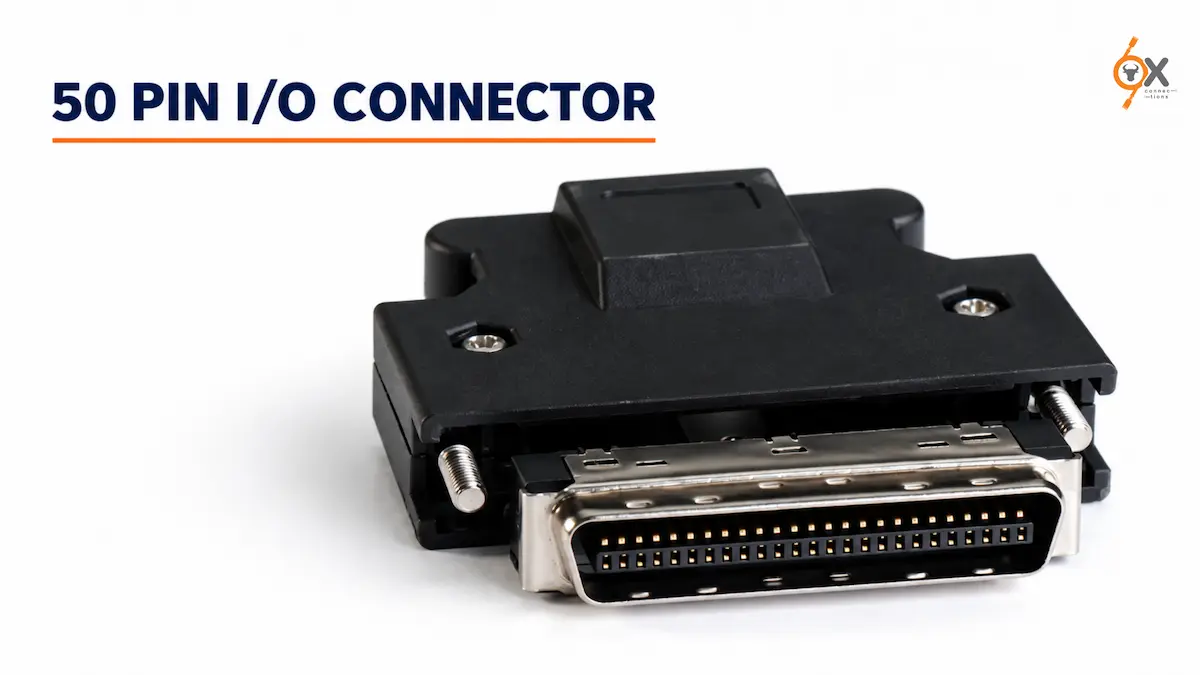
Somewhere between a handful of signal lines and a full data bus, most connectors run out of room. The 50 Pin IO Connector picks up exactly where smaller interfaces stop, carrying dense parallel signal groups through one housing built to survive years of industrial handling.
The Territory Where Fifty Pins Make Sense
Few devices need fifty independent contacts. The ones that do tend to be serious pieces of equipment: data acquisition systems reading many channels at once, industrial controllers coordinating several subsystems, or test racks interfacing with a device that itself exposes dozens of test points. At this density, the connector stops being a simple link between two parts and starts functioning as the backbone of the whole wiring architecture. Choosing this pin count without a genuine channel requirement usually means paying for capacity that never gets used, so it’s worth counting actual circuits before specifying this size.
Why Not Just Use Two Smaller Connectors Instead
Splitting fifty signals across two twenty-six pin connectors sounds like a reasonable workaround, but it rarely simplifies anything. Two connectors mean two mating cycles to service, two points of potential misalignment, and twice the documentation to keep straight during troubleshooting. A single fifty pin interface, properly specified, usually ends up simpler to service over the system’s life than a pair of smaller connectors doing the same job.
Same Reliable IO Connector Types, Built for Volume
Ox Connections keeps the fifty pin version consistent with every other size in the range. Buyers get the same IO Connector Types: a male wire solder version for field-terminated cable assemblies, and a PCB-mounted female version available in straight or right-angle mounting for board-level designs. That consistency across pin counts means an engineering team doesn’t have to relearn mounting details each time a project scales up to a denser connector.
Engineering Margin Shrinks as Pin Count Grows
Fifty contacts packed into a housing leave almost no tolerance for manufacturing drift. Pin spacing, plating thickness, and retention force all need to hold steady across every position, not just a sample few. A compact, rugged build rated for frequent mating cycles keeps that consistency intact through repeated servicing, which matters enormously on a connector this dense, since a single degraded contact can be difficult to isolate among the other forty-nine.
Why Testing and Verification Deserve Extra Attention
A fault buried in a fifty pin connector rarely announces itself clearly. It shows up instead as one channel among many reading intermittently, which can look like a sensor problem or a software bug before anyone checks the connector itself. Teams working with this density benefit from testing continuity across every pin during commissioning, rather than assuming a connector this well-built couldn’t possibly be the source of a strange reading.
Where This Density Shows Up in Real Projects
Data acquisition systems in test labs use this pin count to bring dozens of measurement channels back to a central recorder through one cable. Industrial control cabinets managing several coordinated subsystems consolidate wiring here instead of running many smaller connectors between panels. Communication interfaces linking a controller to a large peripheral device, one with its own extensive set of status and control lines, also settle on fifty pins once smaller options run out of room. Embedded systems built around a large sensor array, where each sensor needs its own dedicated pair of lines, frequently reach this density well before the design team expects it.
Planning the Physical Layout Around a Bigger Connector
A fifty pin connector, and the cable bundle behind it, takes up noticeably more panel and enclosure space than smaller variants. Panel builders should account for this early, reserving clearance for the connector body, the strain relief, and a cable bend radius that won’t stress the termination point over time. Retrofitting space for a connector this size after a panel layout is finalised almost always costs more than planning for it from the start. A quick mock-up of the cable bundle’s actual diameter during the design review often reveals a clearance issue long before the hardware arrives.
Sourcing an IO Connector India Large Projects Can Count On
IO Connector India buyers working on data-heavy or multi-subsystem projects need a supplier who treats high pin-count connectors as everyday stock. Ox Connections carries the fifty pin version alongside 6, 14, 26, 36, and 68 pin configurations, with over 5,000 products in stock and quick dispatch across the country. That availability matters most on larger installations, where a delay on one critical connector can hold up an entire commissioning schedule.
Final Word
A 50 Pin IO Connector belongs on projects where the wiring density genuinely calls for it, not as a default choice for convenience. Planning pin count, mounting type, panel space, and testing procedure together at the design stage keeps a high-density system reliable for years rather than a recurring source of hard-to-trace faults. A short design review focused specifically on this connector, before the panel layout locks in, tends to pay for itself many times over. Ox Connections offers I/O connectors across 6, 14, 26, 36, 50, and 68 pin configurations, in male wire solder and PCB female straight or right-angle types, backed by deep stock and quick dispatch across India.
Quick Answers
What kind of systems actually need a 50 pin IO connector?
Data acquisition systems, industrial controllers coordinating multiple subsystems, and equipment with dozens of dedicated test or status points.
How do I catch a fault hidden among fifty contacts?
Test continuity across every pin during commissioning rather than assuming an intermittent reading points to a sensor or software issue first.
Does this connector need extra panel space?
Yes. Plan clearance for the connector body, strain relief, and cable bend radius early, since retrofitting space later usually costs more.
Leave A Comment