
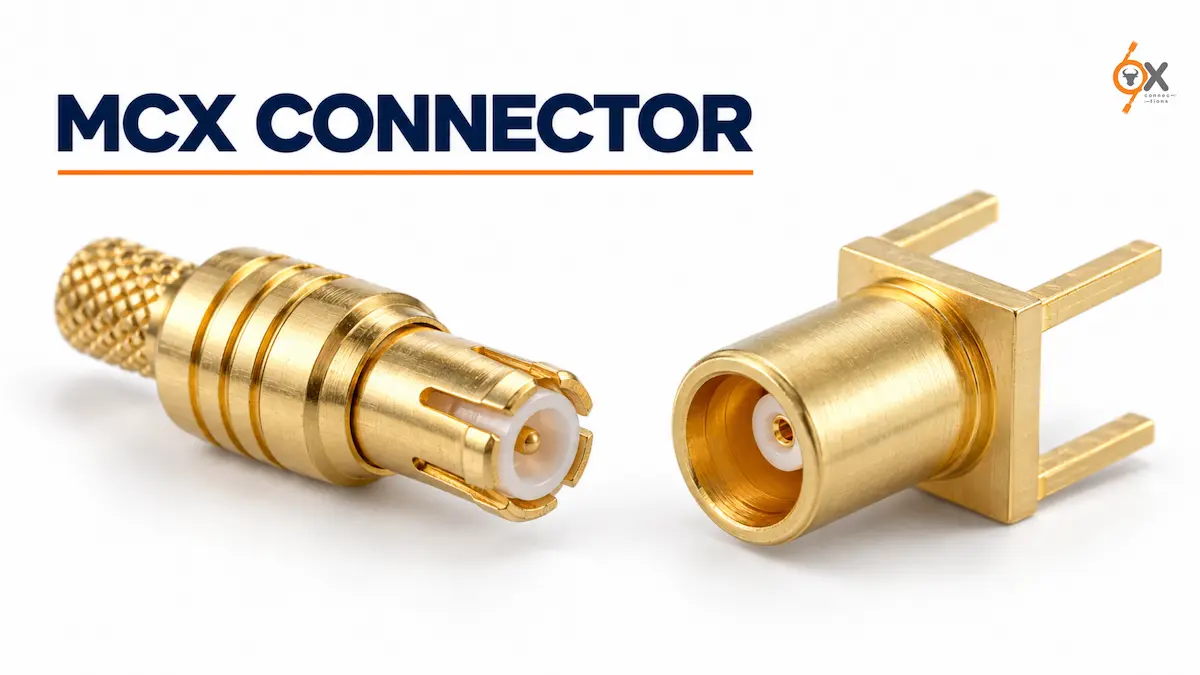
Ever opened a GPS module and wondered how the antenna fits into such little space? Chances are, an MCX connector handled that job. It’s a small, snap-on part that nobody notices until it fails. Engineers pick it for cramped, high-frequency designs where bulkier connectors won’t fit. If size constraints keep tripping up your RF layout, this one’s worth five minutes.
MCX Connector 101: What’s Actually Inside That Tiny Shell
An MCX connector – short for micro coaxial connector – is a subminiature RF connector. Engineers originally designed it in the 1980s as a smaller alternative to the SMB connector. It keeps the same inner contact and insulator dimensions but trims the outer shell by roughly 30%. That shrink is the whole point. Engineers reach for MCX connectors when board space runs short, not when signal performance is the issue.
Industry specs commonly quoted for MCX connectors include an outer diameter of around 3.6mm. Coverage typically runs from DC up to roughly 6GHz. Standard impedance runs at 50Ω, though 75Ω variants exist for specific applications. Mating cycle ratings vary by manufacturer, so always check the specific datasheet rather than assume one number applies everywhere.
Gold-plated contact surfaces are common on MCX connectors, since gold resists corrosion and keeps contact resistance low over repeated mating cycles. That matters for the GPS and antenna work this connector usually handles, because a corroded contact quietly degrades signal quality long before anyone notices a hard failure.
The snap-on coupling sets MCX apart on the workbench. There’s no threading and no torque wrench, just a firm push until it clicks. That makes MCX connectors fast to mate and unmate on production lines. It also means engineers should avoid them anywhere vibration or accidental tugging poses a real risk.
Where MCX Connector Applications Show Up in Real Products
Most MCX connector applications trace back to one theme: fitting a signal where space is almost gone. GPS receivers are the classic example. The connector sits between the antenna cable and the receiver board without eating up enclosure space. USB DVB-T tuner sticks use the same trick to connect an external antenna to a laptop-sized dongle.
MCX also turns up in wireless communication modules and RF test equipment. It’s increasingly common on compact software-defined oscilloscopes and signal generators too, where electrical demands stay modest but enclosures stay tight. If your design brief calls for a small footprint and moderate frequency, an MCX connector usually makes the shortlist.
Telecom infrastructure and broadcast equipment lean on MCX too, wherever compact RF routing beats a bulky connector. The reasoning stays consistent across every one of these uses: prioritize space efficiency without giving up signal integrity.
MCX Connector vs. the Rest of the RF Connector Shelf
It helps to place MCX next to its relatives instead of looking at it alone. MMCX is the next size down, smaller still, with a similar snap-on action. It’s often the pick when even 3.6mm feels too big. Type N and BNC sit at the other end. They’re bulkier, tougher connectors that handle outdoor runs and test benches. A threaded or bayonet lock matters more there than shaving off a millimetre. TNC works like BNC but adds threading for extra vibration resistance. MCX’s job stays narrower: you choose it when PCB layout, not ruggedness, drives the decision.
Handling Tips for a Longer Connector Lifespan
Handle MCX connectors by the shell, never by the cable, when mating or unmating. Twisting the cable to unsnap it stresses the crimp joint and shortens the connector’s working life. Keep unused connectors capped in storage or transit, since dust and moisture inside an open shell degrade the contact faster than normal wear does. In outdoor or near-antenna installs, check whether the assembly needs a boot or sleeve. The connector itself isn’t rated for direct weather exposure.
Sourcing an MCX Connector in India: What to Check Before You Order
OEMs sourcing an MCX connector in India rarely start the checklist with the connector alone. First, confirm impedance, 50Ω or 75Ω, matches the rest of the RF chain. Next, check whether your assembly process needs solder, crimp, or PCB-mount termination. Then verify male or female orientation against your existing cable or board design before placing a bulk order. A mismatched batch turns into a slow, annoying fix once you’ve already populated the boards.
Some projects need the bare connector. Others need it pre-installed onto a cable assembly with a matched connector on the far end. Decide this early, since switching from a raw connector to a finished cable assembly mid-project usually means re-qualifying the supply chain.
Local stock and turnaround matter more here than most spec sheets suggest. OX Connections stocks a full RF connector range, covering MCX and MMCX alongside SMA, SMB, SMC, Type N, BNC, and TNC. They offer solder, crimp, and PCB-mounting types across male and female versions. With 5,000+ products in stock, OX Connections dispatches quickly across India. That suits a prototype-to-production ramp where waiting weeks on an import isn’t an option. For projects that need the connector pre-terminated, OX Connections also stocks RF cable assemblies with MCX and MMCX configurations. They cut and crimp these to spec, in custom lengths and connector orientations.
Bottom Line
The MCX connector rarely gets attention because it disappears into the product. It’s small enough to avoid fighting the enclosure and simple enough to snap on without a second thought. Anyone designing GPS modules, compact wireless hardware, or test equipment knows every millimetre counts. Getting this connector right the first time saves a redesign later. Sourcing it from a supplier that stocks the full RF family beats piecing one connector together from three vendors. That choice usually decides whether your prototype run stays smooth or gets delayed.
One Reply to “MCX Connector: The Tiny Snap-On Fitting Doing Big Work in Small Spaces”
Type N Connector: Built for Mumbai's Monsoons and Everything Else Outdoors Throws at ItSeptember 18, 2026
[…] Type N beside MCX, MMCX, or even BNC, and the difference isn’t subtle. Those smaller connectors save board […]