
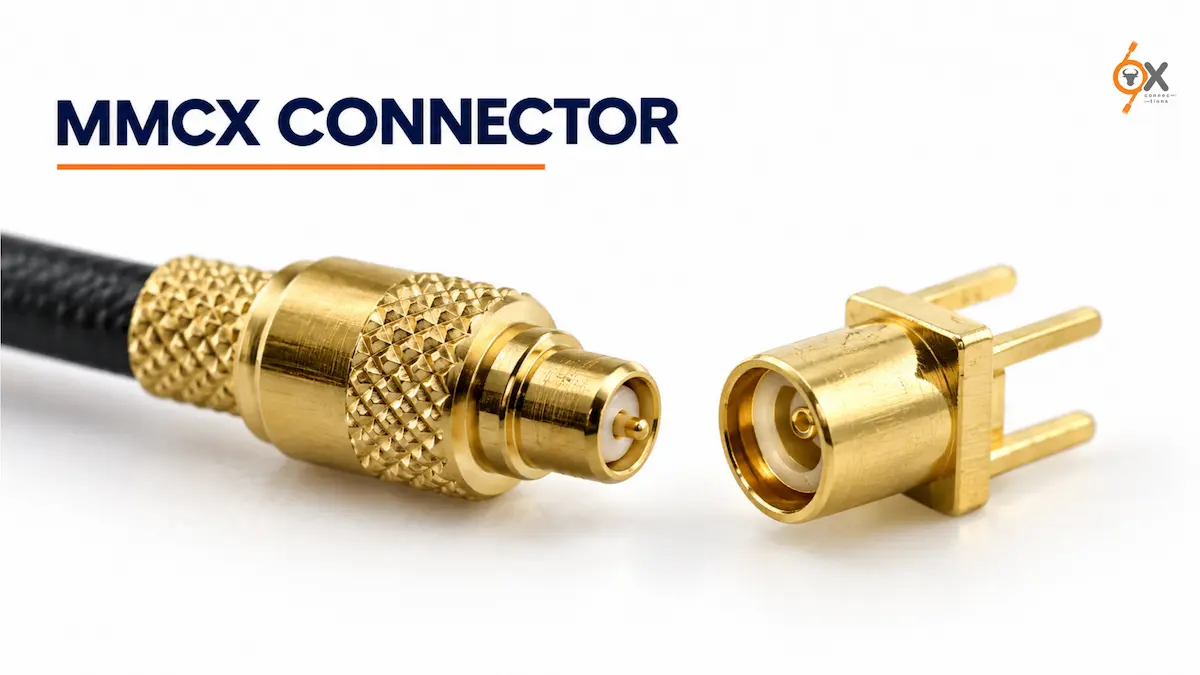
Ever taken apart a wireless earbud case or a compact WiFi module? You may have spotted a connector barely bigger than a grain of rice. That’s likely an MMCX connector at work. It’s the smallest snap-on RF connector most engineers reach for. Designers pick it when SMB or even MCX still take up too much room. If your next design pushes miniaturization further than usual, this one deserves a closer look.
MMCX Connector 101: What’s Actually Inside That Tiny Shell
An MMCX connector – short for micro-miniature coaxial connector – ranks among the smallest snap-on RF connectors in common use. Engineers developed it as a scaled-down successor to MCX and SMB. It targets boards where even 3.6mm feels like too much real estate. Unlike MCX, MMCX adds a rotatable coupling nut, so the cable can spin freely without stressing the connection.
Industry specs commonly quoted for MMCX connectors include an outer diameter of around 2.5mm, noticeably smaller than MCX’s 3.6mm. Coverage typically spans DC up to 6GHz, occasionally higher on precision variants. Standard impedance runs at 50Ω. Mating cycle ratings and exact tolerances still vary by manufacturer, so always confirm against the specific datasheet.
Gold-plated contacts are common here too, for the same reason as MCX. They resist corrosion and keep contact resistance stable over repeated cycles. That consistency matters more at MMCX’s scale, since even minor contact degradation shows up faster in such a compact interface.
The rotating coupling nut is MMCX’s signature feature. It lets installers route the cable at any angle after mating. That matters inside crowded enclosures, where a fixed orientation would force an awkward cable bend. This flexibility makes MMCX a common choice anywhere internal routing space runs tight.
Where MMCX Connector Applications Show Up in Real Products
Most MMCX connector applications center on devices too small for MCX to fit comfortably. Wireless earbuds and hearables use MMCX for internal antenna links, where every fraction of a millimetre counts inside the shell. Mini PCIe WiFi and Bluetooth cards rely on it too, connecting the module to an external or chassis-mounted antenna.
Drones and wearable trackers lean on MMCX for the same reason. It’s light and keeps a tiny footprint that doesn’t fight the rest of the build. GPS modules, telecom equipment, and broadcast gear round out the list. Each one calls for RF routing without inflating enclosure size.
MMCX Connector vs. the Rest of the RF Connector Shelf
Place MMCX next to MCX and the size difference tells the whole story. MMCX runs smaller, at roughly 2.5mm against MCX’s 3.6mm, and adds a rotating coupling nut that MCX skips. U.FL sits below both connectors and handles direct PCB-to-antenna links inside phones and WiFi cards, where nothing bigger fits. SMB and BNC sit well above MMCX in size, and both serve applications where physical durability outweighs saving a few millimetres. Choosing between them usually comes down to one question: how little space does the design actually leave you?
Handling Tips for a Longer MMCX Lifespan
Handle MMCX connectors by the shell, exactly as you would MCX, and avoid pulling on the cable to disconnect. The rotating coupling nut helps here. It lets the cable twist instead of transferring torque to the crimp or solder joint. Even so, repeated rough handling wears down the retention force faster than MMCX’s rated mating cycles suggest. Keep spare connectors capped and dry in storage. MMCX’s smaller contact area gives dust and moisture even less room to hide.
Sourcing an MMCX Connector in India: What to Check Before You Order
OEMs sourcing an MMCX connector in India face the same checklist as MCX, with one extra step: confirm coupling nut rotation direction and torque tolerance match your existing cable assembly. Impedance, termination type, and male/female orientation still need sign-off before a bulk order goes out. MMCX sits at the smaller end of the RF connector range. That makes mismatched batches harder to spot on a visual inspection alone, so a quick continuity check on incoming stock is worth the extra ten minutes.
Local stock and turnaround matter here too. OX Connections stocks a full RF connector range, covering MMCX alongside MCX, SMA, SMB, SMC, Type N, BNC, and TNC. They offer solder, crimp, and PCB-mounting types across male and female versions. With 5,000+ products in stock, OX Connections dispatches quickly across India. That suits a prototype-to-production ramp where waiting weeks on an import isn’t an option. For projects that need the connector pre-terminated, OX Connections also stocks RF cable assemblies with MMCX and MCX configurations. They cut and crimp these to spec, in custom lengths and connector orientations.
Bottom Line
The MMCX connector rarely gets a second thought until a design runs out of room for anything bigger. It’s small enough to disappear inside a wireless earbud or a mini PCIe card. The rotating coupling nut also solves cable routing problems MCX simply can’t. Anyone designing hearables, drones, or compact wireless modules ends up specifying MMCX sooner or later. Sourcing it from a supplier that stocks the full RF connector family beats hunting down one part from a specialist vendor. That choice keeps a tight production timeline on track.
Leave A Comment