
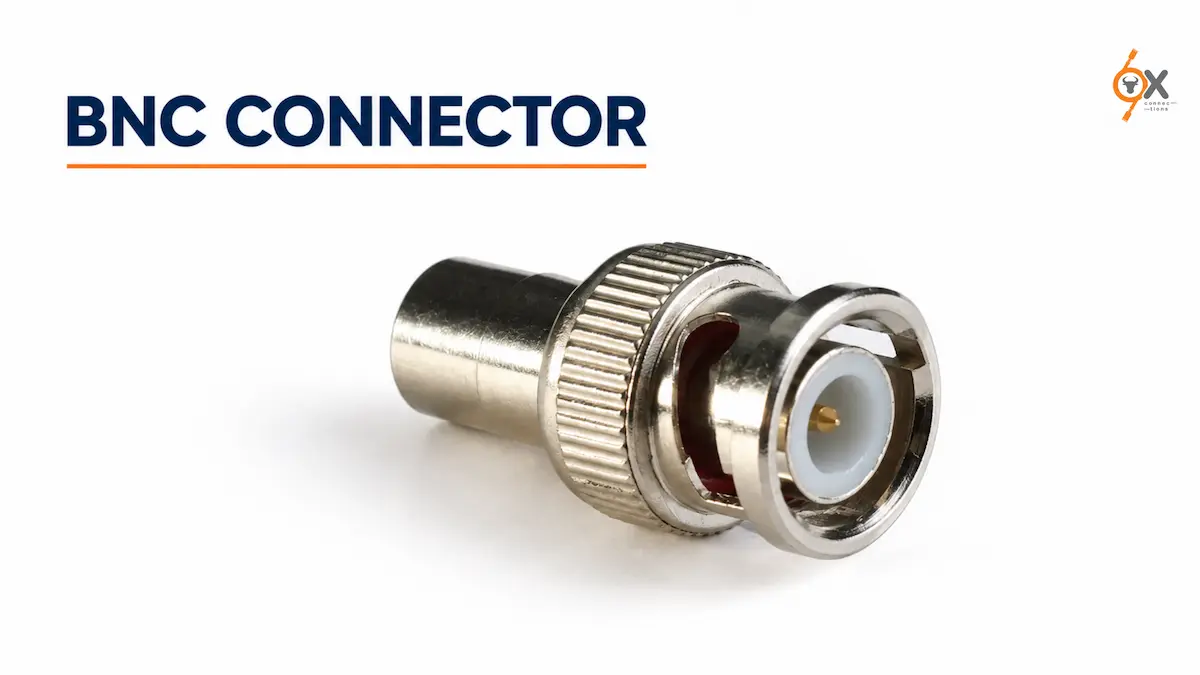
Ever needed to swap a cable on an oscilloscope mid-test, with zero time to fumble with threads? The BNC connector exists to solve exactly that problem. It’s the quick-twist connector on almost every test bench, CCTV rig, and broadcast setup. Engineers prize it for one thing above all: speed. If your work involves equipment that gets connected and disconnected constantly, this connector’s design logic is worth understanding.
Inside a BNC Connector: What Makes the Twist-Lock Work
Paul Neill designed the BNC connector in 1944, building on the same Bell Labs thinking behind the Type N connector. The name stands for Bayonet Neill-Concelman, crediting both Neill and Carl Concelman for the final bayonet-lock design. Unlike Type N’s threaded coupling, BNC uses a twist-and-lock bayonet mechanism. Push, twist a quarter turn, and it’s secure.
Industry specs commonly quoted for BNC connectors put the outer diameter at roughly 14.5mm on the male side. The female side runs about 11.1mm. Standard impedance runs at 50Ω, with a 75Ω variant common in video and broadcast work. Frequency coverage typically extends to around 4GHz, and voltage ratings reach roughly 500V. That’s a narrower frequency range than Type N, which trades top-end performance for mating speed.
The bayonet mechanism is the entire selling point. Two lugs on the female connector engage slots on the male shell. A firm quarter-turn locks the connection without any threading. That speed matters most where cables get swapped dozens of times a day. Think a test lab, or a broadcast van running multiple camera feeds.
Where BNC Connector Applications Show Up in Real Products
Most BNC connector applications trace back to test and measurement work. Oscilloscopes, signal generators, and spectrum analyzers use BNC almost universally for their RF and signal ports. Technicians need to swap probes and cables fast without hunting for a torque wrench. Video equipment relies on BNC too, especially the 75Ω variant used for composite and SDI video feeds in broadcast studios.
CCTV and surveillance systems lean on BNC heavily too. Older analog installations especially rely on coaxial runs that carry video from camera to recorder. Amateur and commercial radio gear uses BNC for antenna connections too. The quick-connect design suits field setups where speed matters more than raw power handling.
BNC vs. the Rest of the RF Connector Shelf
Set BNC beside Type N and the trade-off is obvious. Type N locks down tighter and handles more power; BNC connects in a fraction of the time. TNC solves that trade-off differently. It keeps BNC’s compact size but swaps the bayonet for a thread, trading some speed for better vibration resistance. Against smaller connectors like MCX and MMCX, BNC gives up compactness entirely. In exchange, technicians can make the connection blind, without even looking at the shell. Reach for BNC when speed and repeat connections matter more than board space or brute durability.
Getting the Most Out of a Connector Over Time
Push straight in and twist; never force a BNC connector at an angle. That bends the center pin faster than almost any other failure mode. Inspect the bayonet lugs periodically on connectors that see heavy daily use. Worn lugs stop locking securely and start disconnecting under light vibration. Keep the center contact clean and dry, particularly on outdoor CCTV runs. Moisture ingress at the pin degrades signal quality long before the connector visibly fails.
Sourcing a BNC Connector in India: What to Check Before You Order
Buyers sourcing a BNC connector in India usually hit the same fork early. 50Ω suits RF and test work; 75Ω suits video and broadcast. Mixing the two on the same run causes impedance mismatches. Those show up as ghosting on video or reflected signal loss on RF gear, so confirm this before placing a bulk order. Termination type — solder, crimp, or clamp — should match your existing assembly process. Switching mid-project slows everything down.
Local stock matters as much as spec accuracy here. OX Connections stocks a full RF connector range, covering BNC alongside MCX, MMCX, Type N, SMA, SMB, SMC, and TNC. They offer solder, crimp, and PCB-mounting types across male and female versions. With 5,000+ products in stock, OX Connections dispatches quickly across India, which matters when a broadcast crew or test lab needs parts fast, not in three weeks. For pre-terminated needs, OX Connections also stocks RF cable assemblies with BNC configurations, cut and crimped to spec with custom lengths and connector orientations.
Bottom Line
The BNC connector earns its spot on every test bench for one reason: it gets out of the way. No threading, no torque wrench, just a push and a twist between you and the next measurement. That simplicity is exactly why it survived eight decades of RF connector innovation without losing ground. For any application built around speed and repeated connections, BNC remains the default choice, and for good reason.
Leave A Comment