
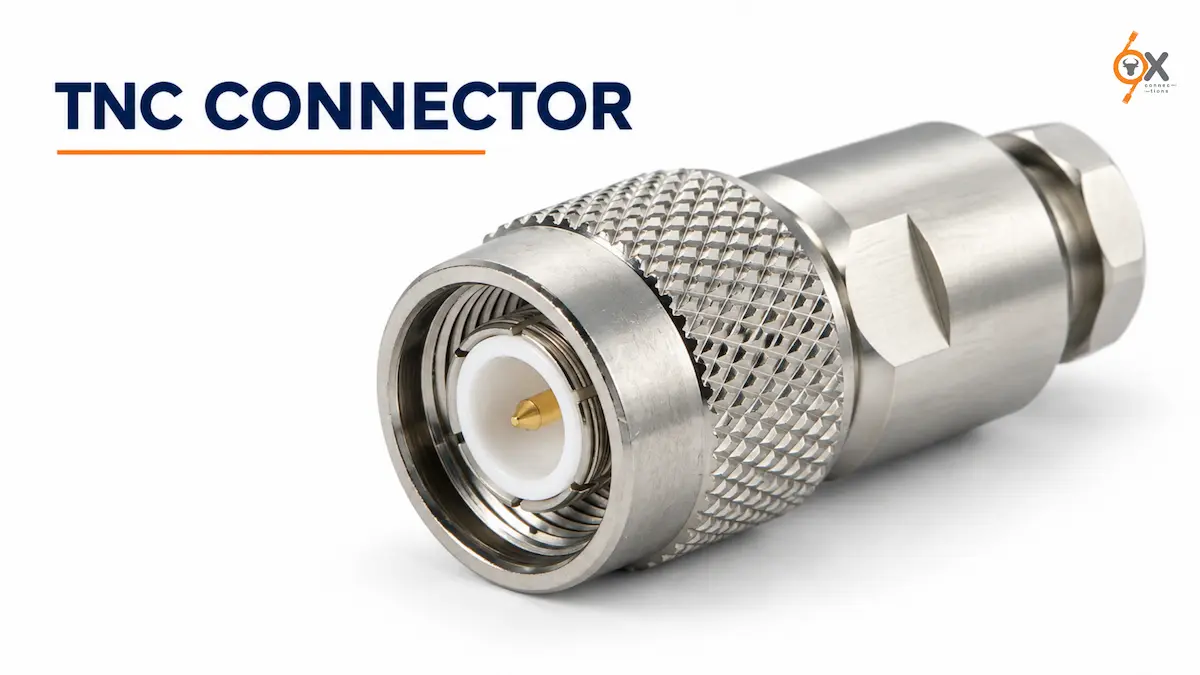
Ask any RF technician what fails first on a rooftop antenna mount, and the answer is rarely the cable. It’s the connector that shook itself loose months after installation. A TNC Connector exists to solve exactly that problem. It takes everything engineers already trust about the BNC connector and adds a threaded coupling that vibration simply can’t shake apart.
Where BNC Runs Out of Grip, TNC Steps In
BNC connectors use a bayonet twist-lock, and that quick-connect design works beautifully on a test bench. It struggles on a moving vehicle, a rooftop mast, or a machine floor that never stops vibrating. Engineers Paul Neill and Carl Concelman, the same pair behind BNC, solved this by threading the coupling instead. The result carries their initials in its name: Threaded Neill-Concelman, or TNC for short. The idea itself was simple, but it solved a problem that had quietly frustrated field technicians for years: a connection that looked secure on the bench but worked loose somewhere between the factory and the field.
Inside the Connector: What the Thread Actually Buys You
A threaded coupling mechanism does more than resist a stiff breeze. It maintains constant contact pressure across the mating interface, even as a vehicle bounces over broken roads or a tower sways in high wind. That steady pressure keeps signal loss low and return loss stable, which matters enormously on RF links running near their power or frequency limits. The threaded design also seals more tightly against dust and moisture than a snap-on connector, making it a natural fit for outdoor and semi-outdoor installations.
TNC Connector Applications That Refuse to Sit Still
TNC Connector Applications cluster around exactly the environments a bayonet lock can’t handle reliably. Cellular infrastructure relies on this connector to keep base station antennas linked through years of wind, rain, and thermal cycling. RF antenna systems on vehicles, from ambulances to telecom survey trucks, use the threaded lock to survive constant road vibration. Wireless communication equipment in industrial settings, where nearby machinery shakes an entire panel, turns to TNC for the same reason. Test instruments that need a secure connection during long, unattended measurement runs benefit too.
TNC vs BNC: A Quick, Honest Comparison
The two connectors share a footprint and a family history, so the choice usually comes down to environment. BNC suits a lab bench, a broadcast studio, or any setting where technicians connect and disconnect equipment throughout the day. TNC suits anywhere that connection needs to survive vibration, weather, or months of unattended service without a technician nearby to check it. Frequency performance favours TNC slightly too, with threaded designs typically rated higher than their bayonet counterparts. Cost sits close enough between the two that frequency and environment, not price, should really drive the decision.
A Word on Weatherproofing and Long-Term Reliability
Weatherproof design sounds like a marketing phrase until a connector actually spends a monsoon season bolted to an outdoor antenna mast. The threaded coupling on a TNC connector compresses a gasket or O-ring far more evenly than a bayonet lock ever could, which keeps moisture away from the actual RF contact. Installations in coastal or high-humidity regions of India benefit particularly from this, since corrosion at the contact point is usually what ends a connector’s working life, not mechanical wear.
Picking the Right TNC Connector for Your Panel
Mounting style matters as much as the connector itself. A solder-type termination suits a technician building a custom cable assembly by hand. A crimp-type version suits volume production, where consistency across hundreds of units matters more than a bench technician’s individual skill. PCB-mounting versions, available in male and female configurations, suit boards that need an RF connection point built directly into the layout rather than wired externally. Matching connector type to assembly method upfront avoids costly rework later.
Sourcing a TNC Connector India Projects Can Depend On
TNC Connector India buyers working on telecom rollouts or industrial RF installations need a supplier who treats this connector as everyday stock, not a special order. Ox Connections stocks TNC alongside its full RF range, including SMA, SMB, SMC, MCX, MMCX, Type N, BNC, and U.FL, in solder, crimp, and PCB-mounting types across male and female configurations. With over 5,000 products in stock and quick dispatch across India, a project scaling from prototype to full rollout rarely has to wait on a connector.
Installation Notes From the Field
Threading a TNC connector too loosely defeats its entire purpose, while over-tightening can strip the threads on a lower-quality part. Technicians should hand-tighten until snug, then confirm with a light torque check rather than forcing it with pliers. Outdoor installations benefit from a weatherproof boot or tape wrap over the joint, even though the threaded design already resists moisture on its own. A quick visual check during scheduled maintenance catches thread wear long before it causes a connection failure. Keeping a small stock of spare connectors on site also saves a return trip when a field replacement turns out to be necessary.
Final Word
A TNC Connector earns its place wherever a BNC-style connection needs to survive conditions a bayonet lock can’t handle. The threaded coupling costs a fraction of a second longer to mate than a snap-on connector, and that small trade-off buys years of stable, vibration-resistant performance. Anyone specifying RF connectors for outdoor, mobile, or industrial installations should weigh that trade-off carefully before defaulting to the faster bayonet option. For more on how TNC compares with other coaxial connector types, see this detailed coaxial connector guide from Ox Connections.
Quick Answers
What makes a TNC connector different from BNC?
A threaded coupling replaces BNC’s bayonet lock, giving TNC far better resistance to vibration and a tighter seal against weather.
Where should I use a TNC connector instead of BNC?
Choose TNC for outdoor, vehicle-mounted, or vibration-heavy installations; BNC still works well for bench and studio settings with frequent reconnection.
Does mounting type affect which TNC connector I need?
Yes. Solder types suit hand-built cable assemblies, crimp types suit volume production, and PCB types suit board-level RF connections.
Leave A Comment