
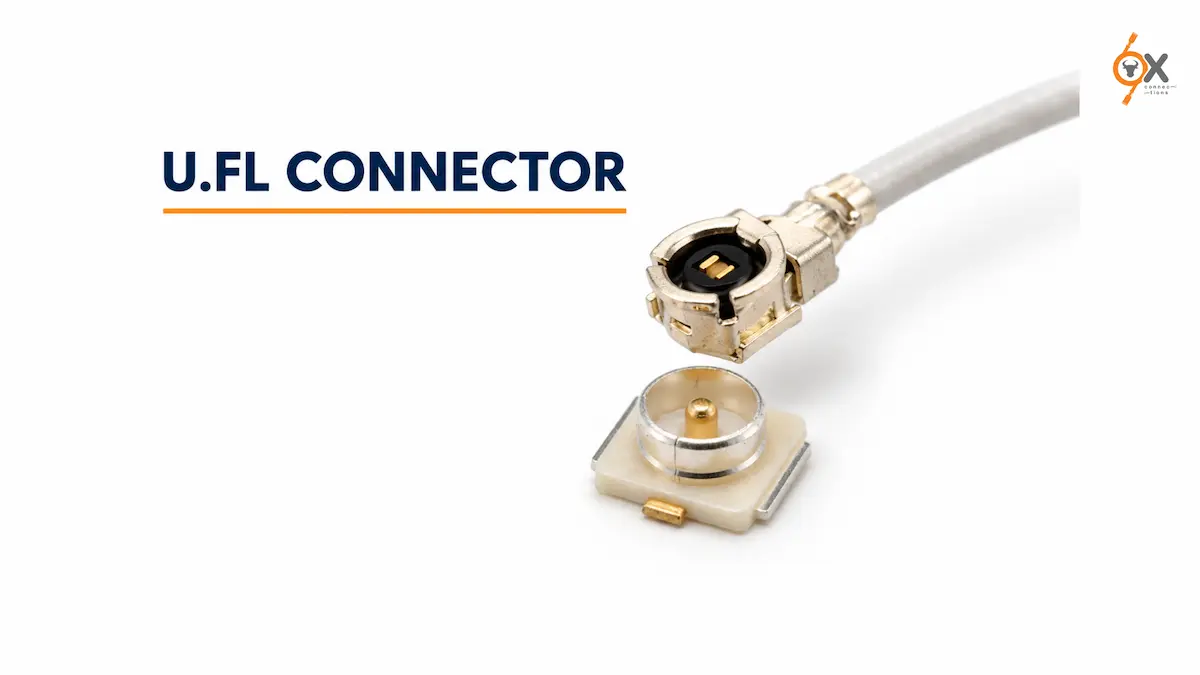
Open up a Wi-Fi router or a laptop’s wireless card, and somewhere inside sits a connector barely bigger than a grain of rice. That’s the U.FL Connector at work. It links a tiny antenna to a PCB in a space where a standard RF connector simply wouldn’t fit, and it does this job inside millions of devices without anyone ever noticing it’s there.
Built for a World Running Out of Space
Hirose Electric developed the U.FL connector in the early 1990s, right as devices started shrinking faster than connector technology could keep up. Engineers needed a snap-on RF fitting that could sit directly on a crowded PCB without stealing space from the battery, the chipset, or the antenna itself. U.FL answered that need with a mated height of roughly two millimetres, small enough to disappear inside a phone, a router, or a compact GPS module. That footprint has barely changed since, even as everything else around it in a device keeps shrinking further.
Snap-On Simplicity, Precision Underneath
Despite its size, U.FL still delivers a genuine 50-ohm RF connection, with performance holding up cleanly from DC through roughly 6GHz. The coupling mechanism is a simple snap fit rather than a thread or bayonet lock, since there’s rarely room on a compact board for anything more elaborate. That simplicity comes with a trade-off worth knowing before specifying it: the female side is typically rated for around 30 mating cycles, far fewer than a threaded or bayonet connector built for repeated field use.
U.FL Connector Applications Hiding in Plain Sight
U.FL Connector Applications sit at the heart of nearly every compact wireless device on the market. Wi-Fi modules use it to link the radio chip to a printed or external antenna without wasting board space. Bluetooth devices, from wearables to smart home gadgets, rely on the same tiny fitting. GPS units in navigation devices and asset trackers use it to route signal from a compact antenna to the receiver board. Laptops route their internal Wi-Fi antenna cables through U.FL connectors precisely because nothing larger would fit inside the chassis. IoT devices, another category built around tight space budgets, lean on the same connector to keep their radio modules compact enough for a coin-sized enclosure.
The Mating-Cycle Limit Nobody Should Ignore
That roughly 30-cycle rating on the female connector isn’t a minor footnote. Repeatedly disconnecting and reconnecting a U.FL joint during testing or rework can degrade the female contact well before a product ships, leading to intermittent RF performance that’s hard to diagnose later. Engineers working on prototypes or repeated bench testing should treat each mating cycle as a small withdrawal from a limited balance, and plan cable assembly and testing sequences accordingly. Production lines that need to test every unit before shipping often build in a dedicated test connector for this reason, keeping the final assembly’s actual mating cycle count as low as possible.
Choosing Between U.FL and Its Slightly Larger Cousins
Designers sometimes default to U.FL simply because it’s the smallest option available, without checking whether the application actually needs that footprint. If a product has even a little extra board space, a slightly larger connector rated for more mating cycles can save considerable rework headaches down the line. U.FL earns its place specifically when space is the binding constraint, not as an automatic first choice for every compact wireless design.
Handling U.FL Without Losing Your Patience
Mating and de-mating a connector this small by hand is not a job for thick fingers or a heavy touch. Technicians typically use a small plastic or metal tool to apply even pressure when disconnecting, since pulling on the cable directly risks damaging the connector or the PCB pad beneath it. A steady, straight-down press during mating avoids bending the delicate centre pin, which is thinner than almost anything else in an RF connector lineup. Assembly lines handling U.FL at volume usually train technicians specifically on this connector, since the habits that work fine on larger RF fittings can damage this one quickly.
Sourcing a U.FL Connector India Manufacturers Can Trust
U.FL Connector India buyers working on compact wireless products need cable assemblies built to consistent tolerances, since even a small variation in this connector’s dimensions can affect mating reliability. Ox Connections stocks U.FL alongside its broader RF range, including SMA, SMB, SMC, MCX, MMCX, Type N, BNC, and TNC, in solder, crimp, and PCB-mounting types. With over 5,000 products in stock and quick dispatch across India, OEMs building Wi-Fi, Bluetooth, or GPS-enabled products can source cable assemblies without long import waits.
Final Word
The U.FL Connector proves that a connector’s importance has nothing to do with its size. It carries wireless signal reliably inside some of the most compact electronics built today, provided engineers respect its mating-cycle limit and handle it with the care its scale demands. Anyone designing a Wi-Fi, Bluetooth, or GPS-enabled product should factor this connector’s fragility into both the design and the testing plan from day one, rather than treating it as an afterthought once the board layout is already locked. For a wider look at how U.FL compares with other coaxial connector families, see this detailed coaxial connector guide from Ox Connections.
Quick Answers
What makes U.FL different from other RF connectors?
Its size. A mated height of about two millimetres lets it fit directly onto crowded PCBs where larger connectors simply won’t fit.
How many times can I mate and de-mate a U.FL connector?
The female side is typically rated for around 30 mating cycles, so repeated testing or rework can wear it out faster than expected.
What devices commonly use U.FL connectors?
Wi-Fi modules, Bluetooth devices, GPS units, and laptops all use U.FL to link internal antennas to the PCB in compact enclosures.
Leave A Comment