
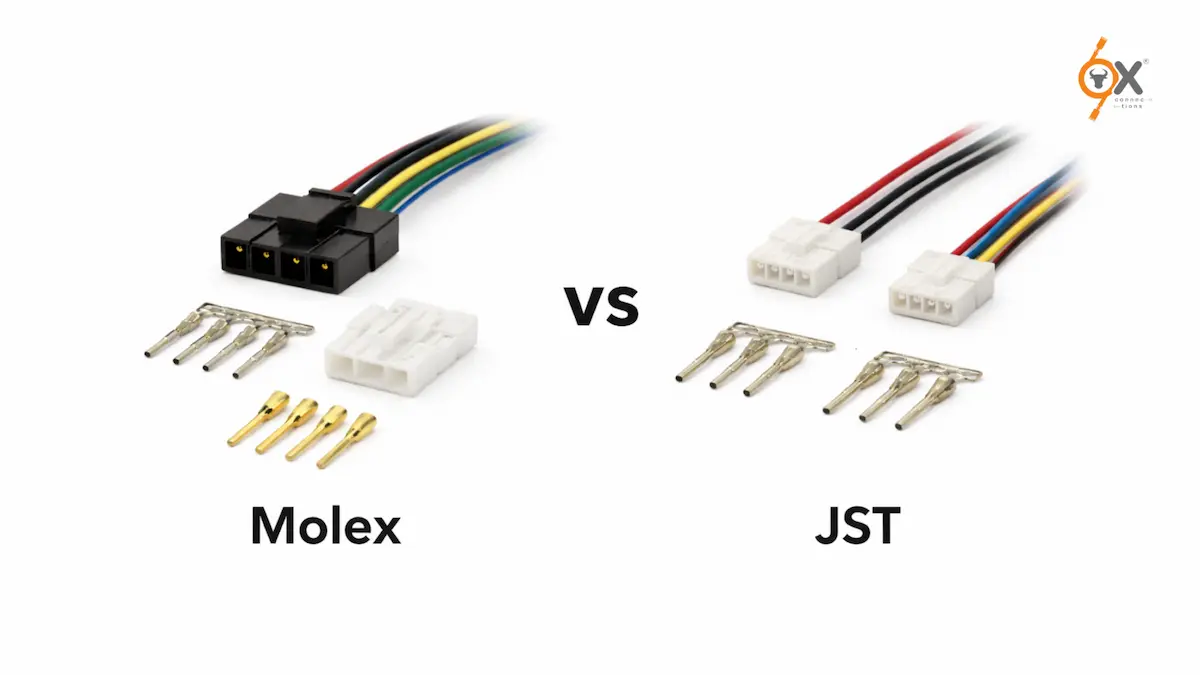
Compare Molex vs JST connectors: understand current rating, pitch, cost, and applications to choose the right connector for your project in India.
If you’re designing a product, sourcing connectors for manufacturing, or simply trying to avoid future failures, one question comes up again and again:
Should you choose a Molex connector or a JST connector?
At first glance, both seem to do the same job – connect wires, carry current, and keep systems running. But when you start looking at performance, current handling, space requirements, and long-term reliability, the difference becomes much more important.
This is exactly why the debate around Molex Micro-Fit 3.0 connector options and JST alternatives is common across industries like EV manufacturing, home appliances, solar systems, and industrial automation.
In India, especially in fast-moving manufacturing hubs like Mumbai, the decision goes beyond technical specifications. Cost, availability, lead time, and consistent supply matter just as much.
So let’s look at a practical JST connector comparison and understand which option makes more sense for your project.
Understanding the Basics: Molex vs JST Connectors
Before comparing performance, it helps to understand what these connectors are built for.
The Molex Micro-Fit 3.0 connector is known for compact design and higher power handling in a relatively small footprint. It is commonly used where space is limited, but performance still needs to be strong – such as industrial controls, battery systems, and compact electronics.
JST connectors, on the other hand, are widely used across consumer electronics and smaller electrical assemblies. They are available in several series like XH, PH, and VH, each designed for different levels of current and pitch size.
This is why Molex vs JST connectors is not really about which brand is better – it is about which connector suits your application better.
Pitch Size and Design: Space vs Strength
One of the first things engineers check is connector pitch- the distance between one pin and the next.
The Molex Micro-Fit 3.0 connector has a 3.0 mm pitch, which allows it to save space while still handling relatively high current.
Many common JST connectors like XH usually come with a 2.5 mm pitch, while others vary depending on the series.
In practical terms, this means JST connectors often work well for smaller electronic systems, while Molex Micro-Fit is preferred when both compactness and stronger power delivery are required.
For Indian OEMs working on EV charging systems or industrial power units, this small design difference becomes a major decision.
Current Rating: Where the Real Difference Shows
This is often the deciding factor in a proper JST connector comparison.
The Molex Micro-Fit 3.0 connector is generally designed to handle higher current loads compared to smaller JST connector families. This makes it suitable for power-intensive applications where stable performance is critical.
JST connectors like PH or XH are excellent for lighter loads and signal applications, but pushing them into higher-current environments can create heat and long-term reliability issues.
This becomes even more important in India, where environmental conditions are rarely ideal. In cities like Mumbai, high temperatures and humidity can increase connector stress over time.
A connector that performs well in testing may behave very differently on a real production floor.
Locking Mechanism and Reliability
Another important factor in Molex vs JST connectors is how securely the connector stays in place.
Molex Micro-Fit connectors are known for stronger locking mechanisms. This matters in environments where vibration, movement, or continuous usage is common – such as EV systems or industrial machinery.
Many JST connectors are excellent for compact applications, but depending on the series, some may not offer the same level of retention strength.
For manufacturers, this directly affects maintenance and field performance. A connector coming loose during operation is never a small problem.
Availability and Cost in India
This is where technical discussions become business decisions.
Branded connectors like Molex and JST are trusted, but sourcing them in India often comes with familiar challenges: high prices, long lead times, and large minimum order quantities.
For manufacturers in Mumbai handling urgent production schedules, waiting weeks for imported stock is rarely practical.
This is why many OEMs now look beyond just brand names and focus on reliable, certified alternatives that are locally available.
At OX Connections, we work closely with industries across solar, home appliances, medical equipment, renewable energy, and EV manufacturing to provide equivalent connector solutions without the usual delays.
Instead of high MOQs and long imports, businesses can access:
- Molex-compatible connectors
- JST-compatible connectors
- Proper certifications like UL, RoHS, and CE
- Faster delivery across India
This makes production planning much smoother, especially for fast-moving industries.
Which One Is Better for Your Project?
The honest answer is -it depends.
If your project requires: higher current handling, stronger locking, and compact power delivery, the Molex Micro-Fit 3.0 connector is often the better choice.
If your application is focused on smaller electronics, lighter loads, and simpler low-power connections, JST may be the more practical option.
This is why a good JST connector comparison should always start with the application – not the brand.
Too often, teams choose based on familiarity rather than actual technical fit.
That usually becomes expensive later.
A Smarter Way to Decide
Instead of asking, “Which connector is better?”
Ask: “What does my system actually need?”
Do you need:
- higher current capacity?
- better vibration resistance?
- lower cost without compromising quality?
- immediate availability in India?
Once you answer those questions, the decision becomes much clearer.
That’s how strong engineering decisions are made – not by choosing the most popular name, but by choosing the right solution.
Final Thoughts
The comparison between Molex vs JST connectors is not about one being universally better than the other.
It is about choosing the right connector for the right environment.
A proper understanding of the Molex Micro-Fit 3.0 connector, combined with a realistic JST connector comparison, helps manufacturers avoid failures, reduce costs, and improve long-term reliability.
And in India’s growing manufacturing ecosystem – especially in cities like Mumbai – those decisions matter more than ever.
Because sometimes, the smallest connector in the system ends up carrying the biggest responsibility.