
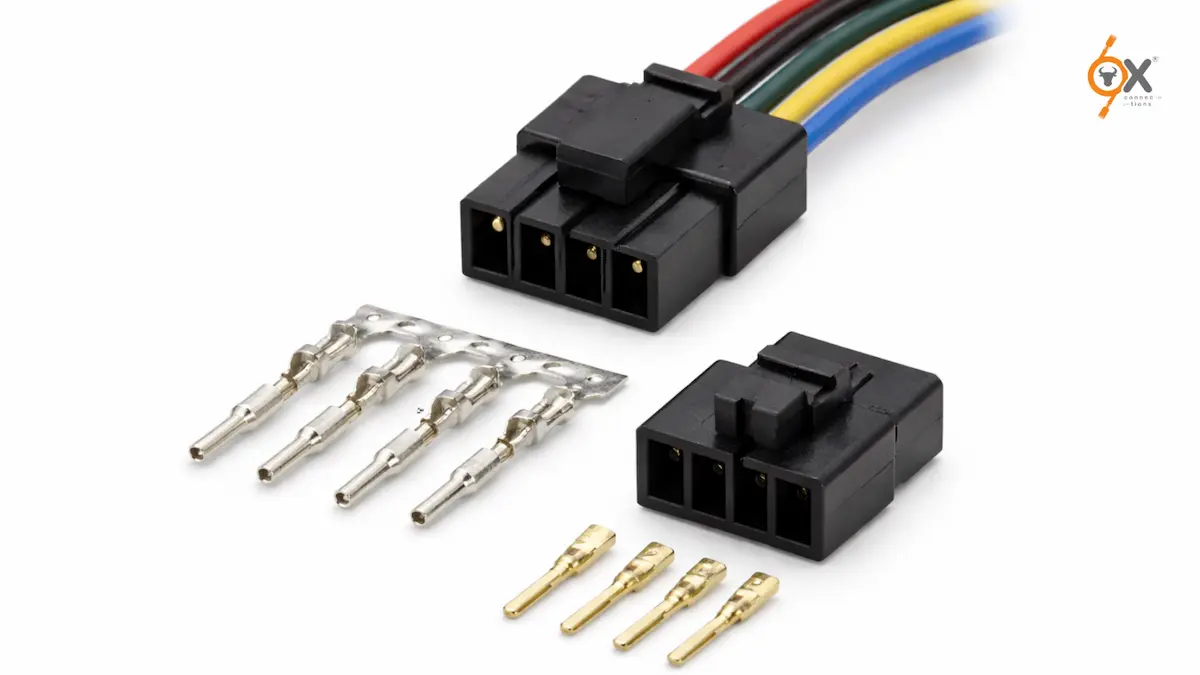
If you’ve ever worked on a product where space is tight but power requirements are still significant, you’ve likely come across Micro-Fit connectors. But what is a Molex Micro-Fit 3.0 connector, and why do engineers consistently choose it over other options?
The answer isn’t just “because it works” – it’s because it solves a very specific problem: delivering reliable power in compact designs without compromising safety.
Let’s break it down in a way that actually makes sense – no textbook jargon.
What is a Molex Micro-Fit 3.0 connector?
A Molex Micro-Fit 3.0 connector is a compact wire-to-wire and wire-to-board connector system designed for mid-range power applications where both space and performance matter.
The “3.0” refers to its 3.0mm pitch (distance between pins) – which places it right between ultra-compact signal connectors and bulky power connectors.
In simple terms:
- Smaller than traditional power connectors
- More powerful than micro signal connectors
- Built for tight but demanding environments
That’s exactly why it shows up in so many real-world systems.
Why It’s So Widely Used (And Not Just for One Industry
The popularity of the Molex Micro-Fit 3.0 connector comes down to balance. It’s not the smallest, not the most powerful but it hits a sweet spot that many applications need.
Here’s what actually matters in real usage:
- Handles moderate current (typically up to ~5A–8.5A per circuit) depending on wire size and conditions
- Has a positive locking system (you’ll hear/feel the click when it mates)
- Designed to avoid incorrect insertion (polarized housing)
- Available in multiple circuit sizes (2 to 24)
This combination makes it reliable without being over-engineered.
Molex Micro-Fit connector applications
Now let’s get practical – because theory doesn’t help unless you know where it’s actually used.
Here are the most common Molex Micro-Fit connector applications you’ll see across industries:
1. Power Supply Units & Computing Systems
Inside desktops, servers, and power supply units, space is limited but stable power is critical.
This is where the Molex Micro-Fit 3.0 connector fits perfectly:
- Internal power routing
- Board-to-board connections
- Modular PSU designs
2. Industrial Equipment & Automation
In control panels and machinery, reliability matters more than anything.
Common Molex Micro-Fit connector applications here include:
- PLC wiring
- Control units
- Industrial automation systems
It’s preferred because it stays secure even in vibration-heavy environments.
3. Automotive & EV Subsystems
Not for high-voltage battery lines but definitely used in supporting systems:
- Dashboard electronics
- Lighting modules
- Control systems
The Molex Micro-Fit 3.0 connector works well in these mid-power applications where compact wiring is needed.
4. Medical Devices
In medical electronics, failure is not an option.
You’ll find Molex Micro-Fit connector applications in:
- Monitoring systems
- Portable medical devices
- Diagnostic equipment
Consistency and secure locking are key here.
5. Home Appliances
From washing machines to air conditioners, these connectors simplify internal wiring.
- Control boards
- Motor connections
- Power distribution
They help manufacturers reduce assembly errors and improve reliability.
6. Renewable Energy Systems
With solar and energy storage growing rapidly, connectors like these are widely used in:
- Battery management systems (BMS)
- Control circuits
- Power distribution modules
The Molex Micro-Fit 3.0 connector supports compact system design without compromising connection quality.
Where It Works Well – and Where It Doesn’t
Here’s something most blogs won’t tell you:
The Molex Micro-Fit 3.0 connector is excellent for mid-range power, but it’s not meant for:
- High-voltage transmission
- Heavy industrial power loads
- Outdoor extreme environments without protection
Knowing this helps avoid costly design mistakes.
The Practical Challenges OEMs Face
Now let’s talk real-world – not catalog specs.
Many OEMs using Micro-Fit connectors run into issues like:
- High component costs at scale
- Long lead times affecting production
- Large MOQ requirements
- Dependency on limited supply chains
These are not technical problems they’re business problems.
Why Many Manufacturers Are Switching to OX Connections
This is where OX Connections becomes relevant – not as a “replacement,” but as a practical alternative.
OX offers connector solutions equivalent to systems like the Molex Micro-Fit 3.0 connector, but with advantages that matter operationally:
- Around half the cost
- No lead time (ready inventory)
- No high MOQ pressure
- Certifications: UL, RoHS, CE
For OEMs in solar, EVs, appliances, and medical sectors, this shift often comes down to supply reliability and cost control, not just specs.
How to Choose the Right Connector (Without Overthinking It)
If you’re deciding whether this connector is right for you, focus on:
- Current requirement (don’t overspec or underspec)
- Available space
- Application environment
- Ease of assembly
- Supplier reliability
That’s it. You don’t need a 20-page datasheet to make a smart decision.
Final Thoughts
So, what is a Molex Micro-Fit 3.0 connector in practical terms?
It’s a connector designed for the real world – where space is tight, power matters, and reliability can’t be compromised.
With a wide range of Molex Micro-Fit connector applications, it continues to be a strong choice across industries. But as manufacturing evolves, businesses are also rethinking sourcing. – looking beyond just performance to cost, availability, and scalability.
And that’s exactly where smarter alternatives like OXConnections are gaining ground.
Because in the end, it’s not just about choosing a connector – it’s about choosing what keeps your production running smoothly.