
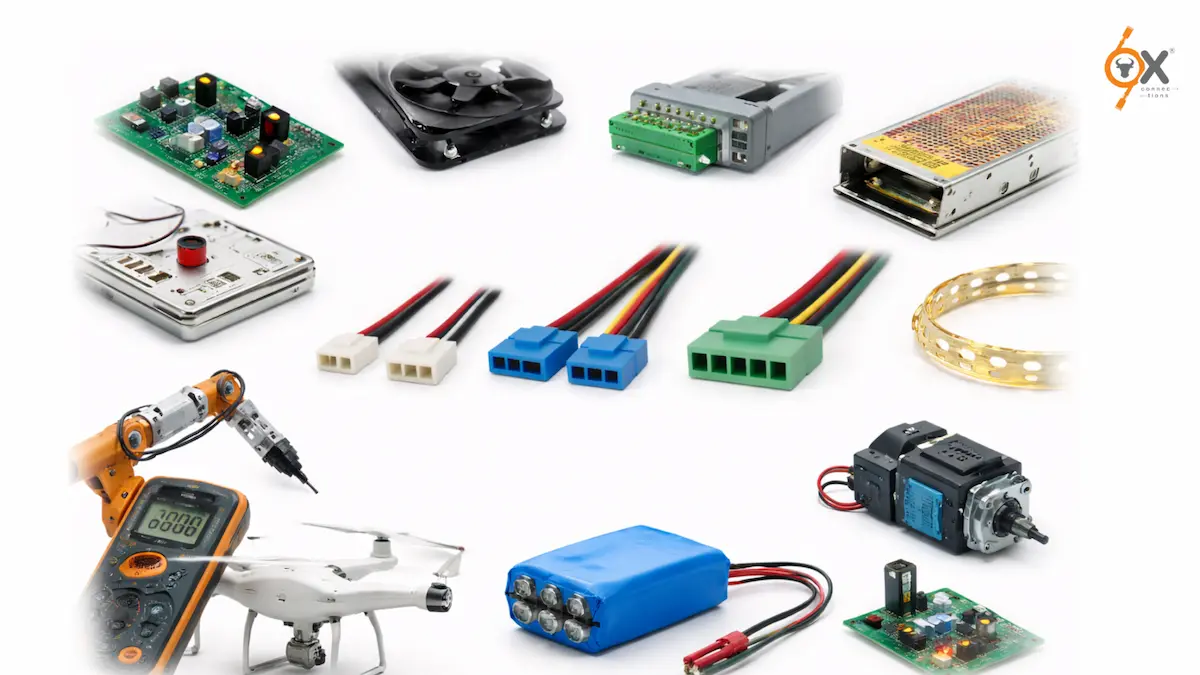
This blog breaks down the JST connectors applications, explores Uses of JST Connectors, and helps you understand different JST connector types – all while giving practical insights for OEMs and manufacturers.
When you open up any modern electronic device – whether it’s a solar inverter, medical equipment, or even a home appliance – you’ll almost always find one small but essential component: JST connectors. These compact connectors play a crucial role in ensuring safe, stable, and efficient electrical connections across industries.
But beyond their size and simplicity, one question matters most: where are JST connectors used, and why are they so widely trusted?
What Are JST Connectors?
JST (Japan Solderless Terminal) connectors are widely used electrical connectors designed for wire-to-board and wire-to-wire connections. They are known for:
- Compact design
- Reliable locking mechanisms
- Easy installation
- Consistent performance in high-volume production
Their versatility is what makes JST connectors applications so widespread across industries.
Understanding – JST connector types
To truly understand JST connectors uses, you need to first know the most common JST connector types:
1. JST XH Series
- Pitch: 2.5mm
- Application: Consumer electronics, PCBs
- Widely used for signal connections
2. JST PH Series
- Pitch: 2.0mm
- Application: Compact devices like wearables and handheld electronics
3. JST VH Series
- Pitch: 3.96mm
- Application: Higher current requirements such as power supplies
4. JST SH Series
- Pitch: 1.0mm
- Application: Ultra-compact devices
5. JST SM Series
- Application: LED lighting and wire-to-wire connections
Each of these JST connector types is designed for specific electrical and mechanical requirements, making them suitable for different environments.
Explore compatible connector solutions from OX Connections:
Where are JST connectors used in real-world applications?
Understanding where are JST connectors used helps manufacturers choose the right connector for the right application.
1. Consumer Electronics
One of the most common JST connectors applications is in consumer electronics.
- TVs, speakers, gaming consoles
- Internal PCB connections
- Battery and signal wiring
Their compact size and reliability make them ideal for mass production.
2. Mobile Devices and Wearables
In smartphones, smartwatches, and fitness trackers, space is limited. This is where smaller JST connector types like PH and SH are used.
- Battery connections
- Display modules
- Sensor integration
These devices rely heavily on precise and stable JST connectors uses.
3. LED Lighting Systems
LED systems are another major area where are JST connectors used.
- LED strips
- Decorative lighting
- Commercial lighting installations
JST SM connectors provide quick plug-and-play functionality, making installation easier and faster.
4. Solar Energy Systems
Solar is one of the fastest-growing sectors for JST connectors applications.
- Solar inverters
- Battery management systems (BMS)
- Power distribution units
However, many solar OEMs face challenges with traditional JST connectors, such as high costs, long lead times, and high MOQs.
OX Connections offers equivalent connector solutions tailored for solar applications – with UL, RoHS, and CE certifications – ensuring performance without supply chain delays.
5. Home Appliances
From washing machines to refrigerators, JST connectors uses are widespread in home appliances.
- Motor connections
- Control boards
- Internal wiring systems
They simplify assembly and improve long-term reliability.
6. Medical Equipment
In medical devices, reliability is critical. This is another key area where are JST connectors used.
- Diagnostic machines
- Patient monitoring systems
- Portable medical devices
Consistent performance and secure connections make them suitable for sensitive applications.
7. Automotive and EV Systems
In modern vehicles, especially EVs, connectors are essential for managing complex electrical systems.
- Battery packs
- Control modules
- Sensor systems
While JST connectors are used for low-power applications, manufacturers often look for cost-effective alternatives at scale.
8. Industrial Automation
Factories and automation systems depend heavily on reliable connections.
- PLC systems
- Robotics
- Control panels
In such environments, downtime is costly – making dependable JST connectors applications extremely important.
Breaking Down JST connectors uses
Across all industries, the most common JST connectors uses include:
- Power transmission
- Signal transfer
- PCB connectivity
- Battery connections
- Modular wiring systems
This flexibility is why JST connectors applications continue to expand across both electronics and industrial sectors.
Challenges with Traditional JST Connectors
Despite their popularity, there are practical limitations that OEMs face:
- High pricing compared to alternatives
- Long lead times
- High minimum order quantities (MOQs)
- Supply chain inefficiencies
These issues become critical in industries like solar, EVs, and manufacturing, where production timelines are strict.
A Smarter Alternative: OX Connections
To overcome these challenges, many OEMs are now turning to OX Connections.
OX offers equivalents to common JST connector types like XH, VH, PH, and HY – with clear advantages:
- Nearly half the price
- No lead time (ready stock)
- No high MOQ requirements
- Certifications: UL, RoHS, CE
- Trusted across solar, EV, medical, and appliance industries
For businesses scaling operations, switching suppliers is not just about cost it’s about ensuring uninterrupted production.
How to Choose the Right Connector
Choosing the right connector depends on:
- Electrical requirements (current & voltage)
- Application type
- Space constraints
- Environmental conditions
- Supply availability
Understanding these factors ensures you select the most suitable option for your specific JST connectors applications.
Final Thoughts
From consumer electronics to industrial automation, where are JST connectors used is no longer a narrow question – it spans across nearly every modern electrical system.
With a wide range of JST connector types, and versatile JST connectors uses, these components remain essential in today’s manufacturing ecosystem. However, evolving industry demands mean businesses must also consider cost, availability, and efficiency.