
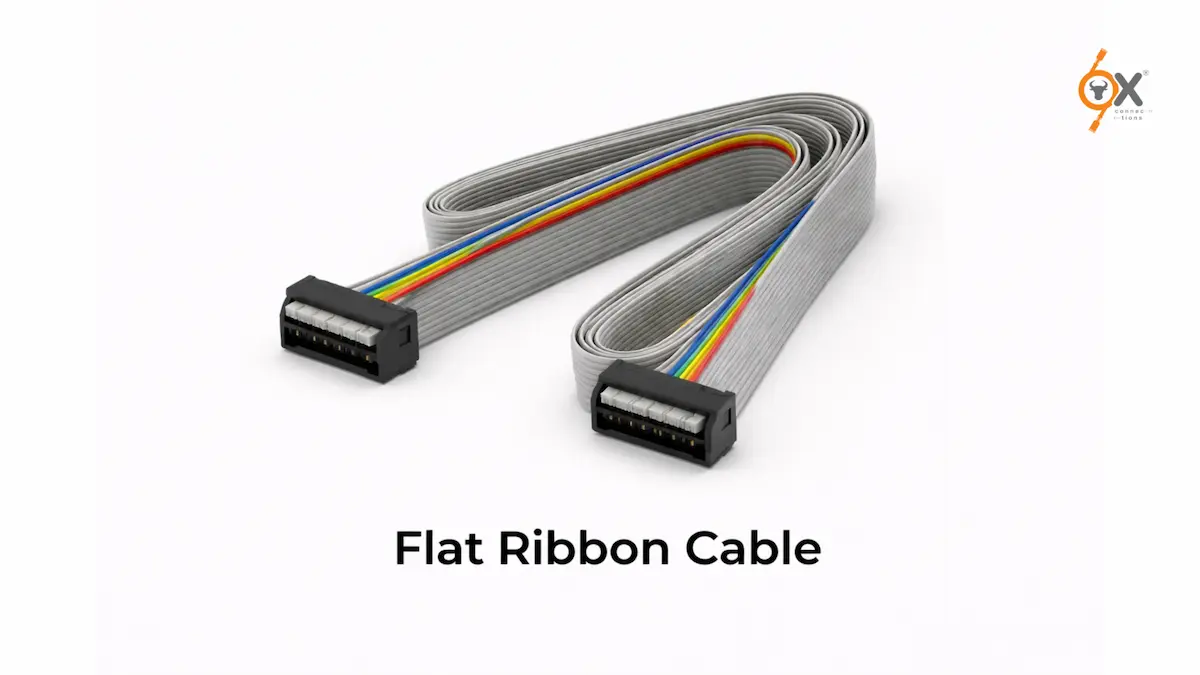
Have you ever placed an urgent Flat Ribbon Cable order on a Friday evening, only to realise on Monday morning that the wrong specification has reached your production floor?
If you work in electronics procurement – especially in fast-moving markets like Mumbai, Pune, Ahmedabad, or across India’s growing OEM hubs – you already know how one small mismatch can create a much bigger problem. A wrong conductor pitch, incorrect AWG, missing UL marking, or an unsuitable conductor count can delay production, hold dispatches, and create unnecessary cost.
And the truth is, flat ribbon cable is often treated as a “simple” purchase.
It looks straightforward. It feels routine. But when the wrong cable reaches your factory, it suddenly becomes the most important item on the BOM.
That is why understanding flat ribbon cable specifications is not just a technical task – it is a procurement decision.
At OXConnections, we regularly work with OEM buyers who need faster deliveries, reliable compliance, and zero surprises during assembly. Whether it is a control panel manufacturer in Bhiwandi, an electronics assembler in Andheri, or an industrial OEM in Pune, the challenge is often the same: getting the right cable, the first time.
This guide breaks down the most important flat ribbon cable specifications, explains where buyers usually go wrong, and helps you make better procurement decisions without turning it into a textbook lesson.
Why Flat Ribbon Cable Selection Matters
Flat ribbon cables are widely used in:
- Industrial control systems
- Consumer electronics
- Embedded systems
- Medical devices
- Renewable energy systems
- Automotive electronics
- Testing and instrumentation equipment
Since these cables are commonly used with IDC connectors, accuracy matters. A mismatch does not just create inconvenience – it can stop production altogether.
A connector that does not terminate properly, a cable that fails compliance checks, or an incorrect conductor pitch can lead to rework, returns, and expensive downtime.
Understanding the right flat ribbon cable uses helps procurement teams avoid these avoidable problems.
What a Complete Ribbon Cable Specification Includes
Many buyers focus only on conductor count and cable width.
That is where mistakes begin.
A complete specification should include:
- AWG (wire gauge)
- Conductor stranding
- Conductor material and plating
- Conductor count
- Conductor pitch
- Insulation material
- Voltage rating
- Temperature rating
- UL style number
- Cable variant (grey, rainbow, shielded)
Each of these directly affects connector compatibility, electrical performance, and certification requirements.
This is why understanding flat ribbon cable specifications properly is critical for OEM procurement.
AWG – Why Wire Gauge Matters
AWG stands for American Wire Gauge and defines conductor thickness.
For most IDC applications, 28AWG is the standard.
This is the most common specification for AWG ribbon cable across industrial electronics.
Typically, 28AWG ribbon cable uses a 7×36 stranded construction – seven strands of 36AWG wire twisted together.
Why does this matter?
Because it gives the cable two important qualities:
- Flexibility for routing inside equipment
- Reliable IDC termination where contacts pierce insulation accurately
In practical use, 28AWG supports approximately 1A to 1.5A per conductor under normal operating conditions.
This makes ribbon cable ideal for signal transmission, not heavy power distribution.
Yet many buyers still assume ribbon cable can handle higher power loads simply because it fits the connector.
That assumption often causes overheating and long-term reliability issues.
Among all flat ribbon cable uses, signal transmission remains the safest and most common.
Conductor Count – Matching the Connector Correctly
Conductor count refers to how many individual circuits the cable carries.
Since IDC connectors usually use a dual-row design, conductor counts are generally even numbers.
Common conductor counts include:
10, 14, 16, 20, 26, 34, 40, 50, and 64
The rule is simple:
The cable conductor count must match the connector pin count.
A 26-pin IDC connector requires a 26-conductor cable.
Some workshops still buy larger cables and manually trim them to size. It may work for testing, but it is not a good production practice.
Exposed conductor edges increase the risk of short circuits and reduce reliability.
Among all flat ribbon cable types, conductor count is one of the first specifications to verify.
Conductor Pitch – The Most Common Ordering Mistake
This is where procurement errors happen most often.
Pitch means the centre-to-centre distance between adjacent conductors.
For standard IDC systems:
- 54mm connector pitch uses 1.27mm cable conductor pitch
- 00mm connector pitch uses 1.00mm cable conductor pitch
- 27mm connector pitch uses 0.635mm cable conductor pitch
This confuses many buyers.
For example, someone may ask for “2.54mm flat cable” assuming it matches a 2.54mm IDC connector.
But that often leads to the wrong order.
The correct specification is cable conductor pitch – not connector pitch.
This is one of the most common reasons for urgent replacement orders in Indian manufacturing clusters like Vasai, Navi Mumbai, and Pune.
Among all flat ribbon cable specifications, pitch matching is the most critical.
UL2651 – Why Compliance Matters
Most standard grey flat ribbon cable used for IDC applications follows the UL2651 ribbon cable specification.
This is the industry benchmark for standard PVC-insulated grey cable.
UL2651 defines:
- 28AWG conductor construction
- PVC insulation
- 300V voltage rating
- 105°C temperature rating
- VW-1 flame resistance
If your equipment requires audits, factory approvals, or third-party certification, using the correct UL2651 ribbon cable becomes essential.
Buying cable without checking the UL style number may save money initially – but it creates serious compliance problems later.
At OX Connections, we always recommend checking the printed marking directly on the cable insulation.
If the cable does not clearly show the UL style number, voltage rating, and temperature rating, it should not be approved for production.
Understanding Different Flat Ribbon Cable Types
Not all ribbon cables are the same.
Different applications require different flat ribbon cable types, and choosing the wrong one increases unnecessary cost.
Standard Grey Cable
This is the most widely used option.
It includes:
- Grey PVC insulation
- Red stripe for conductor 1 identification
- Standard IDC compatibility
It is the most cost-effective choice for most OEM applications.
For internal signal wiring, this is usually the right answer.
Rainbow Ribbon Cable
Rainbow cable uses individually colour-coded conductors.
It is commonly used in:
- R&D labs
- Testing environments
- Debugging setups
It makes troubleshooting easier because each conductor is visually identifiable.
But for mass production, it usually adds cost without adding much value.
Shielded Ribbon Cable
Shielded cable includes foil shielding and drain wires for EMI protection.
It is used when:
- EMC compliance is required
- High-speed signals are involved
- Cable exits the equipment enclosure
- Noise-sensitive systems need protection
The common UL style here is UL2912.
For standard low-speed internal systems, standard grey cable is usually enough.
Choosing the right flat ribbon cable types depends on application – not habit.
Cable Width and Why It Matters
Cable width affects routing inside machines and control panels.
The formula is simple:
Width = Conductor Count × Conductor Pitch
For example:
- 20 conductors × 1.27mm = 25.4mm
- 40 conductors × 1.27mm = 50.8mm
This matters for:
- Internal routing
- Connector clearance
- Cable stacking
- Enclosure design
Many buyers check electrical compatibility but forget mechanical fit.
That creates problems during final assembly.
This is another practical area where understanding flat ribbon cable uses helps prevent production delays.
What Buyers Should Confirm Before Ordering
Before placing a production order, always confirm:
- UL style number (UL2651 or UL2912)
- Conductor pitch in millimetres
- AWG and stranding
- Conductor count
- Voltage and temperature rating
- Minimum reel length
- Batch traceability
- Certificate of conformance
Never accept cable without printed UL markings.
That small verification step can prevent major audit failures later.
Why OEM Buyers Prefer OX Connections
In Indian manufacturing, speed matters.
When production schedules are tight, buyers cannot wait weeks for imported cable with high MOQs and uncertain lead times.
That is where OX Connections makes the difference.
We supply:
- 27mm, 2.00mm, and 2.54mm conductor pitch
- 10 core to 64 core availability
- Fast dispatch across India
- Industry-standard IDC compatibility
- Quality-tested products
- Reliable support for OEMs and distributors
Many global suppliers come with long lead times and procurement friction.
OX offers dependable alternatives with faster availability, competitive pricing, and supply confidence built for Indian OEMs.
Final Thoughts
Flat ribbon cable may look simple – but wrong specifications can create expensive production problems.
Understanding flat ribbon cable specifications helps buyers avoid connector mismatch, compliance issues, and unexpected downtime.
Whether you are choosing between different flat ribbon cable types, selecting the right AWG ribbon cable, or verifying compliance with UL2651 ribbon cable, the details matter.
Because in procurement, the right cable is never just a cable – it is production continuity.