
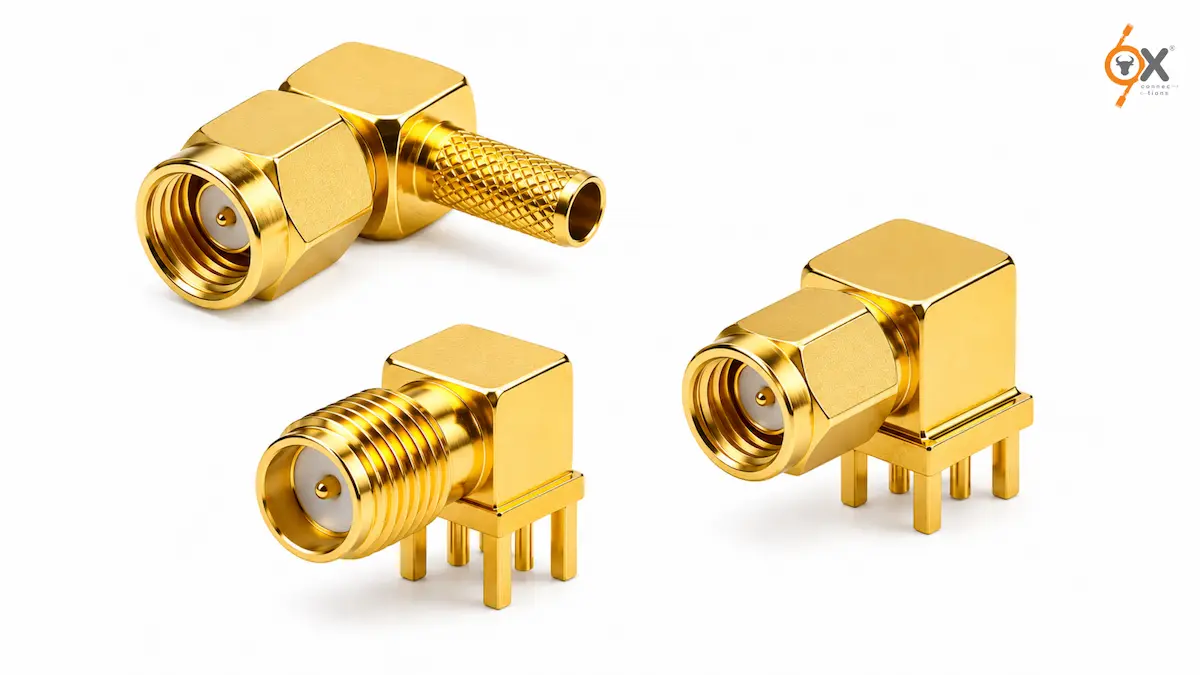
Learn when to use a Right-Angle SMA Connectors, key design considerations, RF performance factors, and how engineers and OEMs can select the right connector for their applications.
Not Every RF Design Has Room for a Straight Connector
In RF system design, connector selection often starts with electrical requirements. However, as products become smaller, denser, and more mechanically complex, physical packaging constraints frequently become just as important as RF performance.
A connector that works perfectly in a schematic may create challenges once the design moves into an enclosure. Limited board space, cable routing restrictions, antenna placement requirements, and mechanical clearances can all influence connector selection.
This is where a Right-Angle SMA Connector becomes a valuable design option.
By redirecting the cable connection through a 90-degree orientation, right-angle SMA connectors help engineers optimize space utilization while maintaining a secure RF connection. They are widely used across wireless communications, industrial electronics, IoT devices, test equipment, and numerous other RF applications.
However, choosing the right connector involves more than selecting a 90-degree form factor. Engineers must evaluate mechanical constraints, PCB layout requirements, RF performance considerations, assembly processes, and long-term sourcing needs.
This guide explores when to use a Right-Angle SMA Connector, the benefits it offers, and the factors engineers and procurement teams should consider during selection.
Understanding Right-Angle SMA Connectors
A Right-Angle SMA Connector is a variation of the standard SMA connector in which the cable or connection interface exits at a 90-degree angle rather than extending straight from the mating surface.
The connector retains the familiar threaded SMA coupling mechanism while providing greater flexibility for installations where space is limited.
These connectors are commonly found in:
- RF communication equipment
- Wireless networking devices
- Antenna systems
- Test and measurement instruments
- Industrial automation systems
- GPS modules
- IoT gateways
- Embedded RF devices
The primary purpose of a right-angle design is to improve packaging efficiency while preserving reliable RF connectivity.
Why Engineers Choose Right-Angle SMA Connectors
Many RF products are designed within increasingly compact enclosures.
In these situations, traditional straight connectors may create challenges such as:
- Insufficient cable clearance
- Difficult cable routing
- Increased enclosure size requirements
- Mechanical interference with adjacent components
A SMA Right Angle Connector helps solve these challenges by allowing cables to be routed parallel to the PCB or enclosure wall rather than extending outward.
This seemingly simple design change can significantly improve overall product packaging and usability.
Common Applications for Right-Angle SMA Connectors
Compact Wireless Devices
Many wireless products require antenna connections within limited enclosure space.
A Right Angle RF Connector allows designers to maintain antenna connectivity without increasing product dimensions.
PCB-Based RF Systems
In PCB-mounted applications, right-angle connectors can simplify routing and improve access to external RF connections.
Industrial Equipment
Industrial control systems often have tightly packed internal layouts where cable management becomes critical.
Test and Measurement Equipment
Laboratory instruments frequently utilize right-angle connectors to optimize panel layouts and improve user accessibility.
Antenna Integration
Many antenna systems benefit from improved cable routing made possible by right-angle connector configurations.
Space Optimization and Mechanical Advantages
One of the most significant benefits of a Right-Angle SMA Connector is efficient use of available space.
As product designers work to reduce enclosure size, every millimeter matters.
A right-angle configuration can help:
- Reduce overall product depth
- Improve cable routing paths
- Minimize cable bending stress
- Enhance connector accessibility
- Simplify enclosure design
In some applications, selecting a right-angle connector may eliminate the need for enclosure redesigns or costly mechanical modifications.
RF Performance Considerations
Although mechanical benefits often drive the selection process, RF performance remains a critical factor.
Any connector integrated into an RF signal path can influence overall system performance.
When evaluating a SMA Right Angle Connector, engineers should consider:
Impedance Consistency
Maintaining a controlled impedance path is essential for minimizing reflections and preserving signal integrity.
Signal Loss
Connector transitions should be designed to support efficient signal transmission.
Frequency Requirements
Different RF applications operate across varying frequency ranges, making application-specific connector selection important.
Grounding Integrity
Proper grounding helps maintain stable RF performance and reduce unwanted electromagnetic effects.
A quality connector combined with good PCB design practices helps ensure reliable system operation.
PCB Layout Considerations
For PCB-mounted applications, connector placement directly affects both mechanical and electrical performance.
When integrating a Right Angle RF Connector, engineers should evaluate:
Connector Positioning
Placing the connector near the PCB edge often simplifies installation and improves accessibility.
Ground Plane Continuity
Maintaining a continuous ground structure supports impedance control and signal quality.
Trace Routing
RF traces should remain as short and direct as possible to minimize losses.
Mechanical Reinforcement
Applications exposed to vibration or repeated cable connections may benefit from additional mechanical support.
Careful PCB planning can significantly improve long-term reliability.
Cable Routing Benefits
Cable management is often overlooked during early design stages.
However, poor cable routing can create challenges during manufacturing, installation, and maintenance.
A Right-Angle SMA Connector can improve cable management by:
- Reducing cable strain
- Preventing excessive bending
- Improving airflow within enclosures
- Simplifying assembly operations
- Enhancing serviceability
These benefits can be particularly valuable in industrial and OEM environments where reliability is a key concern.
Factors to Consider When Specifying a Right-Angle SMA Connector
Selecting the right connector requires balancing multiple technical and commercial considerations.
Application Environment
Consider operating conditions such as vibration, temperature, and mechanical stress.
Mounting Method
Verify compatibility with the PCB layout and assembly process.
Mechanical Clearance
Ensure sufficient space exists around the connector and cable routing path.
Service Requirements
Evaluate whether the connector will be frequently connected and disconnected.
Supply Availability
Reliable sourcing remains an important consideration for production programs.
Early evaluation of these factors can help prevent redesigns and procurement issues later in the project lifecycle.
Common Mistakes to Avoid
Even experienced engineering teams occasionally encounter challenges related to connector selection.
Some common mistakes include:
Focusing Only on Physical Fit
A connector may fit mechanically while still creating RF performance issues.
Ignoring Cable Routing
Poor routing decisions can increase mechanical stress and reduce serviceability.
Overlooking PCB Constraints
Connector selection should always align with board layout requirements.
Delaying Connector Selection
Waiting until late-stage design can lead to avoidable redesign efforts.
Addressing these issues early helps streamline development and production.
Procurement Considerations for OEMs
Connector selection is not solely an engineering decision.
Procurement teams must also consider:
Product Consistency
Using standardized connector families simplifies inventory management.
Long-Term Supply Stability
Reliable product availability supports uninterrupted production.
Quality Assurance
Consistent quality helps reduce field failures and warranty-related concerns.
Supplier Support
Access to technical information and sourcing support can simplify purchasing decisions.
Collaboration between engineering and procurement teams often leads to more effective connector selection strategies.
Conclusion
A Right-Angle SMA Connector is often the preferred choice when enclosure space, cable routing, and mechanical accessibility become critical design considerations.
While the connector’s primary advantage is its ability to improve packaging efficiency, successful implementation also requires careful attention to PCB layout, impedance control, RF performance, and manufacturing requirements.
By evaluating both technical and sourcing considerations early in the design process, engineers can select the most appropriate SMA Right Angle Connector for their application while minimizing development risks and production challenges.
OX Connections: Supporting RF Design and Production Requirements
OXConnections supplies a comprehensive range of SMA and RF connectivity solutions for OEMs, system integrators, and engineering teams across multiple industries.
As a stocking distributor, OX Connections offers access to a complete portfolio of SMA, RF, and related connector solutions backed by competitive commercial terms, consistent top-notch quality, and a proven track record supporting OEM production requirements. Whether supporting new product development, prototype builds, or ongoing manufacturing programs, OX helps customers secure reliable connector supply from a trusted long-term sourcing partner.
For organizations seeking dependable RF connectivity solutions, OX Connections provides both product availability and sourcing confidence.
Disclaimer
Connector selection should always be validated against application requirements, PCB design constraints, environmental conditions, frequency requirements, and manufacturer specifications. Final suitability remains the responsibility of the equipment designer and system integrator.
FAQs
1. What is the main advantage of using a Right-Angle SMA Connector?
A Right-Angle SMA Connector helps optimize space within compact electronic assemblies by allowing cables to be routed at a 90-degree angle. This can improve cable management, reduce strain on connections, and simplify enclosure design without compromising RF connectivity.
2. Does a Right-Angle SMA Connector affect RF performance?
When properly selected and integrated into the design, a Right-Angle SMA Connector can provide reliable RF performance. Factors such as connector quality, PCB layout, impedance matching, and grounding practices play a significant role in maintaining signal integrity and minimizing losses.
3. How do I choose between a straight SMA connector and a Right-Angle SMA Connector?
The choice depends on your application’s mechanical and electrical requirements. A straight connector may be suitable when space is readily available, while a Right-Angle SMA Connector is often preferred in compact designs where cable routing, enclosure constraints, or accessibility are important considerations.