
Selecting the correct SMA Cable Mount Connectors is critical for achieving reliable RF performance, secure mechanical retention, and long-term assembly durability. While SMA connectors may appear similar externally, each connector is designed to accommodate specific cable dimensions and construction characteristics.
For engineers, procurement professionals, cable assemblers, and OEM manufacturers, understanding how SMA Connectors for RG174, SMA Connectors for RG58 Cable, and SMA Connector for LMR200 applications differ can help prevent assembly issues, signal degradation, and costly field failures.
This SMA Cable Termination Guide explains the key considerations when selecting cable-mounted SMA connectors, outlines best practices for termination, and provides sourcing insights for organizations building RF systems and cable assemblies.
Understanding SMA Cable Mount Connectors
SMA Cable Mount Connectors are among the most widely used RF interconnect solutions across telecommunications, wireless communication systems, industrial automation, instrumentation, medical devices, IoT products, and defense applications.
Unlike PCB-mounted connectors, Cable Mount RF Connectors are designed to terminate directly onto coaxial cables, creating a robust RF interface between equipment and cable assemblies.
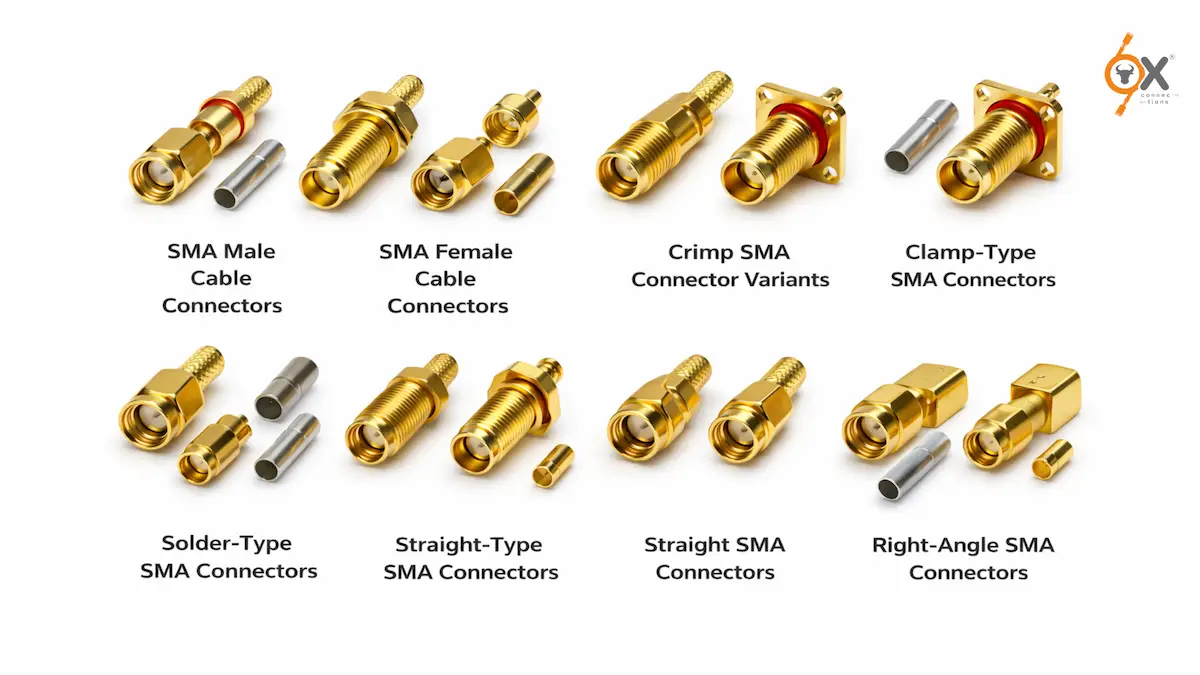
Common cable-mount SMA variants include:
- SMA Male Cable Connectors
- SMA Female Cable Connectors
- Crimp SMA Connector variants
- Clamp-Type SMA Connectors
- Solder-Type SMA Connectors
- Straight SMA Connectors
- Right-Angle SMA Connectors
Selecting the right connector starts with understanding the cable type being used.
Why Cable Compatibility Matters
Every coaxial cable contains multiple layers, including:
- Center conductor
- Dielectric insulation
- Shield braid
- Outer jacket
Although different cable families may share similar electrical characteristics, their physical dimensions often vary significantly.
As a result, SMA Cable Mount Connectors are designed around specific cable diameters and conductor sizes.
Using an incompatible connector can lead to:
- Poor mechanical retention
- Inconsistent crimp quality
- Impedance discontinuities
- Increased insertion loss
- Reduced shielding effectiveness
- Premature field failures
For reliable RF performance, cable and connector compatibility should always be verified before assembly begins.
SMA Connectors for RG174 Cable
SMA Connectors for RG174 are designed for one of the most commonly used small-diameter coaxial cables in RF and wireless applications.
RG174 is frequently used in:
- GPS systems
- Wireless modules
- IoT devices
- Embedded electronics
- Compact communication equipment
Because of its relatively small diameter, RG174 requires connector dimensions specifically optimized for the cable.
Key Termination Considerations for RG174
SMA Connectors for RG174 typically feature:
- Smaller ferrules
- Smaller center pin dimensions
- Retention features designed for thinner jackets
- Optimized crimp geometry
During assembly, technicians should pay particular attention to:
- Accurate cable stripping dimensions
- Proper center conductor insertion
- Shield braid placement
- Correct ferrule crimping
Even small assembly inconsistencies can impact RF performance, particularly at higher frequencies.
SMA Connectors for RG58 Cable
SMA Connectors for RG58 Cable remain among the most commonly specified RF connector solutions across industrial and commercial applications.
RG58 is widely used in:
- Radio communication systems
- Industrial RF equipment
- Wireless devices
- Test and measurement equipment
- Laboratory instrumentation
Compared with RG174, RG58 has a larger diameter and requires a different connector design.
Key Termination Considerations for RG58
SMA Connectors for RG58 Cable are engineered to accommodate:
- Larger outer jacket dimensions
- Larger center conductor sizes
- Different ferrule diameters
- Increased mechanical retention requirements
Using the correct connector helps ensure:
- Reliable shield termination
- Stable RF performance
- Improved assembly consistency
- Enhanced durability
For OEM manufacturing and cable assembly operations, a Crimp SMA Connector is often preferred because it supports repeatable production processes and scalable manufacturing.
SMA Connector for LMR200 Applications
A SMA Connector for LMR200 is commonly used where lower attenuation and improved RF performance are required.
LMR200 is often found in:
- Wireless infrastructure
- Antenna systems
- Cellular communication equipment
- Industrial networking
- RF communication installations
Although LMR200 may resemble certain RG cable families, its dimensions and construction require dedicated connector compatibility.
Key Termination Considerations for LMR200
When selecting a SMA Connector for LMR200, engineers should evaluate:
- Cable diameter compatibility
- Center conductor dimensions
- Ferrule sizing requirements
- Installation method
- Long-term mechanical retention
Using connectors specifically designed for LMR200 helps avoid fitment issues while supporting consistent assembly quality.
Crimp vs Solder SMA Connectors
One of the most important decisions when selecting SMA Cable Mount Connectors is choosing between crimp and solder termination styles.
Crimp SMA Connectors
Advantages of a Crimp SMA Connector include:
- Faster assembly
- Consistent production quality
- Reduced assembly time
- Better suitability for high-volume manufacturing
- Repeatable results across production batches
For OEM production environments and RF Cable Assembly Connectors, crimp-style termination is often preferred.
Solder SMA Connectors
Advantages include:
- Suitable for prototypes and low-volume production
- Flexible installation options
- Familiar assembly process for many technicians
However, solder termination generally requires greater process control and operator expertise to maintain consistent quality.
Common Termination Mistakes to Avoid
Even high-quality SMA Cable Mount Connectors can underperform if termination practices are not properly controlled.
Incorrect Cable Preparation
Improper strip lengths can affect both mechanical and electrical performance.
Using Incorrect Crimp Tooling
Improper tooling may produce inconsistent crimps and weak retention.
Damaged Shield Braid
Incorrect braid handling can reduce shielding effectiveness and negatively impact RF performance.
Excessive Heat During Soldering
Overheating can damage dielectric materials and affect long-term reliability.
Choosing the Wrong Connector Variant
A connector designed for RG174 should never be assumed compatible with RG58 or LMR200 without confirming manufacturer specifications.
Key Factors When Sourcing SMA Cable Mount Connectors
For procurement professionals, sourcing SMA Cable Mount Connectors involves much more than matching connector dimensions.
Product Availability
RF projects often operate on aggressive timelines. Connector shortages can delay testing, prototyping, and production.
For OEMs and manufacturers across India, sourcing challenges can arise when connectors depend heavily on international supply chains. Long lead times and procurement uncertainty often impact project schedules.
Working with a supplier that maintains inventory can help reduce these risks.
Consistent Product Quality
Reliable connector quality helps maintain manufacturing consistency and reduces assembly-related issues.
Documentation and Compliance
Many industries require supporting documentation and compliance information as part of supplier qualification processes.
Broad Product Portfolio
Suppliers offering a comprehensive range of Cable Mount RF Connectors can simplify procurement and reduce sourcing complexity.
OEM Supply Capability
Manufacturers supporting recurring production requirements often benefit from suppliers experienced in long-term OEM support rather than one-off transactions.
Choosing the Right RF Connector Supplier
When evaluating an RF Connector Supplier India, engineering and procurement teams should consider:
- Inventory availability
- Product quality consistency
- Technical support capabilities
- Supply continuity
- Product portfolio breadth
- OEM supply experience
Across India’s major manufacturing hubs – including Mumbai, Pune, Bengaluru, Hyderabad, Chennai, and Ahmedabad – organizations increasingly prioritize dependable local supply support alongside technical specifications.
Access to locally available RF Cable Assembly Connectors and RF interconnect solutions can help reduce sourcing uncertainty while improving project execution timelines.
OX Connections: Supporting RF Connectivity Requirements Across India
Based in Mumbai, OXConnections supports OEMs, cable assemblers, system integrators, and manufacturers across India with a comprehensive range of SMA Cable Mount Connectors and RF connectivity solutions.
As India’s electronics, telecommunications, industrial automation, renewable energy, medical device, and technology sectors continue to expand, dependable access to RF connectivity components has become increasingly important. Our portfolio includes SMA Connectors for RG174, SMA Connectors for RG58 Cable, and solutions for SMA Connector for LMR200 applications, helping engineering and procurement teams source compatible RF solutions from a trusted domestic supplier.
As a Mumbai-based stocking distributor, OX Connections maintains a broad SMA/RF connector portfolio designed to support both prototype development and ongoing OEM production requirements. With competitive cost structures, consistent top-notch quality, inventory availability, and a proven track record supporting multiple OEMs, OX Connections is positioned as a long-term supply partner rather than simply a source for one-time purchases.
Whether you are building a new RF system, developing cable assemblies, or supporting volume production programs, our team is ready to discuss your technical and procurement requirements.
Disclaimer
Connector selection should always be based on application requirements, cable specifications, operating conditions, and manufacturer recommendations. Product compatibility and performance should be verified prior to production deployment. This article is intended for informational purposes only and should not replace engineering evaluation or product-specific documentation.